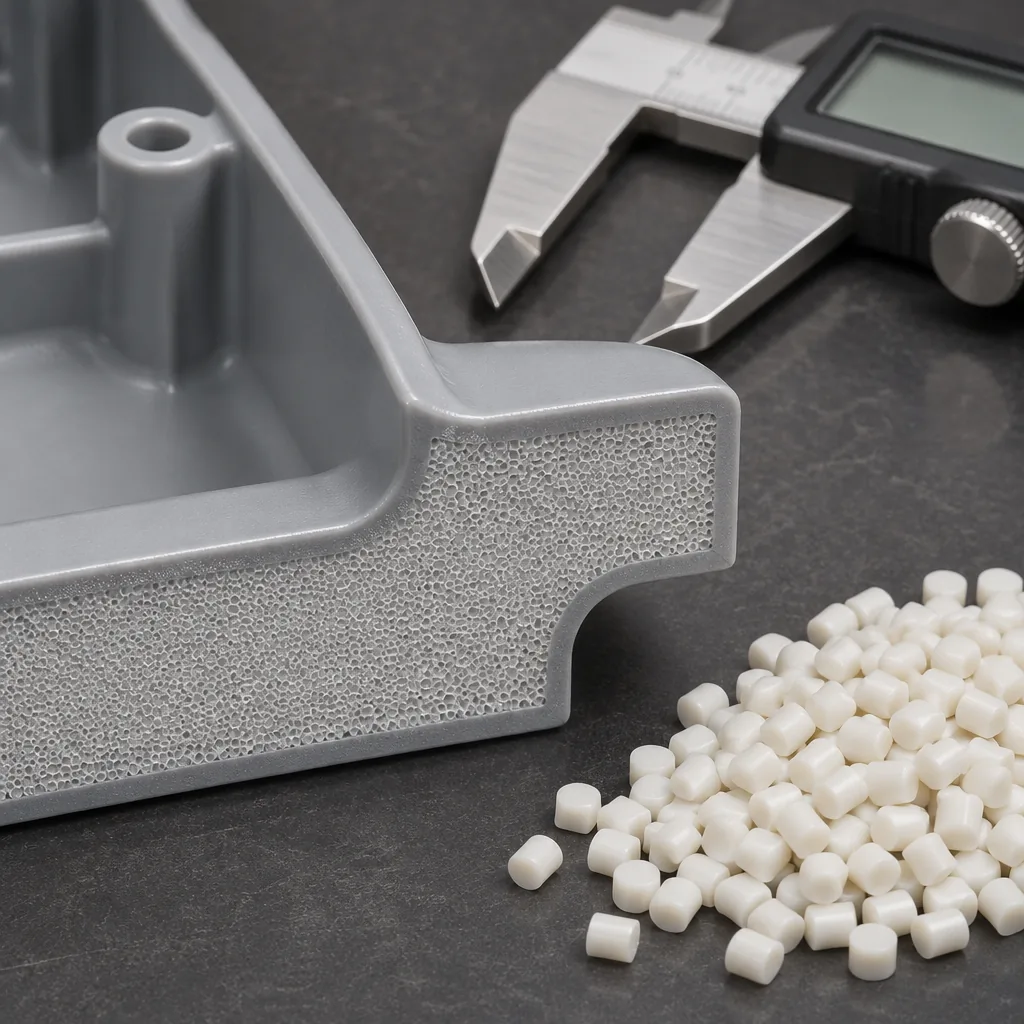
Foaming (Chemical Blowing Agent) Masterbatch is a high-performance functional additive concentrate that decomposes in a controlled manner when it reaches the plastic processing temperature, forming microscopic, homogeneous gas cells within the molten polymer. It is used on injection molding, profile, pipe, sheet and WPC extrusion lines both to improve product quality and to directly reduce raw material consumption.
Drawing on the polymer additive engineering it has developed since 2006, Colorex produces endothermic, exothermic and hybrid (endo/exo) foaming masterbatch formulations tailored to different melting temperatures and process requirements. Without requiring additional investment in your existing molds and machinery, it eliminates sink marks, shortens cycle times and visibly lowers your production cost per ton.
Working PrincipleAbsorbs heat from its surroundings during decomposition and releases mainly carbon dioxide (CO₂) gas.
Technical AdvantagesCreates a very fine, closed and homogeneous microcellular structure. It increases the cooling rate to shorten the cycle time, minimizes the risk of surface silver streaks (splay) and is odorless.
Recommended ApplicationsApplications requiring food contact, injection-molded parts requiring high surface quality, sink mark elimination, multilayer low-noise drainage pipes, PP/PS sheets and WPC profiles.
2. Exothermic Foaming Masterbatches
Working PrincipleReleases heat during decomposition and generates mainly high-pressure nitrogen (N₂) gas.
Technical AdvantagesProvides higher gas yield at the same dosage (high expansion / blowing ratio). Enables significant weight reduction and low density in thick-section parts.
Recommended ApplicationsPVC foam profiles targeting a high density reduction, thick-walled technical injection parts, shoe soles, cable fillers and high-expansion extrusion applications.
3. Endo / Exo Hybrid Foaming Masterbatches
Working PrincipleCombines the fine-cell nucleating power of the endothermic system with the high gas pressure of the exothermic system in a single pellet.
Recommended ApplicationsPVC/WPC building profiles requiring both high weight savings and a smooth outer surface, medium-to-thick-walled pipes and large-volume injection-molded crates.
Key Benefits for Your Production Operation
10% to 25% Raw Material and Weight SavingsReduces specific gravity without changing part volume or geometry, allowing you to produce more pieces or meters of product from the same amount of polymer.
Elimination of Sink Marks and WarpageCompletely eliminates the sink-in caused by cooling shrinkage in thick-walled areas and behind ribs and screw bosses, through the micro-pressure it applies from within.
10–20% Shorter Cycle TimeEndothermic formulations in particular reduce in-mold cooling and holding times, increasing your hourly output per machine.
Lower Clamping Force and Energy SavingsThe gas dissolved in the melt improves flowability; working at lower injection and clamping pressures reduces machine load and electricity consumption.
Sound and Thermal InsulationThe closed microcellular structure improves acoustic insulation in low-noise drainage pipes and thermal insulation performance in building profiles and sheets.
Superior Stiffness-to-Weight RatioWhile the part surfaces remain dense (compact), the microporous core creates a sandwich-structure effect that preserves flexural stiffness even as part weight decreases.
Main Applications and Target Industries
Injection MoldingThick-walled household goods, pallets, crates and buckets, garden furniture, furniture legs and accessories, technical automotive and home appliance parts, clothes hangers, brush handles.
Pipe ExtrusionThe middle foam layer of multilayer (3-layer) low-noise drainage pipes, cable conduits and drainage pipes.
PVC and WPC Profile ExtrusionWindow sills, skirting boards, wall/ceiling panels, door frames, WPC wood-composite decking and facade cladding.
Sheet and ThermoformingPP, PS and PE foam sheets, packaging separators, insulation boards and lightweight thermoformed containers.
Blow Molding and Special ApplicationsThick-walled jerrycans, floats, shoe soles (EVA/PVC/TR) and synthetic cork/stopper production.
Supported Polymer Carriers
Colorex Foaming Masterbatches are formulated with carriers fully compatible with the processing temperature and the base resin:
Styrenics and Construction PolymersPS, HIPS, ABS, PVC (Rigid and Flexible), WPC (Wood-Polymer Composite)
Flexible and Engineering PolymersEVA, TPE, TPU, PET and recycled (PCR / regrind) polymers
Colorex Laboratory Assurance
Every batch of Colorex Foaming Masterbatch is tested in our laboratory to ensure stable density and surface quality in series production:
Active Gas Yield and Decomposition Temperature ControlVerification that it activates in the correct zone at the target process temperature without premature foaming (swelling at the feed throat).
Pilot Injection and Density DeterminationAnalysis of weight reduction percentage, cross-sectional microcell distribution and surface smoothness on standard specimens.
Moisture and Carrier Flowability (MFI) TestControl of a low-moisture, homogeneous pellet structure that causes no brittleness or surface marks.
Thick-walled housewares, pallets, crates and buckets
The middle foam layer of three-layer low-noise drainage pipes
PVC and WPC window sill, skirting board, wall panel and door frame profiles
PP, PS and PE foam sheets and lightweight thermoformed containers
Thick-walled jerrycans, floats and shoe soles
Affected Properties / Effects on the Final Product
Specific gravity: Weight is reduced by 10% to 25% without changing part volume or geometry.
Surface smoothness: Eliminates sink marks and warpage in thick sections and behind ribs and screw bosses.
Stiffness-to-weight ratio: The dense outer skin and microcellular core form a sandwich structure; flexural stiffness is retained while weight is reduced.
Sound and heat insulation: The closed microcellular structure improves acoustic insulation in drainage pipes and thermal insulation in profiles and sheets.
Cell structure: Endothermic grades produce fine, closed and homogeneous microcells; the risk of silver streaks on the surface is reduced.
Effect on the Process and Production Line
Cycle time is shortened by 10% to 20%; in-mold cooling and holding times are reduced.
The gas dissolved in the melt improves flowability; the machine runs at lower injection and clamping pressure and energy consumption falls.
Frequently Asked Questions
Page-specific technical questions and answers about Foaming (Blowing Agent) Masterbatch.
What is Foaming Masterbatch?
Foaming masterbatch is a pelletized additive produced by homogeneously compounding active blowing agents, which chemically decompose and release gas at plastic processing temperatures, into a suitable polymer carrier. It forms microscopic cells within the molten plastic, reducing weight and eliminating sink mark defects.
How does foaming masterbatch work on the production line?
In the heating zones of the extruder or injection barrel, the active components reach a specific decomposition temperature and generate gas (CO₂ or N₂). Thanks to the high pressure inside the barrel, this gas stays dissolved in the molten polymer; when the melt exits into the mold cavity or the extrusion die and the pressure drops, the gas expands and forms homogeneous microcells.
What is the difference between chemical foaming masterbatch and physical foaming (gas injection)?
Physical foaming requires a dedicated high-pressure gas dosing unit on the machine, a special screw and a high capital investment. Colorex Chemical Foaming Masterbatch, by contrast, is dosed directly into your existing standard injection or extrusion machine just like a regular color masterbatch and works without any additional investment.
What is endothermic foaming masterbatch?
It is a foaming system that absorbs heat from its surroundings during decomposition and generates mainly carbon dioxide (CO₂) gas. Because it absorbs heat, it shortens the cooling time of the part, forms very fine and uniform closed cells, and reduces the risk of post-blowing after the part leaves the mold.
What is exothermic foaming masterbatch?
It is a system that releases heat during the decomposition reaction and generates mainly nitrogen (N₂) gas. Its gas release pressure and volume are high; it is therefore preferred for thick-section parts and foam profiles that require high expansion and maximum density reduction.
What are the main differences between endothermic and exothermic foaming agents?
Endothermic systems offer a finer cell structure, a smoother surface, a shorter cycle time, odorless processing and suitability for food contact. Exothermic systems provide higher gas yield and greater weight reduction capacity, but their cooling time is slightly longer and they may have a greater tendency toward a yellowish tint and odor.
When is Endo/Exo hybrid foaming masterbatch preferred?
Hybrid formulations are used where the expansion power of an endothermic system alone is insufficient, while an exothermic system alone coarsens the cells and impairs the surface. The endothermic component forms fine nuclei, while the exothermic component grows these cells in a balanced way.
What do closed-cell and open-cell structures mean?
In a closed-cell structure, each micro gas bubble is surrounded by polymer walls and is independent of the others; this structure provides water impermeability, high mechanical strength and superior thermal/acoustic insulation. In plastic injection, pipe and profile applications, the target structure is a homogeneous closed-cell structure.
Why is the decomposition temperature critical?
The temperature range in which the foaming masterbatch starts to release gas must be compatible with the melting temperature of the base polymer being processed. If the decomposition temperature is too low, the gas escapes back through the feed throat; if it is too high, the polymer starts to burn or foaming does not occur at all.
What is the importance of the carrier resin in foaming masterbatch?
The carrier resin both protects the active chemicals from premature decomposition in the barrel and mixes fully with the base polymer, preventing gas bubbles from concentrating at a single point (forming large voids).
By what percentage can I reduce part weight using foaming masterbatch?
Depending on the application, wall thickness and process type, density and weight reductions of 3–8% can be achieved in injection molding for sink mark elimination, 10–20% in weight-reduction-focused injection molding, and 15–35% in PVC/WPC profile and multilayer pipe extrusion.
Does foaming masterbatch really save on raw material costs?
Yes. For example, when part weight is reduced by 15% by adding 1.5–2% foaming masterbatch, a very substantial net raw material gain per ton is achieved even after deducting the cost of the foaming agent used. In addition, the shorter cycle time also reduces machine and energy costs.
What is the recommended dosage rate?
It is generally used at 0.5–1.0% in injection molding solely to eliminate sink marks and warpage; at 1.0–2.5% in injection molding for weight reduction; and at 1.0–3.0% in profile, pipe, WPC and sheet extrusion, depending on the target density.
Does increasing the dosage beyond what is necessary provide more weight savings?
No. Overdosing leads to uncontrolled gas pressure in the barrel, cells merging into large voids, pronounced silver streaks/roughness on the surface and reduced part strength. The most efficient result is achieved with the optimum dosage and correct process settings.
How does foaming masterbatch shorten the cycle time in injection molding?
It shortens it in two ways: first, because the internal gas pressure fills the mold cavity, the holding/packing time is significantly reduced or eliminated entirely. Second, endothermic foaming agents absorb heat from the melt as they decompose, allowing the part to cool faster in the mold.
Does it reduce the clamping force (tonnage) of the injection molding machine?
Yes. The gas dissolved in the molten polymer lowers viscosity, improves flowability and reduces the need for high holding pressure. As a result, the required clamping force decreases, large parts can be molded on lower-tonnage machines and flash formation is reduced.
How does the use of a foaming agent affect the mechanical strength of the part?
When homogeneous microcells and a compact outer skin (sandwich structure) are formed, flexural stiffness is largely preserved even if part weight is reduced by 10–15%. However, at very high expansion ratios (25% and above) a certain decrease in tensile and impact strength will occur, so the dosage must be balanced against the mechanical requirements.
How does foaming masterbatch eliminate sink marks on injection-molded parts?
Thick-walled parts, support ribs and screw bosses shrink as they cool and pull the surface inward. Foaming masterbatch creates micro-expansion in these thick core regions, compensating for cooling shrinkage from within and pushing the outer surface against the mold wall, completely eliminating the sink mark.
Is foaming masterbatch effective against warpage?
Yes. Especially in large, flat-surfaced crates, lids and furniture parts, the internal stresses created by high holding pressure cause warpage. With a foaming agent, holding pressure is reduced and in-mold pressure becomes more uniform, so warpage decreases significantly.
What should the minimum wall thickness be when using a foaming agent in an injection-molded part?
A wall thickness of at least 2.5–3 mm is recommended for foaming agents to work optimally. In very thin-walled parts below 2 mm, the melt freezes as soon as it touches the mold wall, leaving the gas no time to expand, so the weight reduction effect is limited.
What temperature profile should be applied on the injection molding machine?
Generally, the feed zone (throat) temperature is kept low so that the gas does not escape prematurely; the middle and front zones are raised to the active decomposition temperature of the foaming agent; and the nozzle temperature is set at a controlled level (to prevent drooling).
How should back pressure be set?
To keep the gas generated in the barrel dissolved in the melt and prevent it from escaping backward (into the hopper), a slightly higher and stable back pressure should be applied compared to standard production. If back pressure is too low, gas escapes during screw recovery and foaming becomes irregular.
Should the injection speed be high or low?
A high injection speed should be preferred. The faster the melt fills the mold cavity, the more sudden and uniform the pressure drop inside the mold; this results in small, uniform cells and a smoother outer surface.
How should holding pressure and time be changed?
At low dosages aimed at sink mark elimination, holding pressure is reduced gradually. In foaming aimed at weight reduction, the shot (dosing) volume is reduced in proportion to the target weight reduction and holding pressure/time is minimized or set to zero, giving the gas room to expand in the cavity.
Can a standard open nozzle be used, or is a shut-off nozzle essential?
For low-dosage sink mark elimination, an open nozzle can be used by switching off decompression (suck-back) and optimizing the nozzle temperature. However, in high weight-reduction projects, a shut-off nozzle is the ideal solution to prevent material drooling from the nozzle tip and gas loss.
Can foaming masterbatch be used in hot runner molds?
Yes. Valve gate hot runner systems in particular work excellently with foaming masterbatch, because gas pressure is retained within the system when the gate closes. Open-tip hot runners, on the other hand, require endothermic systems and precise tip temperature control to prevent drooling.
What causes “post-blowing” in injection molding and how can it be prevented?
If the core of the part is still hot and soft when it is ejected from the mold, the internal gas pressure pushes the wall outward, swelling the part and distorting its shape. The solution is to slightly increase the cooling time, lower the mold temperature, optimize the dosage or switch to a faster-cooling endothermic Colorex formulation.
What causes silver streaks (splay / flow marks) on the injection-molded surface and how can they be reduced?
Gas bubbles at the melt flow front rub against the mold wall and burst, creating silvery streaks on the surface. To reduce this, a fine-cell endothermic foaming agent should be selected, injection speed increased, mold temperature raised slightly and, if necessary, a light texture (sandblasting/graining) applied to the mold surface.
Is mold venting important when using a foaming agent?
It is very important. The vents must be open and clean so that the air in the mold cavity can escape quickly. Insufficient venting leads to burning in corner areas (diesel effect) and short shots.
How is a foaming agent used in multilayer (3-layer) low-noise drainage pipes?
In 3-layer PVC or PP drainage pipes, the inner and outer layers are extruded compact (unfoamed), while Colorex Foaming Masterbatch is added only to the middle (core) extruder layer. This reduces weight and achieves high sound insulation while preserving the smoothness of the pipe’s inner/outer surfaces and its crush resistance.
Which foaming agent should be preferred for PVC foam profile, panel and sill production?
In PVC profiles, endothermic or endo/exo hybrid systems are used depending on the desired surface gloss and target density (typically 0.55–0.85 g/cm³). Colorex formulations are designed to be fully compatible with PVC’s narrow processing temperature window (170–195 °C).
What does a foaming agent offer in WPC (Wood-Polymer Composite) decking and profiles?
Because WPC formulations contain a high proportion of wood flour, the products are heavy and carry a risk of cracking during screwing/nailing. Foaming masterbatch reduces the weight of WPC profiles by 10–20%, provides screwability similar to real wood and increases line speed.
How does a foaming agent affect PP and PS sheet / thermoforming production?
In sheet extrusion, the use of a foaming agent lowers the specific gravity of the sheet, reduces raw material cost per unit of thickness, and gives thermoformed food/packaging containers high thermal insulation (no hand burns) and an impact-absorbing structure.
How should die pressure and temperature be set on extrusion lines?
Die pressure must be kept sufficiently high so that the melt does not foam before leaving the die. Lowering the die exit temperature slightly increases melt strength; this way, the gas bubbles are trapped inside a closed, smooth outer skin without tearing the surface.
Can a foaming agent be used in blow molding production?
Yes, endothermic foaming masterbatch can be used at controlled dosages (0.5–1.5%) for weight reduction and increased stiffness, especially in thick-walled jerrycans, technical parts and multilayer bottles.
Which polymers is foaming masterbatch compatible with?
Colorex produces foaming masterbatches with polymer-specific decomposition temperatures for PP, LDPE, LLDPE, HDPE, PS, HIPS, ABS, rigid and flexible PVC, WPC, EVA, TPE, TPU and PET processes.
Is a foaming agent used with recycled (PCR / regrind / flash) raw materials?
Yes, it is widely used. However, possible moisture in recycled raw materials can upset the gas balance of the foaming agent and create irregular bubbles. Therefore, it is recommended to dry the regrind or to balance it with Colorex Desiccant & Antigas Masterbatch.
How does a foaming agent behave in formulations with a high calcite (filler) content?
Calcium carbonate (CaCO₃) particles can act as nucleating agents in the melt and increase the number of cells. However, since a very high filler content lowers the melt strength of the polymer, the foaming agent dosage should be optimized by laboratory testing according to the calcite percentage.
Does foaming masterbatch change the color of the product?
Because the micro gas cells formed by foaming scatter light (optical scattering), the shade of dark and vivid colored parts may lighten somewhat or become more pastel. To compensate for this effect, the color masterbatch dosage is increased slightly or the color formulation is adjusted in the Colorex laboratory using a foamed sample.
Can foaming masterbatch be used together with color masterbatch and other additives?
Yes. It works reliably together with color masterbatch, UV stabilizers, antioxidants and Processing Aid (PPA) additives. In extrusion in particular, using it with PPA produces a glossier and smoother outer skin.
Does a foaming agent cause yellowing in white or transparent products?
Exothermic (azodicarbonamide-based) foaming agents can cause slight yellowing or a shade shift in white and light-colored products. For white and light-toned products, the completely colorless, non-yellowing endothermic Colorex Foaming Masterbatches should be preferred.
Does foaming masterbatch leave an odor in the product?
Endothermic foaming agents are completely odorless because they produce only harmless compounds such as CO₂ and water vapor derivatives. With exothermic systems, a slight ammonia-like odor may occur at high temperatures, so endothermic series are recommended for indoor and sensitive products.
Can foaming masterbatch be used in products that come into contact with food?
Yes. Colorex’s endothermic foaming masterbatches, formulated with food-contact-compliant raw materials, can be used safely for food packaging sheets, thermoformed containers and household goods.
Do foaming masterbatches comply with REACH and RoHS regulations?
Yes. We offer endothermic and environmentally friendly formulation options that fully comply with European Union regulations and export requirements and take SVHC restrictions into account.
Does the use of foaming masterbatch prevent the product from being recycled?
No. Since chemical foaming agents do not cross-link the polymer’s chemical chain structure, runners, flash and end-of-life parts produced with a foaming agent release their gas when reground and remelted, and can be recycled again like standard plastic.
Are foaming masterbatches sensitive to moisture, and how should they be stored?
Endothermic foaming agents in particular are sensitive to moisture and excessive heat. They should be stored in their original, tightly sealed moisture-barrier packaging in a cool (preferably below 30 °C), dry area out of direct sunlight. Opened bags should be resealed immediately after use.
Should foaming masterbatch be put in a drying oven (dryer) before use?
Foaming masterbatch must never be placed in high-temperature dryers; otherwise, premature decomposition may begin before it enters the machine. If the base polymer (e.g., ABS, PET or moist regrind) needs to be dried, the base resin should be dried separately and the foaming masterbatch dosed directly at the feed throat.
How should the machine be cleaned at the end of production or when switching from foaming to standard production?
No material should be left in the barrel after foaming agent use is finished; a foaming agent left at high temperature can continue to decompose and increase barrel pressure. At the end of production, the barrel should be thoroughly purged with standard natural polymer or Colorex Machine and Screw Cleaner (Purging Compound) before the machine is shut down.
How is foaming masterbatch performance measured and monitored in production?
The most practical shop-floor check is measuring part weight or weight per meter (in extrusion) on a precision scale and determining specific density (g/cm³) by the water displacement method. In addition, a cross-section is cut from the part and the uniformity of cell size is checked under a microscope or magnifying glass.
How can we select the most suitable Colorex Foaming Masterbatch for our production line and obtain a sample?
Simply share your base polymer (PP, PE, PVC, PS, WPC, etc.), your production process (injection molding, pipe, profile, sheet), your operating temperature, the part wall thickness and your main goal (sink mark elimination or weight reduction) via the contact channels on our website or our WhatsApp technical support line. Our engineering team will determine the most suitable formulation for your line and send you the sample along with process setting recommendations.
Cut Your Raw Material Costs, Put an End to Sink Marks
Get a Colorex Foaming Masterbatch sample and technical process support to achieve 10–25% weight savings, shorter cycle times and smooth surface quality on your existing molds and machines without any additional investment.