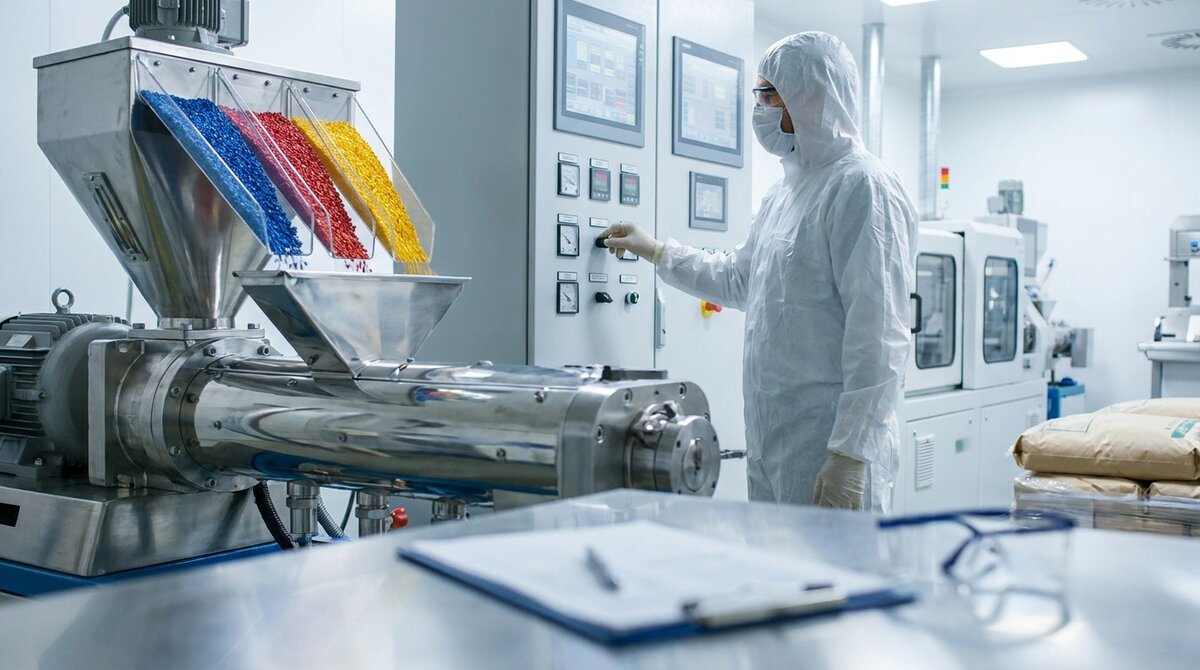
The use of masterbatch in different plastic processing applications is a critical engineering procedure that directly affects the structural, visual, and functional quality of the final product. To maximize production efficiency on a sectoral basis and prevent operational errors, the following process parameters must be managed with precision. Film and Bag Extrusion: When using masterbatch in extrusion lines, the melt flow index of the carrier polymer must be in absolute harmony with the main raw material.
Formulations with excellent dispersion should be selected to prevent gel formation, fish eye defects, and microscopic thickness variations. The thermal profile and screw design of the extruder must be optimized to ensure the flawless and homogeneous distribution of the pigment within the melt without undergoing phase separation. Injection Molding: In molding processes, cycle time and temperature fluctuations directly affect masterbatch performance.
Products with high thermal stability should be used to prevent color fluctuations, silver streaks, or flow marks. The calibration of dosing units and the cooling and shrinkage behaviors of the polymer inside the mold must be carefully monitored to maintain dimensional stability and visual integrity. Cable Extrusion: The use of masterbatch in high speed cable sheathing and insulation lines requires the preservation of the dielectric properties and insulation resistance of the polymer.
To avoid errors in spark tests and prevent surface roughness, products with very low filter pressure values and absolute dispersion must be preferred. In addition, UV stabilization and thermal oxidation resistance in outdoor cables are of vital importance for the long term performance of the product. Textile and Fiber Spinning: In continuous fiber, dope dyeing, and non-woven processes, masterbatch particle size is the most critical parameter.
Agglomeration free formulations providing nanometric level distribution must be used to prevent yarn breakages and spinneret blockages. Selecting series that do not undergo chemical degradation at high drawing speeds and process temperatures, and that possess superior light, washing, and rubbing fastness, is an absolute technical necessity.
Frequently Asked Questions and Solutions
A technical guide of 50 questions compiled from the field experience of the Colorex engineering team.
What is the most important point when adding masterbatch during production?
Correct dosage and homogeneous feeding; gravimetric dosing ensures even distribution of the pigment/additive.
How is the barrel temperature set in extrusion?
Based on the MFI compatibility of the base polymer and the masterbatch; using the range in the TDS as reference, melt fracture and degradation are balanced.
The color is not coming out homogeneous in production, what is the first check?
The dosing pump and feeding; irregular feeding and low color strength cause streaking, so the gravimetric dosing is checked.
Why must masterbatch be dried before production?
If the hygroscopic carrier absorbs moisture, silver streaks/bubbles form; drying at 80°C prevents these defects.
Why do black specks (charring) occur in the melt?
The residence time has been exceeded or the heat is too high; the temperature should be lowered by 15°C and a thermal stabilizer should be added.
How is scrap reduced during a color change (batch change)?
With a purging compound; the heat is temporarily increased by 10°C and a high-viscosity purging agent is pushed through to clean the barrel.
Why do bubbles/pores occur on the surface?
There is moisture in the raw material; the polymer should be dried at 80°C or a desiccant additive should be used.
The filter pressure is rising, what is the cause?
Agglomeration or gel; a well-dispersed masterbatch with low FPV should be used and the filter porosity should be checked.
How is melt fracture prevented?
By optimizing the head pressure and using a process flow modifier; a smooth surface is achieved at high speed.
What happens if too much color dosage is applied in production?
Mechanical properties decrease, cost increases and the die clogs; the upper dosage limit in the TDS should not be exceeded.
What is the sign that a masterbatch is incompatible with the base polymer?
Phase separation, gel, poor distribution and mechanical weakness; a compatible series with the same carrier should be selected.
Why do silver streaks occur in injection molding?
Moisture or thermal degradation; the masterbatch/polymer should be dried and the process temperature should be optimized.
How is feeding irregularity resolved in production?
The masterbatch granule size should be compatible with the base polymer; similar granule geometry ensures feeding without segregation.
The color is coming out different from the laboratory approval, why?
Color approval should be done under actual process conditions; a difference in temperature/shear changes the ΔE, so process simulation is essential.
Why is residence time important in the extruder?
Long residence causes thermal degradation and charring; it should be optimized with the machine capacity and heat settings.
How is the ideal melt temperature found in production?
Based on the compatibility of the carrier and the base polymer; too low causes poor distribution, too high causes degradation, so the TDS range is used as reference.
How is dispersion quality checked in production?
With the Filter Pressure Value (FPV) test and a film/press sample; good distribution gives a smooth, spot-free surface.
How is consistency ensured in color batch repetition?
With a standard recipe and spectrophotometer control of each lot; on repeat orders the exact same color is guaranteed.
How is gel (fish-eye) formation prevented in production?
With controlled heat, short residence time and a gel-free masterbatch; a melt filter also helps.
Why is extra care required in PVC production?
PVC is heat-sensitive; excessive temperature releases HCl and causes degradation, so low temperature and a stabilizer are essential.
How should color selection be made in polyolefin production?
A masterbatch with a PE/PP carrier and suitable heat and light fastness; incompatible carriers should be avoided.
When should the melt filter be changed in production?
According to the increase in FPV; a quality low-FPV masterbatch extends filter life and reduces downtime.
How does masterbatch storage affect production?
Moist/degraded masterbatch creates production defects; it should be stored in a cool, dry environment away from sunlight.
What should be done in production if the color strength is low?
The dosage is increased or a high-concentration series is selected; depth is achieved based on the TDS recommendation.
How is warpage reduced in production?
With balanced mold temperature, a nucleant and design; internal stress and irregular crystallization are prevented.
Why does plate-out occur on the mold?
The buildup of a non-low-migration pigment/additive on the mold; it is prevented with a compatible, low-migration series.
Why does surface roughness occur in high-speed production?
Melt fracture is occurring; the head pressure should be brought into the 150-200 bar range and a flow modifier should be added.
What are the signs of thermal degradation in production?
Charring, yellowing, odor and mechanical weakness; the heat should be lowered and an anti-oxidant/thermal stabilizer should be used.
What is the production risk in a color combination?
If the heat/light resistance of the components differs; the weakest pigment sets the limit, so all should be selected to be compatible.
Why should MFI compatibility be checked in production?
If the flow of the masterbatch and the base polymer is incompatible, irregular distribution and flow problems occur.
How are flow marks resolved in injection molding?
By optimizing dispersion and mold/melt temperature; the surface improves with a homogeneous masterbatch.
Does the color dosing pump type matter in production?
Yes; gravimetric dosing provides more consistent color and less deviation than volumetric dosing.
Why does wall thickness fluctuation occur in film production?
Feeding or melt inhomogeneity; it is stabilized with gravimetric dosing and a low-FPV masterbatch.
How is the odor problem (rPCR) resolved in production?
With an odor-removing masterbatch; VOC and odor molecules are neutralized to achieve odorless production.
How does a high filler ratio affect production?
Excessive filler lowers mechanical properties and causes wear; optimum filler and good dispersion should be balanced.
The color is coming out light/dark in production, what is the cause?
Dosage deviation or a process temperature difference; the tone is controlled with gravimetric dosing and a stable process.
Does screw speed affect color in extrusion?
Yes; it changes the shear force and affects dispersion and therefore color strength, so it should be optimized.
How often should samples be taken in production?
At regular intervals; deviations are caught early through color (spectrophotometer) and surface control.
Is a pre-mix of masterbatch and base polymer necessary?
It is recommended for good feeding; a homogeneous pre-mix or gravimetric dosing prevents segregation.
How is color shift due to heat prevented in production?
With a heat-resistant pigment suitable for the process temperature; the heat resistance value in the TDS should not be exceeded.
Why does matting occur on the surface?
Thermal degradation, additive migration or poor distribution; gloss is preserved with appropriate heat and a quality masterbatch.
Does the rework ratio affect color in production?
Yes; high rework changes the color and properties, so the ratio should be controlled and compensated for with a stabilizer.
What equipment is needed for color consistency?
A gravimetric dosing unit and a spectrophotometer; feeding and color measurement are brought under control.
How is melt homogeneity improved in production?
With a suitable screw design, temperature profile and a well-dispersed masterbatch; mixing efficiency is increased.
What happens if the process temperature is too low?
The masterbatch does not fully melt, causing poor distribution and surface defects; the lower temperature limit in the TDS should be observed.
How is the dusting/airborne problem prevented in production?
By using masterbatch instead of powder pigment; dust-free granules provide clean production and occupational health.
Why should the barrel be cleaned before a color change?
Old pigment adheres to the steel; if it is not cleaned by purging, the new color is contaminated and scrap increases.
Does Colorex provide support with production problems?
Yes; Colorex engineers provide technical support on process, dosing and recipe matters with field experience.
Why is the technical document (TDS) important before production?
It contains dosage, temperature and storage conditions; compliance with the TDS is the foundation of flawless and consistent production.
What should be paid attention to in production in terms of occupational safety?
By using dust-free masterbatch, proper ventilation and control of heat and pressure equipment; both operator safety and product quality are ensured.
Let's find the right solution for your project
Contact our team for sample requests, color matching or technical consultancy.