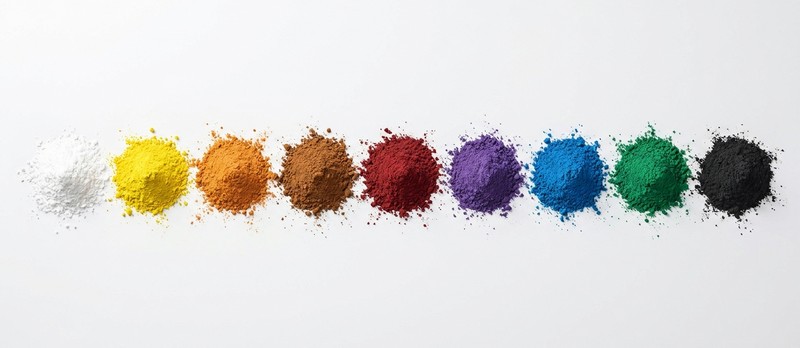
In the plastics, coatings, and ink industries, fine powdery inorganic and organic molecular structures that impart color, opacity, and aesthetic value to materials and are insoluble in the polymer or liquid medium in which they are used are called pigments. Unlike dyes, they function by remaining suspended through a homogeneous dispersion without melting chemically within the polymer matrix. The selection of pigments in plastic processes is a chemical process that directly affects not only color formulation but also critical engineering parameters such as high thermal stability, migration resistance, and lightfastness.
While inorganic pigments offer high thermal stability, chemical resistance, and excellent opacity, organic pigments provide extraordinary tinting strength, transparency, and brilliance. High performance pigments, formulated according to process conditions and the rheological properties of the polymer, distribute at a microscopic level without causing agglomeration, thereby preserving the mechanical strength and structural integrity of the final product.
Acting as a shield against photo oxidative degradation and enhancing UV resistance, these technological components are the most strategic elements determining the outdoor durability and visual quality of products in every sector, from automotive and food packaging to textiles and construction materials.
Frequently Asked Questions and Solutions
A technical guide of 50 questions compiled from the field experience of the Colorex engineering team.
What is a pigment?
It is a fine powder of inorganic or organic molecular structure that imparts color, opacity and aesthetics to plastic, paint and ink, and is insoluble in the medium in which it is used.
What is the difference between a pigment and a dye?
A pigment is insoluble in the medium and disperses while remaining suspended; a dye dissolves. Pigments offer higher heat and light fastness.
What is the difference between inorganic and organic pigments?
Inorganic pigments offer high heat/light fastness and opacity; organic pigments offer high color strength, vividness and transparency.
What are examples of inorganic pigments?
Titanium dioxide (white), carbon black, iron oxides (yellow/red/brown), ultramarine and chrome-based pigments.
It is the strongest white and opacifying pigment; at low dosage it provides absolute opacity and high whiteness together with UV protection.
Why is carbon black preferred?
For deep blackness, superior UV protection and conductivity properties; high-structure types provide better dispersion.
Why is heat resistance important in pigment selection?
The pigment must not degrade at the processing temperature; a pigment with insufficient heat resistance causes color shift and degradation.
What does light fastness indicate in a pigment?
The resistance of color to preservation against sunlight; it is measured with the Blue Wool Scale (1-8), where 8 is the highest resistance.
What is migration resistance in a pigment?
The property of a pigment to remain within the polymer without migrating (bleeding); it is required for food and adjacent-part safety.
What is tinting strength?
The coloring power a pigment provides; a high-strength pigment achieves the target color with a smaller amount.
What does opacity (hiding power) depend on?
The refractive index and particle size of the pigment; high-index inorganics such as TiO2 provide the highest hiding power.
Which pigment is used in a product requiring transparency?
Organic transparent pigments and clarifiers; they are preferred in clear applications where opacity is not desired.
Why is pigment dispersion critical?
A poorly dispersed pigment forms agglomerates; it creates color defects, roughness and mechanical weakness.
What is the Color Index (C.I.)?
It is the international code that classifies pigments as a standard (e.g., PW6, PBk7, PB15, PR122); it ensures reliable selection.
What is PW6?
It is the color index of titanium dioxide; it is the most common white pigment and offers high hiding power and heat/light fastness.
What is PBk7?
It is the color index of carbon black; it provides deep blackness and superior UV protection.
What colors are PB15 and PG7?
PB15 is copper phthalocyanine blue, PG7 is phthalocyanine green; both are high-fastness organic pigments.
Why is diarylide yellow (PY83) economical but limited?
It offers high color strength but its heat and light fastness are limited; it is suitable for indoor/short-life applications.
What do DPP pigments (PR254) provide?
Vivid red/orange with high heat and light fastness; they are preferred in outdoor applications.
Where is quinacridone (PR122/PV19) used?
For high-fastness magenta/violet tones; it is suitable for demanding applications such as automotive and outdoor use.
How is the safety/toxicity of a pigment evaluated?
By heavy metal content and regulatory compliance; for food/toys, pigments free of lead-cadmium-chromium and compliant with REACH/FDA are selected.
Why are pigments containing heavy metals risky?
They carry the risk of toxicity and regulatory violation; Colorex offers heavy-metal-free alternatives for food and sensitive applications.
What does a pigment's particle size affect?
Color strength, hiding power and dispersion; fine particles tend to give higher strength, coarse particles higher hiding power.
What is metamerism?
It is when two colors appear the same under one light and different under another; it is minimized with the correct pigment combination.
Why is pigment used as a masterbatch rather than directly?
Powder pigment causes dusting, health risk and uneven dispersion; as a masterbatch it is pre-dispersed.
Why do inorganic pigments look matte/dull?
Due to high opacity and low color strength; they are combined with organic pigments for a vivid tone.
What is the disadvantage of organic pigments?
The heat/light/migration fastness of some is variable; high-performance types must be selected according to the application.
How does a pigment give color if it is insoluble?
By remaining suspended in the medium and selectively reflecting and absorbing light; it creates color through physical dispersion without dissolving chemically.
How is UV resistance achieved in a pigment?
With the selection of a photo-stable pigment and a UV stabilizer; color is preserved by delaying the degradation of chromophore groups.
What is the difference between a pigment and a filler?
A pigment provides color/opacity; a filler (calcite, talc) is added for volume/cost and mechanical properties, its primary purpose is not color.
What is the limitation of fluorescent pigments?
They give very vivid color but their light fastness is low; they are suitable for indoor and short-life applications.
How does pigment selection affect cost?
High-performance organic pigments are expensive, inorganics are economical; an optimum balance is established according to the application.
On what basis is the pigment heat resistance test duration given?
Generally as an upper limit for a 5-minute residence time; the value may drop at long residence times.
What is the difference between color depth (masstone) and light tone (tint)?
Masstone is the pure pigment color, while tint is the tone lightened with white; fastness values may differ in the tint.
How is pigment agglomeration prevented?
With a dispersant and high-shear extrusion; clumping is prevented in Colorex masterbatch production.
Which pigments are preferred in automotive applications?
Premium organic/inorganic pigments with high heat, light and migration fastness; for durability suitable for a 10-year warranty.
How should pigment selection be for food packaging?
Low-migration, heavy-metal-free pigments compliant with EU 10/2011 and FDA; the transfer of color/substances to food is prevented.
How is color matching done with a pigment?
With spectrophotometer measurement and recipe optimization; the target color is achieved within the ΔE tolerance.
What is the property of ultramarine blue (PB29)?
It gives a clean blue tone and has good heat resistance but is sensitive in acidic media; it is used in suitable processes.
Why are iron oxide pigments durable?
Thanks to their inorganic structure they offer high heat, light and weather resistance; they are ideal for earth tones and outdoor use.
What happens when pigment concentration increases?
Color depth increases, but beyond a certain point dispersion becomes difficult; the optimum loading is balanced in the masterbatch.
Which pigment class for a transparent colored product?
High-transparency organic pigments; clarity is preserved by avoiding opaque inorganics.
Why is a pigment's chemical resistance important?
Color must be preserved upon contact with acid/base/solvent; fading and degradation are prevented with a chemically resistant pigment.
Why is pigment supply critical for color consistency?
With consistent pigment from the same source; batch differences are reduced and long-term color stability is ensured.
Is the process type influential in pigment selection?
Yes; different shear forces and temperatures such as injection, film and fiber give rise to different heat/dispersion requirements.
Where does Colorex source its pigments?
It offers high-performance organic and inorganic pigments imported through careful selection from the world's leading global manufacturers.
Who makes the correct pigment/masterbatch selection?
Colorex sales and R&D engineers; they determine the optimum pigment and recipe according to the polymer, process and performance requirement.
How are a pigment sample and technical documentation obtained?
You can request a sample and TDS by applying to the Colorex laboratory with the application, polymer and target color information.
What determines pigment performance in the final product?
The compatibility of heat, light, migration and chemical fastness with the application; correct pigment selection determines product life and aesthetics.
Let's find the right solution for your project
Contact our team for sample requests, color matching or technical consultancy.