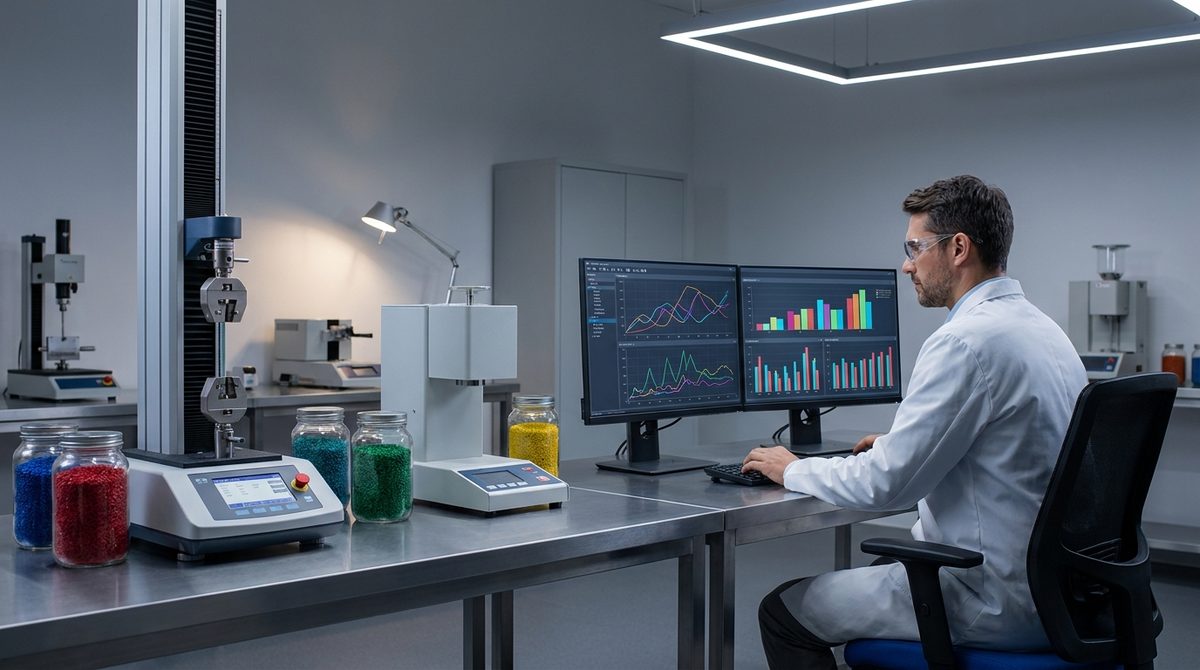
In the plastics industry, migration is the phenomenon where colorant pigment molecules exceed their solubility limit within the polymer matrix, creating a thermodynamic imbalance and migrating to the surface (blooming) or transferring color to a different contacting phase (bleeding). Particularly in flexible polymers with a low glass transition temperature (Tg), amorphous structures, or those containing high amounts of plasticizers (such as flexible PVC, EVA, TPU), the free volume between macromolecules increases, maximizing the diffusion coefficient and molecular mobility of the pigments.
The plate-out problem frequently encountered in extrusion and injection molding processes is also a direct result of low migration resistance. This critical engineering parameter, which determines product quality, toxicological safety, and regulatory compliance, is tested according to international standards such as DIN 53775 and graded on a grey scale from 1 to 5. On this scale, a value of 1 represents severe phase separation and color bleeding, while a value of 5 indicates absolute migration fastness with no molecular migration.
In high specification applications such as cable insulations, medical devices, multi layer films, and food contact packaging, the use of premium pigment systems with maximized chemical stability and high molecular weight is mandatory. The masterbatch formulations we produce at Colorex lock into the rheological and morphological structure of the carrier polymer at a microscopic level, completely halting the diffusion of color particles, and flawlessly guaranteeing the visual integrity of your final product and its compliance with international regulations.
Migration Fastness (Grey Scale 1–5, DIN 53775)
Typical migration fastness by polymer/application (Grey Scale 1–5):
Medium / Polymer
Grade
Migration Risk
Rigid PVC
4–5
Low
Flexible PVC (plasticised)
2–3
High
Polyolefins (PE/PP)
4–5
Low
Styrenics (PS/ABS)
3–4
Medium
EVA / TPU (flexible)
2–3
High
Engineering plastics (PA/PC/PET)
4–5
Low
Frequently Asked Questions and Solutions
A technical guide of 50 questions compiled from the field experience of the Colorex engineering team.
What is migration fastness?
It is the ability of pigment molecules to remain in the polymer without migrating; low migration prevents color bleeding and blooming to the surface.
How does migration occur?
When a pigment exceeds its solubility limit in the polymer, thermodynamic imbalance occurs; it blooms to the surface (blooming) or moves into an adjacent phase (bleeding).
What is blooming?
It is the migration of pigment/additive to the surface, forming a whitish or colored layer; it is prevented with a low-migration system.
What is bleeding?
It is the transfer of color into another material/phase it contacts; it is a critical problem in multilayer and food-contact products.
How is migration fastness rated?
In standards such as DIN 53775, it is rated from 1 to 5 on the gray scale; 1 means severe migration and 5 means no migration at all.
In which polymers is the migration risk high?
In amorphous or plasticized flexible polymers with low glass transition temperatures (flexible PVC, EVA, TPU); molecular mobility is high.
What is the migration risk in rigid PVC?
It is low (rating 4-5); since molecular movement is restricted in the rigid structure, pigment migration is minimal.
Why is the risk high in flexible (plasticized) PVC?
The plasticizer increases free volume and facilitates diffusion; a high molecular weight, low-migration pigment is required.
What is plate-out?
It is the accumulation of pigment/additive on the mold surface; it is a consequence of low migration resistance and is prevented with a compatible pigment.
Why is migration critical in food packaging?
The pigment/additive must not migrate into the food; an EU 10/2011 compliant, low-migration and heavy-metal-free pigment is mandatory.
What is an example of a high migration fastness pigment?
High molecular weight pigments (e.g. PY151, PR122); with their low diffusion coefficient they do not migrate.
Can migration risk be tested?
Yes; through DIN 53775 and food simulant tests; Colorex's low-migration series meet these criteria.
How is migration prevented in multilayer film?
With low-migration pigment and a compatible carrier; color bleeding between layers and delamination are prevented.
What is the relationship between migration and product life?
High migration causes surface blooming and color loss over time; low migration provides long-lasting aesthetics.
How does temperature affect migration?
High temperature increases molecular mobility and accelerates diffusion; a low-migration pigment is essential in heat-exposed products.
Are migration fastness and light fastness the same?
No; migration measures physical migration, while light fastness measures photochemical fading. The two are evaluated separately.
Why is migration important in toys?
For mouth contact and safety; an EN-71 and REACH compliant, low-migration, heavy-metal-free pigment is required.
How is migration controlled in medical products?
For biocompatibility and low migration; regulation-compliant, high molecular weight, stable pigment systems are used.
What is the migration risk in cable insulation?
Color can transfer to the adjacent layer; with low-migration premium pigment, color codes are preserved for a long time.
How does migration depend on the diffusion coefficient?
High diffusion coefficient = fast migration; large molecules and low solubility reduce diffusion, thereby reducing migration.
What prevents color bleeding in flexible products?
High molecular weight pigments that lock into the polymer matrix; Colorex completely stops migration with these systems.
What does 5 mean on the migration gray scale?
Absolute migration fastness with no molecular migration whatsoever; it is the highest safety level.
What does 1 mean on the migration gray scale?
Severe phase separation and color bleeding; a pigment at this level should not be used in sensitive applications.
What is the migration behavior in polyolefins (PE/PP)?
It is generally low risk (rating 4-5); with the crystalline structure and a suitable pigment, migration is minimal.
What is the migration situation in styrenics (PS/ABS)?
It is moderate (rating 3-4); depending on the application, a low-migration pigment should be selected.
What should be done with flexibles such as EVA/TPU?
Due to the high risk (rating 2-3), special low-migration, high molecular weight pigment systems should be used.
What about migration in engineering plastics (PA/PC/PET)?
It is low risk (rating 4-5); the high Tg and rigid structure limit migration.
Where are low migration fastness pigments used?
In rigid, non-contact-critical and non-food interior applications; they are never used in sensitive areas.
How is migration evaluated in a color combination?
Each component is evaluated separately; the pigment with the highest migration determines the risk of the mixture, so all should be selected as low-migration.
What is the relationship between migration and plasticizer?
The plasticizer increases free volume and facilitates pigment movement; the migration risk is highest in plasticized systems.
Is colored staining on the surface migration?
Generally yes; color transfer to an adjacent material stems from bleeding and is prevented with a low-migration pigment.
Can a migration fastness certificate be obtained?
Yes; Colorex provides a TDS containing the migration rating and test data of the selected series.
Is there migration in white/black pigments?
Since TiO2 and carbon black are inorganic and coarse-particled, they practically do not migrate; the migration risk is very low.
How is migration permanently stopped?
By microscopically locking the pigment into the polymer matrix; Colorex formulations completely stop diffusion.
Does migration cause waste during color batch changeover?
Indirectly; pigment that plates out onto the mold requires cleaning, and a low-migration series reduces this.
Is migration related to odor/taste changes?
Migrating components can cause taste/odor changes in food; low migration is mandatory in food contact.
Is migration more visible in transparent products?
Yes; bleeding and hazing become pronounced in transparent matrices, so a high-fastness pigment should be preferred.
How are migration test duration and temperature selected?
According to the real conditions of the application; for food, testing is done with the relevant simulant, temperature and contact time.
Does thermal processing trigger migration?
Migration can begin during cooling after a high process temperature; heat resistance and migration should be evaluated together.
How does migration fastness affect product design?
The pigment should be selected from the outset according to the contact, food and flexibility situation; it is difficult to correct afterward.
Is a low-migration pigment more expensive?
Generally yes; they are high molecular weight premium pigments, but they are necessary for safety in sensitive applications.
Does Colorex keep low-migration series in stock?
Yes; for food-contact and sensitive applications, it keeps lead/chromium/cadmium-free, FDA/REACH compliant groups ready.
What is the relationship between migration fastness and recycling?
In recycling, various pigment residues can migrate; with a low-migration system, safety is ensured in rPCR products.
In which colors is the migration risk most commonly seen?
In some low molecular weight organic red/yellow/orange pigments; high-fastness alternatives are selected in their place.
Which standards is the migration fastness test based on?
Within the framework of DIN 53775, ISO and, for food, EU 10/2011; it is rated under standard conditions.
Is migration related to surface tackiness?
An additive that blooms to the surface can cause tackiness and printing problems; with a low-migration system, the surface stays clean.
Why is migration control important in automotive?
For odor/staining and aesthetics in interior trim parts; a low-migration, low-VOC pigment and additive are required.
Who selects the pigment with the correct migration fastness?
Colorex R&D and sales engineers; they determine the optimum low-migration system according to the contact type, polymer and regulation.
How can a migration test and sample be requested?
You can obtain a test and sample by applying to the Colorex laboratory with the polymer, contact condition and target color information.
What does migration fastness guarantee in the final product?
That the color remains without blooming to the surface or migrating into an adjacent phase; visual integrity and regulatory compliance are ensured.
Let's find the right solution for your project
Contact our team for sample requests, color matching or technical consultancy.