The thermomechanical behaviors and processability of polymer matrices are strictly determined by their macromolecular architecture and morphological structure. The glass transition temperature (Tg) of amorphous polymers and the melting temperature (Tm) of semi crystalline polymers directly affect the thermodynamic phase compatibility and dispersion kinetics of masterbatches and additives. In semi crystalline structures, pigment particles acting as heterogeneous nucleating agents within the polymer melt can alter the spherulite growth rate, leading to anisotropic shrinkage and dimensional warpage.
Therefore, absolute engineering compatibility must be established between the molecular weight distribution (MWD) and rheological profile of the polymer and the solubility parameters of the carrier resin. In polymeric melts exhibiting shear thinning behavior, while viscosity decreases under shear stress during extrusion, the goal is to microscopically break down pigment agglomerates and ensure their flawless penetration into the free volumes.
The masterbatch formulations we develop are advanced morphological integration solutions that preserve the tensile modulus, impact dampening capacity, and optical transmittance of the final product at the highest point of industrial standards, without disrupting the molecular orientation and degree of crystallization of the polymer chains.
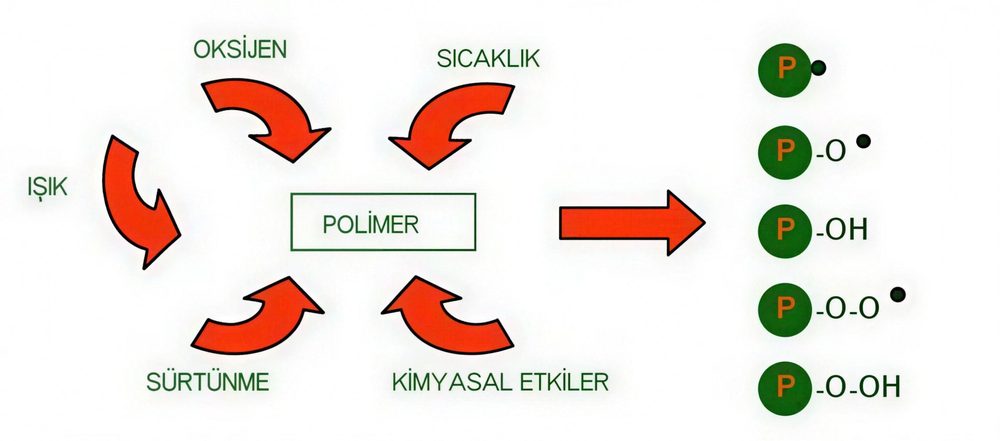
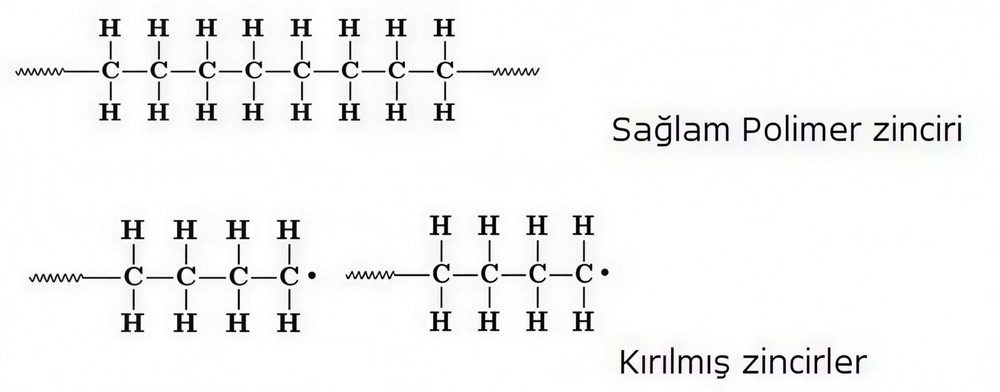
Degradation in Plastics and the Colorex Solution
Plastic degradation types and Colorex masterbatch solutions:
Colorex SolutionHeat-stabilised masterbatch with raised thermal resistance
🧪Chemical Degradation
SymptomsDissolving, swelling, cracking
Affected PolymersPipes, tanks, PVC, PP
Colorex SolutionSpecial masterbatch with chemical-barrier properties
🦠Biological Degradation
SymptomsStaining, odour, fungus
Affected PolymersFood packaging, medical products
Colorex SolutionAntimicrobial masterbatch
🌀Operational Issues (Warpage)
SymptomsDimensional warpage, shrinkage
Affected PolymersSemi-crystalline parts, PE, PP, PA
Colorex SolutionNucleated masterbatch with tuned crystallisation
🔎Optical Degradation
SymptomsHazing, loss of gloss
Affected PolymersTransparent packaging, PMMA, PC
Colorex SolutionClarifier masterbatch for improved clarity
Glass Transition (Tg) and Melting (Tm) Temperatures of Thermoplastics
Thermoplastic
Glass Transition Tg (°C)
Melting Tm (°C)
HDPE
-110
135
LDPE
-90
115
PP
-27
176
POM
-75
175
PTFE
20
327
PA (66)
50
265
PVC
80
–
PS
100
–
PC
150
–
ABS
100
–
PMMA
100
–
The “–” mark indicates amorphous thermoplastics, which have no distinct melting temperature.
Gallery
Frequently Asked Questions and Solutions
A technical guide of 50 questions compiled from the field experience of the Colorex engineering team.
What is plastic morphology?
It is the way polymer chains are arranged in the solid state; the amorphous, semi-crystalline, or crystalline structure determines the properties of the final product.
What is the difference between amorphous and semi-crystalline polymers?
Amorphous polymers have disordered chain structures and are generally transparent (PS, PC); semi-crystalline polymers contain ordered regions and are generally opaque (PE, PP).
How does crystallization affect coloring?
The crystalline structure creates light scattering, increasing opacity and haze; crystal size is reduced with a clarifier/nucleant to improve transparency.
What is the glass transition temperature (Tg)?
It is the temperature at which amorphous regions transition from a rigid glassy state to a soft state; it affects pigment migration and mechanical behavior.
What is the melting temperature (Tm)?
It is the temperature at which the crystalline regions of semi-crystalline polymers melt; the process temperature and pigment heat resistance are selected accordingly.
What does a nucleating agent do?
It accelerates crystallization and reduces crystal size; clarity, mechanical strength, and cycle time are improved.
How does a clarifier work?
In polymers such as PP, it reduces crystal size below the wavelength of light; it lowers haze and provides glass-like clarity.
How does the polymer chain structure determine mechanical properties?
Chain length, branching, and crystallinity directly affect strength, flexibility, impact resistance, and heat resistance.
Why is shrinkage high in semi-crystalline polymers?
Volume decreases during crystallization; shrinkage and warpage are managed with a nucleant and process control.
Does morphology affect pigment dispersion?
Yes; pigment disperses more easily in amorphous regions and can be excluded from crystalline regions, which affects color homogeneity.
What is a spherulite?
It is a spherical crystalline structure that grows in semi-crystalline polymers; its size determines opacity and mechanical properties.
Can a pigment have a nucleating effect?
Yes; some pigments behave like a nucleant, altering crystallization and thus shrinkage/transparency, which should be taken into account.
What is orientation?
It is the alignment of chains in one direction during processing; it increases fiber/film strength but can create directional color differences.
What is the relationship between morphology and transparency?
An amorphous or small-crystalline structure is transparent; a coarse-crystalline structure is opaque. For a transparent product, morphology is controlled.
How does cooling rate affect morphology?
Rapid cooling gives a small-crystalline/amorphous structure (transparent), while slow cooling gives coarse crystals (opaque); mold temperature controls this.
Is polymer density dependent on morphology?
Yes; higher crystallinity gives a denser and more rigid structure (HDPE > LDPE), which determines mechanical and barrier properties.
How does morphology affect heat resistance?
Crystalline regions increase heat resistance; highly crystalline polymers withstand higher service temperatures.
How does copolymerization change morphology?
A comonomer can lower crystallinity and increase flexibility and transparency; PP random copolymer is an example of this.
Can a pigment delay crystallization?
Some pigments can; since this affects cycle time and dimensional stability, it should be taken into account in the formulation.
Does morphology affect barrier properties?
Yes; high crystallinity lowers gas/moisture permeability and is preferred for packaging barriers.
What causes warpage?
Uneven crystallization and internal stresses; it is reduced with a balanced nucleant, appropriate mold temperature, and design.
How does morphology affect impact resistance?
Amorphous/rubber-phase structures increase impact resistance; excessive crystallinity can lead to brittleness.
Does orientation change color perception?
In oriented structures, light scattering differs; directional color/gloss differences can be seen especially with metallic/pearlescent pigments.
Why does morphology control affect masterbatch selection?
Transparency, shrinkage, and heat requirements determine pigment/nucleant selection; an incompatible choice creates opacity and warpage.
How is crystal size reduced?
By adding a nucleant/clarifier and by rapid cooling; small crystals provide higher transparency and strength.
Why is migration risk high in amorphous polymers?
Low Tg and free volume increase molecular mobility; pigment migration is easier than in crystalline structures.
Does polymer morphology affect recycling?
Yes; reprocessing changes crystallinity and chain structure, and properties are preserved with appropriate stabilizers and nucleants.
What is the relationship between morphology and surface gloss?
A smooth, small-crystalline surface is glossier; a coarse-crystalline surface or one with crystallization marks appears matte.
What does annealing provide?
It increases crystallinity and reduces internal stresses; dimensional stability and heat resistance improve, but transparency may decrease.
What is the relationship between morphology and tensile strength?
Orientation and crystallinity increase tensile strength; this is used particularly in fiber and film processes.
What is the morphology of polymer blends?
Phase-separated structures form; the phase size is reduced with a compatibilizer to improve mechanical and aesthetic properties.
How is the degree of crystallization measured?
With DSC (differential scanning calorimetry); the crystallinity percentage is calculated from the melting enthalpy.
How does morphology determine light transmittance?
Crystalline-amorphous phase interfaces scatter light; the more homogeneous/small-crystalline it is, the more transparent it becomes.
What happens if the nucleant dosage is excessive?
Excessive nucleation occurs, its effect plateaus, and cost increases; the optimum dosage should be selected according to the TDS.
How does morphology affect cycle time?
A rapidly crystallizing polymer (with nucleant) solidifies faster, shortening cycle time and increasing efficiency.
What should be done for a transparent PP product?
With a clarifier-added masterbatch and rapid cooling; a small crystal structure is achieved to obtain glass-like clarity.
How does morphology affect dimensional stability?
Balanced crystallization and low internal stress provide dimensional stability; warpage and shrinkage are reduced.
What if opacity is not desired in a semi-crystalline polymer?
By controlling crystallization; haze is lowered with a clarifier and rapid cooling to provide semi-transparency.
What is the relationship between morphology and chemical resistance?
High crystallinity increases chemical and solvent resistance; amorphous regions are more susceptible to chemical attack.
How does chain branching change properties?
Branching lowers crystallinity; LDPE is branched and flexible, while HDPE has linear chains and is rigid.
Does morphology affect color reproducibility?
Yes; process/cooling differences can change crystallinity and shift color perception, while a stable process maintains consistency.
How does mold temperature in injection molding determine morphology?
A hot mold cools slowly and gives coarse crystals (opaque, durable); a cold mold cools rapidly and gives small crystals (transparent).
What is the relationship between morphology and additive efficiency?
Additives are effective in amorphous regions; morphology affects the dispersion of the additive and therefore its efficiency.
Why is polymer morphology an engineering parameter?
Because it determines all critical properties such as transparency, strength, heat, and barrier; it is the foundation of product design.
Does Colorex offer morphology-compatible solutions?
Yes; it optimizes morphology according to the target property with clarifier, nucleant, and polymer-specific carrier masterbatches.
Should transparency or strength be prioritized?
It depends on the application; Colorex engineers determine the formulation that optimizes both goals with a clarifier/nucleant balance.
How can Colorex be contacted for morphology analysis?
By contacting our laboratory with information on the polymer, process, and target property, you can receive technical support and a suitable additive recommendation.
What is the relationship between morphology and product life?
A balanced, low-stress morphology delays cracking and degradation; long life is ensured with the right additive.
Who selects the correct morphology additive?
Colorex R&D and sales engineers; they determine the optimum solution according to the polymer, process, and aesthetic/mechanical requirements.
Is there a relationship between morphology and masterbatch dosage?
Yes; since the crystalline structure determines the proportion of the amorphous phase in which the pigment/additive disperses effectively, the dosage should be optimized according to the morphology and target property.
Let's find the right solution for your project
Contact our team for sample requests, color matching or technical consultancy.