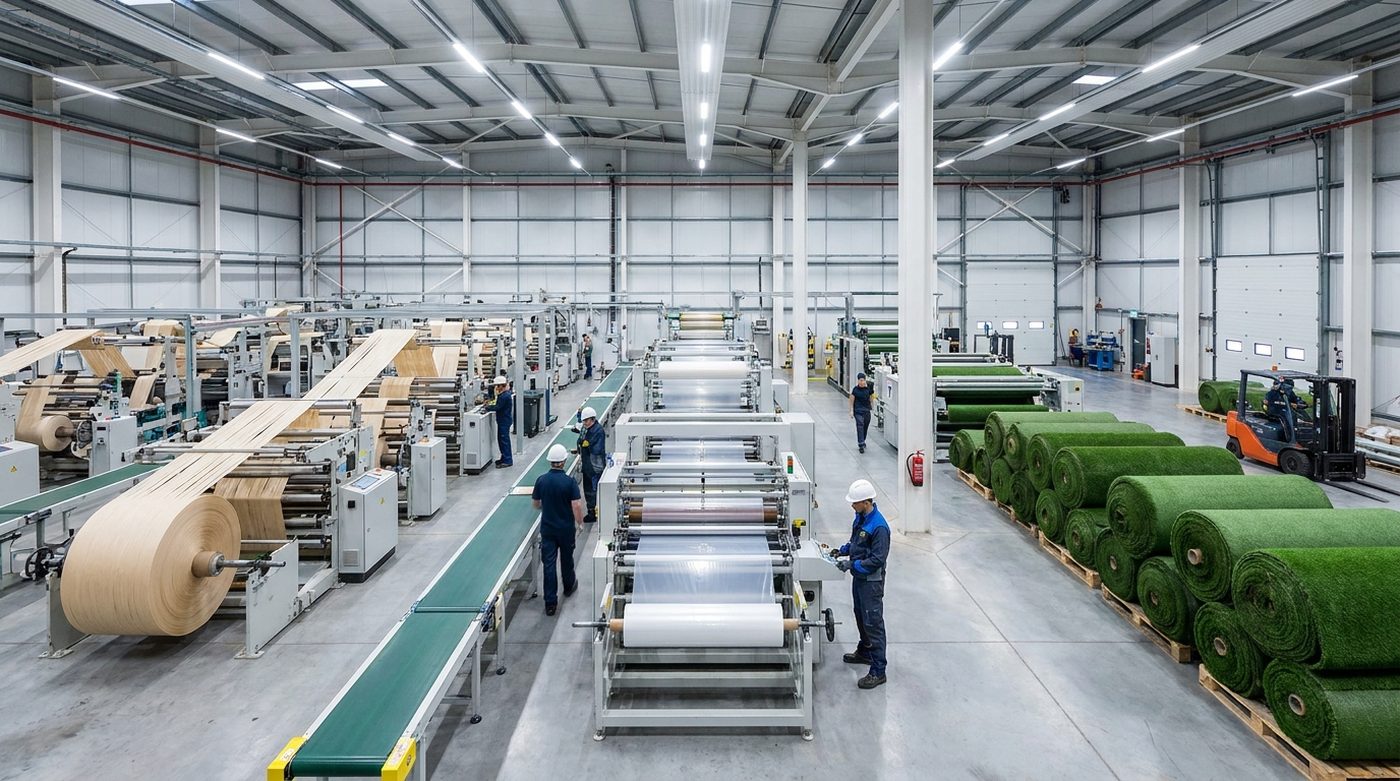
As Colorex, we take great pride and happiness in being a solution partner to the leading companies in Turkey operating in the raffia, lamination, and artificial grass sectors. In these demanding fields that require high durability, we develop special masterbatch and additive formulas that add value to our customers' production processes. We produce products that provide maximum UV protection and high color fastness especially for artificial grass applications exposed to continuous sunlight and harsh weather conditions.
In raffia (sack, big bag) and industrial packaging productions, we minimize waste rates with our formulas having perfect dispersion that prevent yarn breakages and provide high strength and flexibility. We continue to be the most preferred reliable brand of the sector with our technical solutions that increase surface adhesion and maximize process speed in lamination processes.
Recommended Dosage
In standard raffia and sack productions: 1.0% - 2.0%
In lamination and technical textile applications: 1.5% - 3.0%
In artificial grass and outdoor weavings requiring high UV resistance: 2.0% - 4.0%
Frequently Asked Questions and Solutions
A technical guide of 50 questions compiled from the field experience of the Colorex engineering team.
Why is there so much breakage in raffia (sack) yarn?
Poor dispersion and coarse particles; with a PP-carrier masterbatch offering homogeneous distribution, strength is maintained and breakage is reduced.
Why does the color of artificial grass fibers fade in the sun?
Light fastness is insufficient; a masterbatch rated 7-8 on the Blue Wool Scale and containing UV stabilizer additive should be used.
How is UV resistance improved in big-bag (FIBC) fabric?
With a stabilizer masterbatch containing HALS and UV absorber; sacks that last a long time outdoors are produced.
Surface adhesion is weak in the lamination process, what is the solution?
With an additive masterbatch that increases surface energy and/or corona treatment; interlayer adhesion is strengthened.
What causes cracking/splitting in raffia tape?
Excessive stretching or poor dispersion; with a well-dispersed, strength-preserving masterbatch, tape integrity is ensured.
How is the natural appearance of different green shades achieved in artificial grass?
With a combination of multiple green/brown pigments; UV-resistant, natural-grass-like tonal transitions are created.
How is die/filter clogging prevented in raffia production?
With a high-purity, low-FPV masterbatch; coarse particles and impurities are prevented, ensuring uninterrupted production.
What causes color streaking (striping) in sack yarn?
Dosage irregularity; with gravimetric dosing and a high-color-strength masterbatch, homogeneous color is achieved.
Why is the lamination film becoming matte?
Excessive heat or additive migration; with proper process temperature and a non-migrating masterbatch, gloss is preserved.
What should the raffia masterbatch dosage be?
1-2% for standard sacks, 1.5-3% for lamination, 2-4% for high-UV artificial grass; adjusted according to the TDS.
How is softness (soft feel) achieved in artificial grass fiber?
With a masterbatch containing slip/softening additives; surface friction is reduced to obtain a natural, soft fiber.
How is a balance of strength and flexibility established in raffia fabric?
With a compatible carrier and good dispersion; the required flexibility is provided while tensile strength is maintained.
Carbon black or organic pigment for UV resistance?
For black/dark products, high-structure carbon black is the best UV barrier; for light colors, a UV-stabilized pigment is preferred.
What causes delamination (layer separation) in lamination?
Surface incompatibility and weak adhesion; prevented with a compatible masterbatch, corona, and the correct lamination temperature.
What causes wall-thickness fluctuation in raffia yarn?
Melt inhomogeneity; with a low-FPV masterbatch and steady feeding, tape thickness is stabilized.
How is color matching ensured in the artificial grass backing?
With a compatible masterbatch for the backing and fiber; integrity and aesthetic tonal harmony are preserved.
How is print (flexography) adhesion improved on raffia sacks?
With a surface-energy-compatible masterbatch and corona; the adhesion and sharpness of printing ink are increased.
How is waste reduced in high-speed weaving (circular loom)?
With a low-FPV, clean masterbatch; yarn breakage and die clogging are reduced, lowering waste.
How is the lifespan of artificial grass fibers extended?
With a UV + antioxidant stabilizer package; photo-oxidative and thermal degradation is delayed, extending outdoor service life.
Why must the carrier in raffia masterbatch be PP?
Because the base polymer is PP; an incompatible carrier causes phase separation, breakage, and die clogging.
Can heat-related color shift occur in lamination applications?
Yes, if a heat-stable pigment is not selected; with a masterbatch resistant to lamination temperature, the color is preserved.
Is antistatic necessary in raffia products?
Yes, in dust-attracting/process-problematic applications; with an antistatic masterbatch, surface resistivity is lowered.
Shine is excessive in artificial grass, a natural appearance is desired?
With a matting additive; excessive gloss is reduced to obtain a more natural, matte grass appearance.
How is the tenacity value of raffia tape maintained?
With a strength-preserving, well-dispersed masterbatch and the correct stretch ratio; tenacity loss is prevented.
Color comes out different from batch to batch in sacks?
With a spectrophotometer and tight ΔE tolerance; each lot is measured to ensure color consistency.
Are barrier properties preserved in laminated packaging?
With a barrier-compatible masterbatch; color and lamination are achieved without impairing oxygen/moisture permeability.
Color homogeneity in artificial grass fibers of different heights/thicknesses?
With a high-opacity, homogeneous masterbatch; the color difference between thick and thin fibers is minimized.
What causes the gel (fish-eye) problem in raffia production?
Burnt polymer/coarse gel; with a controlled process and a gel-free masterbatch, tape quality is preserved.
How is target lifespan verified in UV testing (QUV)?
With an accelerated aging test; the light fastness and UV package of Colorex series are verified through these tests.
How should raffia masterbatch be stored?
In a cool, dry environment away from sunlight; moisture-absorbing carriers should be dried before production.
Can a guarantee be given against color fading in artificial grass?
With the correct UV package and fastness values; color durability is targeted throughout the specified outdoor lifespan.
Adhesion weakens when lamination speed is increased?
Surface activation is insufficient; with corona/priming and a compatible masterbatch, adhesion is maintained even at high speed.
How is heat shrinkage controlled in raffia yarn?
With a suitable process and a nucleant-containing masterbatch; dimensional stability is increased, reducing shrinkage.
What causes tearing during transport of big-bags?
Strength is low; resolved with a masterbatch that preserves tear/puncture resistance and correct weaving.
How is fibrillation (splitting) prevented in artificial grass fiber?
With a compatible carrier and good dispersion; fiber integrity is preserved, reducing fibrillation.
How is the cost of color selection optimized in raffia products?
With a high-color-strength concentrated masterbatch; the target color is achieved at a low dosage, reducing cost.
What if anti-slip is desired in lamination film?
With an anti-slip additive masterbatch; surface friction is increased to prevent slipping during stacking/handling.
Why are white specks seen in raffia tape?
Contamination/poor dispersion; resolved with a high-purity, well-dispersed masterbatch.
Can UV resistance be neglected in the artificial grass backing?
No; the backing is also exposed to UV, so the backing masterbatch must also contain UV stabilizer.
How often should the melt filter be changed in raffia production?
According to FPV increase; a low-FPV masterbatch extends filter life and reduces downtime.
What does a pigment with low heat resistance do in sack yarn?
Color shift and degradation; a heat-resistant pigment suitable for the process temperature should be selected.
How is compatibility between color and adhesive ensured in lamination?
With a non-migrating pigment that does not interact with the adhesive; color and adhesion performance are preserved together.
Is an antimicrobial/hygiene property necessary in artificial grass?
It is preferred for playgrounds; with an antimicrobial masterbatch, surface hygiene can be improved.
Is the use of recycled PP possible in raffia products?
With a PCR-compatible masterbatch, toner, and stabilizer; the disadvantages of rPP are overcome, enabling its use.
Why is the dosage kept high in high-UV artificial grass?
For continuous sun exposure; with a 2-4% dosage, sufficient UV barrier and color fastness are provided.
How is a color sample approved in raffia products?
Under actual production conditions; since the laboratory-production temperature difference affects ΔE, it is approved with process simulation.
Which carrier is selected in lamination applications?
A carrier suitable for the polymer of the lamination layer; PE for PE, PP for PP ensures compatibility and adhesion.
How are samples and TDS obtained for an artificial grass project?
Requested by applying to the Colorex laboratory with fiber polymer, target lifespan (UV), color, and application information.
Who determines the correct raffia/lamination masterbatch?
Colorex sales engineers; they recommend the optimum series according to UV resistance, strength, process, and aesthetic requirements.
Is there an eco-friendly (sustainable) solution in raffia and lamination?
With recycled-PP and biopolymer-compatible masterbatch series; the environmental footprint is reduced without compromising strength and UV resistance.
Let's find the right solution for your project
Contact our team for sample requests, color matching or technical consultancy.