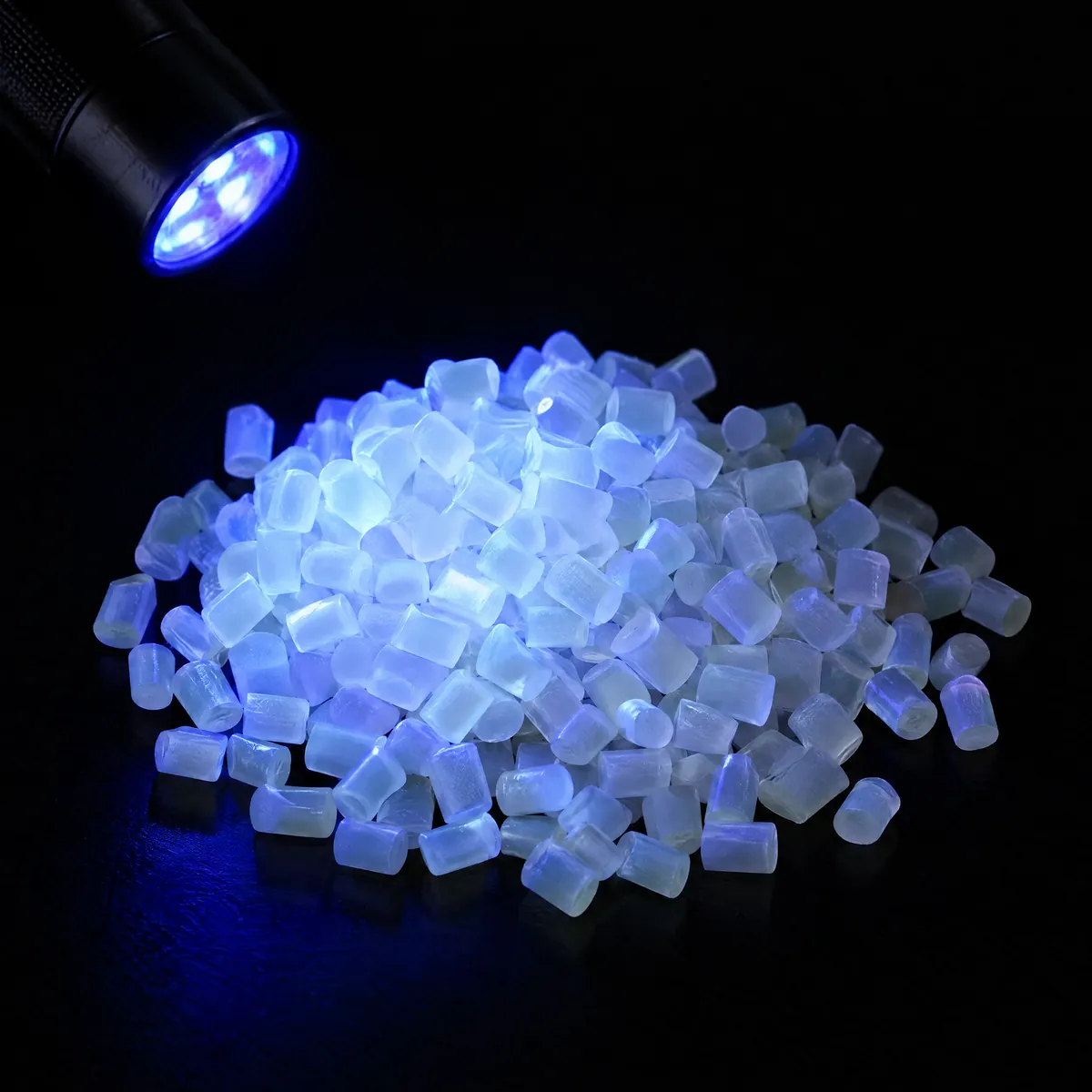
Crystal Brilliance, Superior Whiteness Index and Yellowness Masking Technology
Colorex Optical Brightener Masterbatch is a special additive concentrate that neutralizes the yellowish undertones present in the natural structure of plastic products or formed after thermal processing, giving products an eye-catching snow-white appearance and crystal brilliance.
Polymer chains tend to yellow as a result of thermal oxidation, especially in high-temperature extrusion and injection molding processes or during recycling. Colorex Optical Brightener Masterbatch has a special molecular structure that absorbs invisible ultraviolet (UV) radiation (~340–370 nm wavelength) and re-emits it as fluorescent light in the blue-violet region of the visible spectrum (~420–470 nm). Thanks to this optical mechanism, the yellowness perceived by the eye is completely masked, and the product's b* axis in the CIELAB color space (L*, a*, b*) is optimized toward blue, giving a much higher perception of whiteness.
Key Advantages and Technical Features
Flawless Masking of YellowingBreaks the dull, yellowish appearance of recycled raw materials (r-PP, r-PE, r-PET, r-PS), giving a vivid look of virgin raw material quality.
Synergy with White Masterbatch (TiO₂)Used together with white masterbatch, it optimizes the titanium dioxide (TiO₂) loading, lowering cost while delivering a much brighter, bluish "snow-white" shade.
Crystal Clarity in Transparent ProductsRemoves yellowness in transparent film, sheet and bottle applications without causing haze, giving the product a glass-like brilliance and an attractive clarity.
High Thermal Resistance (Heat Stability)Thanks to special active components that work without degrading even at high processing temperatures of 300°C and above, it is used safely on extrusion, injection molding and fiber/raffia lines.
Excellent Dispersion and Low DosageDisperses homogeneously in the polymer matrix even at low let-down ratios (0.2–1.0%) and causes no surface defects or migration (blooming).
Main Application Areas
Recycled Pellet and Compound ProductionLightening the color and upgrading the quality of post-consumer (PCR) or post-industrial (PIR) recycled plastics.
PP Raffia, Sack and Big-Bag ProductionExtra whiteness and a glossy surface appearance in woven sacks.
BOPP, CPP and PE Packaging FilmsA vivid, clean and bright optical effect in food and industrial packaging films.
Injection and Blow MoldingHome appliance parts, cosmetic packaging, garden furniture, bucket and canister production.
Synthetic Fiber, Nonwoven and Textile ApplicationsLasting whiteness in polyester (PET) and polypropylene (PP) fibers.
Recommended Dosage
General use (depending on the degree of yellowness, wall thickness and target whiteness): 0.2% - 1.0%
Recycled raw materials and thin films requiring high brilliance: 1.0% - 1.5%
Applications and Effects on the Final Product
Applications / Application Areas
Manufacture of recycled white and transparent pellets/products
PP raffia, woven sacks, Big-Bags and rope/twine production
BOPP, CPP, LDPE and HDPE food and textile packaging films
Home appliance outer housing parts, cosmetic containers and plastic furniture
Transparent PET/PP sheets, bottles and synthetic fiber (nonwoven) applications
Affected Properties / Effects on the Final Product
Yellowness Index: Neutralizes the yellowish undertone caused by thermal processing or recycling with blue-violet fluorescent emission.
Degree of whiteness (CIE Whiteness): Gives white products an eye-catching, cool and bright "snow-white" appearance.
Crystal brilliance and clarity: Gives transparent products glass-like clarity and vividness without causing haze.
Color vibrancy: When used with light and pastel color masterbatches, it makes colors look much cleaner and brighter.
TiO₂ cost optimization: Working in synergy with white masterbatch, it creates a high visual perception of whiteness even at lower TiO₂ ratios.
Effect on the Process and Production Line
Works at high extrusion and injection molding temperatures of up to 300°C without burning or building up in the mold.
Thanks to its pellet form, it eliminates the dusting, agglomeration and dosing errors created by powder optical brighteners.
Frequently Asked Questions
The most frequently asked questions about optical brightener masterbatch and their answers. If you cannot find what you are looking for, please contact our team.
What is Optical Brightener Masterbatch and how does it work in plastics?
Optical Brightener Masterbatch is a special optical additive used to remove the yellowish color in plastics and increase brilliance. It does not provide hiding power like a conventional dye or pigment; instead, it absorbs the invisible UV light in the environment and re-emits it as blue-violet light. The yellow tone in the plastic and the emitted blue light neutralize each other, and the human eye perceives the product as much whiter, brighter and more vivid.
Can Optical Brightener be used directly instead of White Masterbatch?
No, the two have different functions. White Masterbatch (thanks to the TiO₂ it contains) gives the product hiding power (opacity) and a white color. Optical Brightener used on its own does not provide opacity; it brightens a transparent product and removes its yellowness. However, when used together with White Masterbatch, it makes the white look much crisper, brighter and "snow-white".
Does it completely remove the yellowing in recycled plastics?
It is the most effective and economical solution for removing the yellowing and dullness caused by thermal history in recycled PE, PP, PET and PS raw materials. In all recycled raw materials that are not very dark, it rapidly lowers the Yellowness Index and gives the product the brilliance of first-grade (virgin) raw material.
What is the recommended let-down ratio (dosage)?
Depending on the degree of yellowness of the raw material, the wall thickness of the product and the target whiteness index, it is generally used at 0.2–1.0%. In recycled raw materials or in thin films requiring high brilliance, the dosage can be increased to 1.0–1.5%.
Does using Optical Brightener cause haze in transparent films?
Colorex Optical Brightener Masterbatch is formulated with active agents that dissolve at the molecular level in the polymer carrier. When used at the correct dosage, it definitely does not cause haze in transparent products such as BOPP, CPP, LDPE or PET; on the contrary, it increases the clarity and crystal brilliance of the product.
Which polymer types is it compatible with?
We offer carrier options suitable for all standard and engineering plastics, including polyethylene (LDPE, LLDPE, HDPE), polypropylene (PP homopolymer, copolymer), polystyrene (GPPS, HIPS), ABS, PET and polyamide (PA).
Is it resistant to high processing temperatures?
Yes. The optical brightener masterbatches in the Colorex product range have full thermal stability at high extrusion and injection molding temperatures of 280°C – 320°C. They do not cause burning, yellowing or plate-out in the mold during production.
Can it be used together with a UV & Light Stabilizer masterbatch?
This point is important from an engineering standpoint. Optical Brightener needs to absorb UV light in order to work; some strong UV absorber additives also absorb UV light at the same wavelength and can therefore partly reduce the brightening effect of the optical brightener. For projects requiring outdoor resistance and optical brilliance at the same time, you can get support from the Colorex technical team for our special formulations compatible with our HALS-based UV stabilizers.
Is it suitable for food-contact packaging?
The food grade Optical Brightener Masterbatch types in our product portfolio fully comply with international food contact regulations (FDA and EU/EFSA standards) within the specified usage limits. Simply state your food contact compliance requirement when ordering.
What happens if it is overdosed (used at an excessive ratio)?
Optical brightening additives have a "saturation limit". Going far above the recommended maximum dosage does not increase whiteness indefinitely; on the contrary, fluorescence saturation can cause a greenish/yellowish reflection and surface migration in the product. For this reason, staying within the recommended 0.2–1.0% range is the right approach in terms of both cost and optical performance.