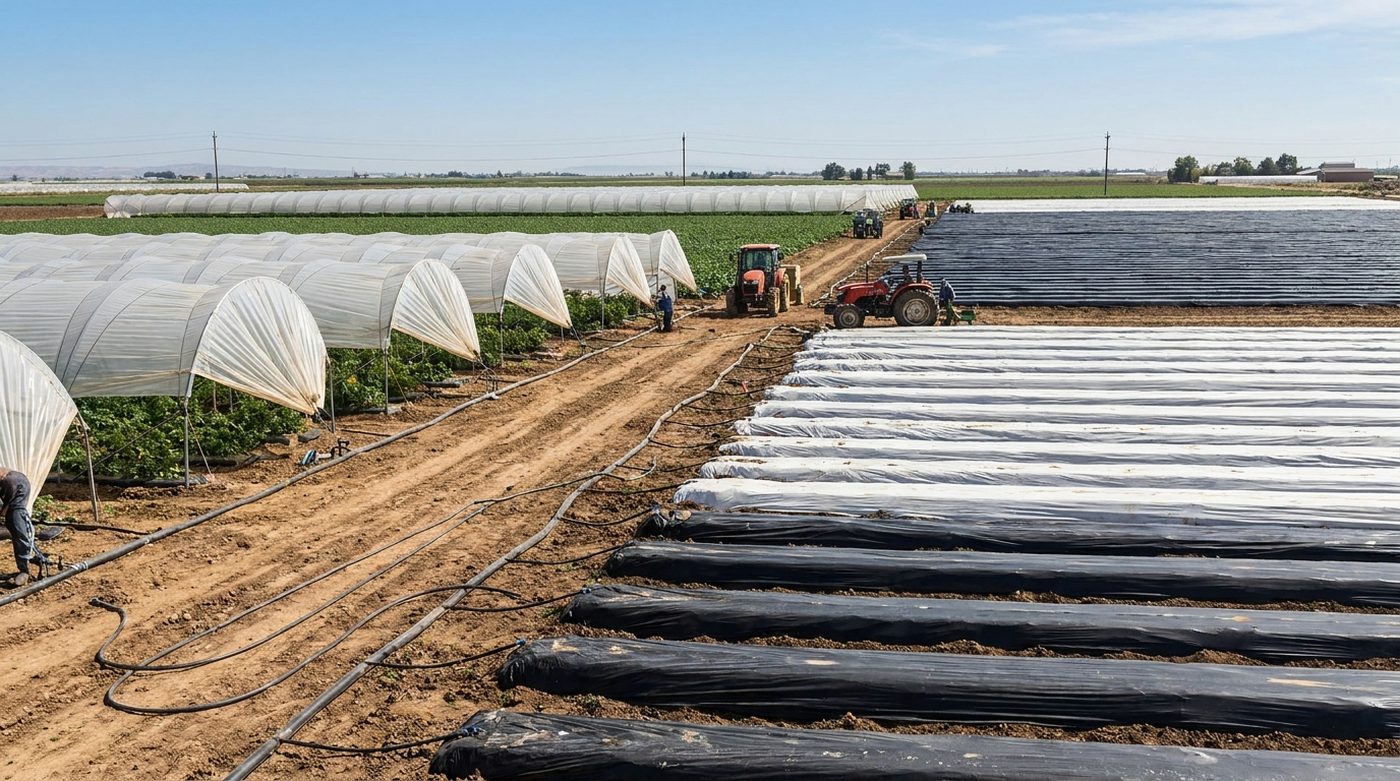
Smart irrigation systems and greenhouse technologies, which are the cornerstones of productivity and water conservation in modern agriculture, rely on high-performance polymer components. As Colorex, we produce high-technology masterbatch and specific additive solutions especially for flat drip irrigation pipes and micro-irrigation systems that increase agricultural productivity. In the production of thin-walled flat drip pipes, the perfect dispersion of carbon black within the polymer matrix is of vital importance.
The high-concentration black masterbatches we have developed provide maximum UV resistance to the pipes while completely preventing algae formation and clogging inside the pipes by reducing light transmittance to zero. At the same time, with our special formulations that allow smooth production at high speeds in extrusion lines, we maximize the mechanical strength and environmental stress crack resistance (ESCR) of the pipes.
In addition to irrigation systems, we create climate control shields that optimize plant growth with the UV stabilizers, infrared absorbers, and anti-fog additives we have developed for greenhouse covers and agricultural films. In today's world where water resources are decreasing, we are the most reliable solution partner for global manufacturers with our innovative chemical infrastructure that powers sustainable agricultural technologies.
Recommended Dosage
In standard drip irrigation pipes and general agricultural parts: 1.5% - 2.5%
In thin-walled flat drip pipes and high-concentration black applications: 2.0% - 3.5%
In greenhouse covers, agricultural films, and special climate control additives: 2.5% - 5.0%
TROUBLESHOOTING POTENTIAL PRODUCTION ISSUES IN THE AGRICULTURAL SECTOR
Common Problems and Solutions
A technical guide of 279 questions compiled from the field experience of the Colorex engineering team.
Why is carbon black agglomeration the most critical production defect in thin-walled flat drip irrigation pipes?
This problem leads to sudden filter clogging and the formation of micron-level holes in the pipe wall. While the barrel temperature is at 195 degrees, structural collapse must be prevented by ensuring the nanometric distribution of the particles using Colorex high-dispersion black masterbatch.
How does insufficient ultraviolet protection in greenhouse covers lead to a disaster after production?
It causes the film to degrade and tear within weeks under the sun. The film extrusion temperature should be kept below 210 degrees, and photo-oxidative chain cleavages must be stopped using Colorex HALS-based stabilizers.
What is the rheological reason for the burst pressure in drip pipes falling below standards?
It is the degradation of polymer chains at temperatures above 220 degrees during extrusion. The temperature profile should be stabilized in the 190-205 degree range, and molecular bonds must be strengthened with Colorex replenishing additives.
Why is the thermal degradation of the polyoxymethylene polymer used in sprinkler production dangerous?
It releases formaldehyde gas at temperatures above 210 degrees, causing explosions in the mold. The injection barrel temperature must be strictly kept within the 185-190 degree band, and the system should not be left idle for long periods.
How can the loss of functionality of anti-drip and anti-fog additives in greenhouse films be prevented?
Production temperatures above 200 degrees destroy these sensitive molecules. The temperature profile should be kept at 190 degrees, and the surface tension of the water must be optimized with Colorex migration-controlled additives.
Why is layer delamination the primary mechanical problem in multi-layer agricultural films?
A temperature difference of more than 20 degrees between layers prevents fusion. All barrel temperatures should be synchronized at 195 degrees, and Colorex tie-layer polymers must be used.
How does environmental stress cracking (ESCR) end the field life of drip pipes?
The bonds of the polymer, which weaken after processing at 200 degrees, break upon contact with fertilizers and pesticides. Resistance against these chemical attacks must be built using Colorex high-performance antioxidant packages.
Why does the water temperature in the calibrator tank exceeding 20 degrees stop production?
The outer wall of the pipe cannot reach the hardness required to resist the vacuum, and the pipe collapses. The water regime must be reduced to the 15-degree level to increase the heat transfer coefficient.
What does weld line weakness in sprinkler parts lead to under water pressure?
The inability of the flow fronts to fully fuse at a 210-degree temperature causes the part to crack instantly. The injection speed should be increased, and the in-mold temperature must be stabilized at 60 degrees.
What does the failure of carbon black to reduce light transmission to zero percent trigger inside the pipe?
Algae growth resulting from photosynthesis clogs the drippers. Total opacity must be achieved by using Colorex black masterbatch at a three percent ratio and a processing temperature of 195 degrees.
How does the incorrect dosage of infrared absorbers in greenhouse films affect the plant?
Heat loss occurs at night, and the plant freezes. Colorex IR additives preserve their inorganic structures at a 200-degree extrusion temperature and reflect the thermal radiation back inside.
What is the thermal cause of bridging in the feed throat of the extruder screw?
It is the sticking of granules as the throat zone exceeds 70 degrees. The cooling water flow rate must be increased, and the raw material flow should be continuously transferred to the 190-degree main barrel zone.
How is wall thickness fluctuation (surging) resolved in thin-walled pipes?
It is caused by the deterioration of the screw speed and the 195-degree pressure stability inside the barrel. Pressure fluctuations must be trapped, and thickness must be stabilized using a melt pump.
How is the warpage problem in the sprinkler body noticed after production?
It is due to the different shrinkage rates of the walls during cooling. The temperature difference between the mold water inlet and outlet should not exceed two degrees, and the part must be cooled slowly after the 210-degree injection.
What does the frost line remaining too high in greenhouse films ruin?
Slow crystallization makes the film hazy. The cooling capacity of the air ring must be increased with 15-degree air.
How does remaining debris in the drip pipe punching unit affect the flow rate?
It blocks the labyrinth exit and cuts off the water flow. The laser heat must be calibrated according to the melting point of the polymer, and an air jet must be applied during punching after 190 degrees.
How is the formation of fish eyes (gels) in the polymer matrix related to the extruder filters?
It is the inability to filter out polymers that do not fully melt in zones below 180 degrees. The temperature profile should be increased gradually, and Colorex replenishing carriers must be used.
What is the effect of the carbon black particle size on the strength of agricultural pipes?
Large particles create stress concentration points and initiate tearing. Colorex micronized carbon black eliminates these risks at a 200-degree processing temperature.
What is the pressure-related cause of flash formation in sprinkler threads?
It is the injection pressure overcoming the mold clamping force. The melt temperature must be reduced from 230 degrees to 210 degrees, and the holding pressure should be profiled.
What triggers the drop in sulfur (pesticide) resistance in greenhouse covers?
It is the deactivation of UV stabilizers as a result of a chemical attack. In such greenhouses, Colorex nickel-based or highly resistant UV series must be processed at 200 degrees.
What happens as a result of stress relaxation in drip pipe coils?
A pipe wound too tightly eventually relaxes, loses its form, and gets crushed. The winding torque must be finely adjusted after the pipe cools down from 190 degrees.
What thermal error causes smoke to come out of the vent during polyethylene extrusion?
It is the barrel temperature exceeding 220 degrees, gasifying the polymer and additives. The temperatures must immediately be reduced to the 195-degree level.
How is friction wear prevented in moving parts like sprinkler rotors?
The surface friction coefficient must be reduced by adding Colorex silicone-based slip agents to the polymer matrix at an injection temperature of 210 degrees.
How does the excessive use of antiblock additives in greenhouse films ruin optical quality?
It scatters the light, making the film hazy. Colorex nanometric antiblock solutions are designed to preserve clarity at a 195-degree temperature.
What is the thermal reason for the inner wall of the drip pipe remaining matte?
It is the formation of large crystal structures resulting from slow cooling on the inside. The inner mold temperature must be kept at 200 degrees to increase surface fluidity.
What kind of damage does a cold start of the extruder cause to the screw?
It causes the frozen polymer to break the screw. Even if the temperatures reach 200 degrees, at least thirty minutes must be allowed for the inside of the screw to heat up.
What is the effect of vibrations in the gravimetric dosing unit on the additive ratio?
It distorts the weight measurement, causing erroneous Colorex masterbatch usage. The system must be installed on a vibration-free platform, and the 195-degree feeding must be monitored.
How does pulling the cores out early in sprinkler molds damage the part?
If the threaded parts of the 210-degree part are pulled before fully freezing, the threads will be stripped. The cooling time must be extended, and the mold water should be stabilized at 50 degrees.
What is the effect of corona treatment on ink adhesion in greenhouse films?
It creates a chemical bond by increasing the surface energy. Post-production surface tension must be raised to the 38 dynes level, and printing should be done after 190 degrees.
Why does the spacing distance of drippers shift in drip pipes? Question 33: Why is shear thinning critical in polymer processing? Question 34: What is the effect of light diffuser additives on photosynthesis in greenhouse films?
It delivers light to the lower leaves by preventing shadowing. Colorex diffusers must integrate homogeneously with the matrix at 200 degrees.
How does a blown extruder barrel heater band affect the motor amperage?
Local cooling increases viscosity and strains the motor. The amperage rise must be monitored, and the 195-degree equilibrium must be maintained.
What is the resistance of bimetallic barrel coating against chemical wear?
It prevents acidic gases and carbon from eroding the steel at a 210-degree temperature. It extends the barrel life by working compatibly with Colorex masterbatches.
What is the effect of static mixers on extrusion pressure and homogeneity?
They eliminate temperature differences but increase the pressure by up to 20 bars. The flow must be perfected by balancing the temperature at 195 degrees.
Why does calcification in cooling tower heat exchangers cause a production crisis?
It blocks heat transfer, causing the polymer to exceed 20 degrees in the cooling pool. The water regime must be chemically protected.
What kind of explosion risk does a clogged pressure transducer create? Question 40: What is the importance of machine vibration analysis for predictive maintenance?
It prevents thermal and mechanical stoppages by detecting bearing wear in advance. The system frequency must be monitored during 195-degree production.
What is the role of the annealing process in drip pipes?
It relieves internal stresses by slightly heating them, restoring the flexibility of the pipe in the field after 190 degrees.
Why is a twin screw more advantageous than a single screw in masterbatch feeding?
It prevents the bridging of high-friction materials like carbon and ensures the Colorex ratio remains constant down to the milligram.
How do antistatic additives block the fire risk in greenhouse films?
They discharge the static load by increasing surface conductivity. The barrel temperatures must be stabilized at 195 degrees to preserve the activation time.
What happens when the velocity-to-pressure switchover point is set incorrectly in injection molding?
It causes the 210-degree polymer to overpack the mold, creating flash. This point must be set by screw position.
How is the machine wear effect of masterbatch pigments eliminated?
Pigments in Colorex formulas are coated with special dispersants, eliminating the sandpaper effect at a 195-degree temperature.
How does gearbox oil exceeding seventy degrees initiate mechanical damage?
Viscosity drops, initiating metal-to-metal friction, which increases vibration and distorts the polymer flow.
Why is a reverse temperature profile applied in extruders?
To quickly melt the polymer by keeping the feed zone at 210 degrees and to increase melt strength by dropping the temperature to 180 degrees at the tip.
What is the effect of pineapple mixers on the screw on melt heat?
They prevent the outer wall from remaining hot while the center stays cold by splitting the flow, ensuring the 200-degree heat reaches every micron.
Why is a low melt flow index polymer used during rapid color changes?
High-viscosity material acts like a brush to scrape off wall residues at 190 degrees, speeding up the cleaning process.
How is the plate-out (sweating) problem seen in agricultural molds related to volatile components?
It is the smearing of low-quality pigments onto the mold surface as they evaporate at 220 degrees. Volatile-free Colorex solutions should be selected.
What is the benefit of Colorex thermal stability packages during machine stoppages?
They cushion thermal stress for hours by preventing the polymer waiting in the 190-degree barrel from oxidizing.
How is the failure of optical sensors to detect black drippers resolved?
Infrared frequency sensors must be used, and punching synchronization should be done at 190 degrees.
How is the opaquing of crease lines in greenhouse films stopped?
To prevent friction-induced whitening, Teflon coatings and 195-degree heat control must be used on the roller systems.
What does the longitudinal stretching of unbelted fish eye gels in the machine direction mean?
It is the stretching of high molecular weight structures inside the hot melt. Raising the temperatures by ten degrees is the solution.
What kind of defect does flat pipe puller rubber wear cause on the surface?
It creates mechanical scratches on the newly extruded, soft 190-degree surface. Alignment and rubber quality must be monitored.
How does carbon accumulation on the melt pressure sensor distort the reading?
By creating insulation, it delays the rheological load transmitted to the pressure diaphragm, giving false pressure drops in a 200-degree environment.
How is wear in sprinkler spring slots slowed down?
Colorex friction-reducing additives must be added to the matrix in the 210-degree injection mold.
What is the effect of day-and-night ambient temperature differences on calibration?
The vacuum tank water can quickly drop below 15 degrees, uncontrollably shrinking the pipe diameter and ruining the tolerance.
What does the cushion value changing with every shot in injection molding indicate?
It shows that the 200-degree liquid is leaking back past the check ring on the screw, indicating machine wear.
How does static electricity increase dusting in pneumatic conveying systems?
Friction inside the pipes causes dust to stick to the silo. Antistatic ventilation is mandatory.
How do waxes accumulating in the greenhouse film air ring fluctuate thickness?
Waxes evaporating at 210 degrees divert the direction of the cooling air, causing one side of the bubble to freeze thinner.
What is the effect of using calcite filler on the tear resistance of agricultural films?
Agglomerated particles accelerate tearing. Colorex optimized fillers integrate with the matrix at 200 degrees. Answer: If the 195-degree heat is insufficient, the polymer chains cannot fully knot, and the pipe will split from this line under pressure.
What danger does exceeding eighty degrees in masterbatch drying ovens create?
It causes the granules to melt and stick together inside the oven, jamming the dosing system.
What happens if the core pulling speed is set incorrectly in sprinkler molds?
If pulled before the threaded parts of the hot 200-degree part fully freeze, the threads will strip.
How does the polymer melt generate its own heat inside the barrel?
As the screw turns, internal heat is generated by the friction of molecules against each other, and the melt can remain stable at 210 degrees.
Why is it necessary to break the surface tension of the water in the cooling pool?
To prevent air bubbles from sticking to the 190-degree pipe and leaving crater marks.
How is the sudden pressure drop during an extruder filter change balanced?
The melt pump increases the RPM to compensate for the flow deficiency at 195 degrees with millisecond precision.
What is the result of missing a tie-layer in multi-layer agricultural films?
The outer layer of the film peels and sheds in the wind. The tie-layer melt must be extruded in sufficient volume at 200 degrees.
Why is polishing the o-ring slots in sprinklers critical?
The polymer injected at 195 degrees makes flawless sealing replication on a mirror-polished surface.
What is the shrinkage allowance in polypropylene drip pipe fittings?
It shrinks by two percent while cooling down from 210 degrees. The mold diameters must be machined larger by calculating this shrinkage.
How does a low L/D ratio of the extruder screw restrict dispersion?
The polymer cannot be kneaded long enough at a 195-degree temperature, and the color does not fully develop. Dispersion agents are a must.
What is the risk when the IBC valves of the greenhouse film bubble close?
The trapped 210-degree air expands, causing the bubble to burst from a weak point.
How should drying be done for printing ink to adhere to agricultural pipes?
Strong air knives must completely blow off the water on the surface after 190 degrees so the ink can bond.
Why must the extruder heat control PID algorithm be updated?
If the response time to 195 degrees slows down, fluctuations in the melt ruin the thickness band.
How does blade dulling in the recycling line affect granule quality?
It tears the 200-degree polymer, creating dust, and this dust forms gels in the main extruder.
What is the resistance of nickel-based UV additives in greenhouse films like?
They resist acidic attacks without reacting, even after being processed at a 210-degree temperature.
Is the clogging of inner water paths in drip pipes solely due to filtration?
No, micro-gels breaking off from poorly processed polymer at 190 degrees can clog the dripper right in the factory.
How long does it take for antioxidants to deplete during machine start-stops?
At a 200-degree temperature, antioxidants deplete within ten minutes, and the material yellows irreversibly.
How does the hot pipe crashing into rollers in the cooling tunnel distort ovality?
The flexible pipe emerging from 195 degrees gets permanently crushed when it hits hard. Alignment must be zeroed using a sensor.
How does excessive decompression in sprinkler injection cause splay (silver marks)?
It swallows air from the nozzle, and this air mixes into the polymer during the 210-degree shot, creating bursts.
Why is the granule size in Colorex products designed close to the raw material?
To prevent settling to the bottom in silos and to maintain the dosing ratio on a milligram basis at 195 degrees.
Do IR additives used in greenhouse films reduce flexibility?
Colorex nanotechnological IR additives merge with the matrix at 200 degrees without compromising the polymer's elasticity.
What does the mold water being below ten degrees in dripper production lead to?
It condenses moisture on the mold surface, and when the 210-degree melt touches this moisture, it leaves a stain on the surface.
What should the corona power be for the printing on agricultural pipes to be permanent?
The plasma shock should raise the surface energy to the 38 dynes level after 190 degrees.
How does a high screw RPM in injection affect glass fiber reinforced parts?
It breaks the glass fibers inside the 220-degree melt, lowering the tensile strength of the sprinkler.
How is melt overflow from barrel vent holes prevented?
The vacuum zone of the barrel running at 200 degrees must be cleaned with brass tools to ensure gas flow.
How does gloss change with the freezing rate in greenhouse films?
Fast cooling polishes the 195-degree film with small crystals, while slow cooling increases haziness.
How is the joint clearance in sprinklers related to the holding time?
If the holding time of the 210-degree part is short, it shrinks more, and the clearance increases, leading to wobbling.
What error causes the weakness of folding at the edges in drip pipe coil winding?
It is the angle of the gusseting boards crushing the pipe too much. At 190 degrees, the angle must be positioned softly.
What is the environmental impact of polymer fumes in the extruder?
Temperatures exceeding 220 degrees turn into toxic gases. Colorex formulas, which disperse at low heat, put an end to this.
What is the effect of mold chrome plating on linear defects?
Worn surfaces slow down the 200-degree polymer, and burnt particles draw lines on the film.
Why is a hot runner necessary in dripper injection?
It prevents the 210-degree polymer from freezing in the sprue and wasting material, saving fifty percent.
What does the lack of internal cooling air in thick-walled pipes do?
If the 195-degree melt is not supported internally, it collapses under its own weight, creating an asymmetrical wall.
How does Colorex high opacity performance support UV life?
Fully dispersed carbon at 200 degrees absorbs light at the surface and protects the inner layers from radiation.
What thermal error causes sprinkler threads to be incomplete in injection?
The melt dropping to 190 degrees freezes before reaching the grooves. The nozzle's temperature profile should be raised by five degrees.
What is maximum efficiency in modern agricultural polymer processing?
It is managing the 195-210 degree band, ensuring homogeneous viscosity with Colorex additives, while preserving thermal stability.
What is the activation time of antistatic agents used in greenhouse covers?
The migration time to the surface after 190-degree production is 24 hours, and the static load must be monitored during this period.
What does longitudinal tearing in drip pipe burst tests indicate?
It indicates that the polymer is over-oriented in the machine direction during 200-degree extrusion, dropping its strength.
What is the function of the Maddock mixer at the tip of the extruder screw?
It is to open the masterbatch pigments at a molecular level by crushing the 195-degree melt with high shear.
What causes the "fish tail" defect on the drip pipe surface? Question 103: What should the temperature be during plastic coating to prevent sprinkler springs from rusting?
To avoid ruining the spring's flexibility, the coating polymer should be processed at the lowest possible temperature, such as 190 degrees.
How does the excessive use of calcium carbonate in greenhouse film production affect sealability?
As the filler amount increases, it becomes difficult for the 210-degree polymer chains to cling to each other, and the film breaks at the seams.
Do thermal expansion differences in the extruder barrel cause screw jamming?
Yes, if the barrel heats up quickly to 195 degrees but the screw remains cold, the tolerance between them closes, and the motor can stall.
How is the pressure adjustment on drip pipe puller pads made?
A delicate pneumatic pressure must be set that will not crush the pipe fresh out of 190 degrees but also won't let it slip.
What does the "melt cushioning" amount dropping to zero in injection molding do?
The holding pressure cannot be transmitted to the mold, and shrinkage voids occur inside the 210-degree part.
Why is the quality of titanium dioxide in Colorex white masterbatch critical?
Poor quality TiO2 agglomerates, instantly clogs the extruder filter at 195 degrees, and stops production.
What is the effect of slip additives used in greenhouse films on the surface energy of the film?
It lowers the energy while making the surface slippery; therefore, corona treatment is a must if printing is to be done after 190 degrees.
How does granule friction in the feed channel of the extruder screw affect the heat?
If the throat heat exceeds 70 degrees due to friction, the granules fuse together and stop the feeding.
What does it indicate if the tear resistance of agricultural film is lower in the TD direction than in the MD direction?
It shows that the blow-up ratio is insufficient during 200-degree extrusion, and the film is oriented unbalanced. Answer: It causes the 195-degree melt to flow faster to one side of the pipe, leading to a deviation in wall thickness.
What does desiccant saturation in the masterbatch drying oven do?
It fails to dry the air, and the moisture entering the barrel at 195 degrees tears the polymer chains apart with water (hydrolysis).
How does the thermal expansion of pins used in sprinkler molds damage the mold?
Pins that heat up during a 210-degree cycle can jam in their slots and break; therefore, a thermal expansion allowance must be left.
How is the viscosity of the polymer melt prevented from changing with ambient humidity?
Raw material silos must be insulated, and the moisture rate should be pulled down to the 0.05 percent level before 200-degree extrusion.
Why is the acid resistance of pigments used in colored agricultural pipes important?
Acidic liquids under the soil can dissolve the paint processed at 190 degrees; Colorex offers resistant series.
How is the calcium in the cooling pool water prevented from leaving white stains on the pipe surface?
Water softening systems must be used, and the 15-degree water should not be allowed to dry on the pipe surface.
What is the danger of manual filter changes in the extruder?
It can cause massive blowouts in the pipe during the sudden release and refilling of pressure at 195 degrees.
What is the most critical parameter that determines the cycle time in dripper injection?
It is the freezing time of the 210-degree plastic inside the mold; this time is directly dependent on mold cooling efficiency.
What does the inhomogeneous distribution of UV additives in multi-layer films lead to?
It causes some areas of the film to lose their 195-degree structural integrity under the sun sooner than others.
What is the effect of a smooth surface on the water jet form in sprinklers?
The smoother the surface, the farther the water is thrown; molding at 200 degrees determines this surface.
How is the continuous shrinkage of polypropylene parts at room temperature prevented?
After coming out of the mold, they must be annealed in 80-degree ovens to ensure controlled completion of crystallization.
What does the shallowing of the channels in the metering zone of the extruder screw create?
It improves melting quality by increasing the pressure on the 195-degree polymer but can decrease the flow rate.
How does the air blown internally by the IBC system in greenhouse films cool the film?
It quickly freezes the crystal structure by taking the heat off the inner surface of the 210-degree film via convection.
What should the ink viscosity for the date print on agricultural pipes be?
It must be fluid enough and have a balanced solvent ratio to dry instantly on the hot pipe emerging from 190 degrees.
What is the effect of air jets in the dripper bowl feeder on the dripper direction?
It prevents clogging by sorting out incorrectly oriented drippers before they enter the 200-degree injection line.
What does the deterioration of the "proportion" setting on the extruder heat controller do?
It causes the heat to constantly deviate from the 195-degree target, creating visual ripples on the pipe.
What is the effect of the vacuum pump used in the recycling line on polymer odor?
By drawing out volatile gases from the 200-degree melt, it reduces the bad odor inside the pipe by seventy percent.
What is the working logic of special gloss masterbatches used in greenhouse films?
They increase light reflection and make the film more transparent by shrinking polymer crystals at 210 degrees.
How does the entry angle of water into the dripper labyrinths affect the flow rate?
The steeper the entry angle molded at 190 degrees, the more turbulence increases, keeping the flow rate stable.
How does the polymer flowing too quickly in the extruder barrel ruin dispersion?
The polymer cannot be kneaded sufficiently at 200 degrees, and masterbatch pigments remain unopened in the melt.
How is the pipe coming out of the mold prevented from floating in the water pool?
Water should be allowed to fill the 195-degree pipe, or it should be kept under water with weight rollers.
What kind of risk does the thermocouple in the nozzle getting dislodged in injection molding create?
The heaters run uncontrollably, raising the nozzle to 250 degrees, burning the polymer and clogging the system.
Why is the melting point of the carrier polymer in Colorex products important?
It must melt at the same time as the main raw material so the dispersion process begins seamlessly at 195 degrees.
How does a barrier-type extruder screw improve agricultural pipe quality?
It guarantees a smooth pipe wall by physically separating the un-melted granules from the 200-degree melt.
What is the effect of using IR additives in greenhouse films on the thermal shrinkage of the film?
The mineral content makes the film more stable at 195 degrees and reduces shrinkage under hot air.
What does an alignment error in the ejector plates used in the dripper mold do?
It causes one side of the 210-degree part to be pushed more, warping it and creating problems during assembly.
Why is the ultraviolet resistance of the print on agricultural pipes necessary?
If sunlight fades the ink, serial numbers printed at 190 degrees become unreadable in the field.
What is the negative effect of a high melt temperature on cycle time in injection molding?
A part that hits 230 degrees takes longer to cool, dropping hourly production output by ten percent.
What does a change in the sound of the extruder barrel fans indicate?
It indicates that the motor is strained or the fan bearings are worn trying to maintain the 195-degree heat.
What is the effect of diffuser additives used in greenhouse films on the light PAR value?
While scattering light, it can reduce the total energy by around two percent; this ratio must be optimized at 200 degrees.
How does the micron-level change in the nozzle diameter of sprinklers ruin irrigation efficiency?
A narrowed diameter after 210-degree injection increases water pressure but drops the flow rate, failing to irrigate the area.
What does the oscillation of the tension arm (dancer) in the drip pipe winder do?
It causes physical deformations on the pipe by fluctuating the winding speed of the 190-degree pipe.
What does polymer vapor leaking into the dosing throat in the extruder ruin?
It lubricates the surface of the granules, lowering the screw's capacity to transport the raw material to 195 degrees. Answer: If the line depth exceeds ten percent of the wall, there is a ninety percent probability the film will tear from that line in the wind.
What should the closing speed of the valve gate pin be in dripper injection?
It should be fast enough to cut the 210-degree plastic without leaving a nub on the part, and precise enough not to damage the mold.
Why is the flow rate of internal cooling air constant in thick-walled pipes?
Fluctuations in the air flow rate cause a continuous change in the inner diameter of the 195-degree pipe.
How does the high opacity in Colorex products ensure plant nutrients remain in the pipe?
By cutting off the light, it prevents algae from consuming nutrients, preserving water quality after 200-degree processing.
What does the loosening of the heating jacket at the nozzle tip in injection molding do?
Heat transfer is cut off, the nozzle drops below 210 degrees, and the freezing polymer blocks the flow into the sprinkler mold.
In conclusion, how is maximum efficiency in agricultural polymer processing defined rheologically?
It is the maintenance of thermal stability, ensuring homogeneous viscosity with Colorex additives, and managing the 195-210 degree band.
How is the distribution of antiblock particles on the surface optimized at 210 degrees in greenhouse covers?
Colorex special carriers prevent particle clumping, ensuring they are arranged at equal distances on the film surface.
What kind of loss does the increasing screw-barrel clearance in a drip pipe extruder create?
Due to pressure loss, the 195-degree melt flows backwards, and energy consumption rises by twenty percent.
What is the effect of spring stiffness on the lifespan of plastic parts in sprinkler heads?
Springs that are too stiff gradually wear out the slot of the part injected at 200 degrees, leading to mechanical failure.
Why is the carbon content of black masterbatches used in agricultural films above forty percent?
Lower ratios cannot fully block light at a 195-degree processing temperature, causing light leakage that ruins silage quality.
What does the loosening of thermal expansion bolts on the extruder barrel lead to?
The alignment of the barrel operating at 200 degrees gets distorted, and the screw scratches the barrel internally, producing metal shavings.
How long does it take for slip additives used in greenhouse films to migrate to the surface?
They reach full performance within twenty-four hours after being processed at 190 degrees; the film must be handled carefully during this period.
How does water accumulating inside the calibrator in a pipe extruder affect the vacuum?
If water drainage is insufficient, water gets between the 195-degree pipe and the vacuum, causing waves on the pipe's outer surface.
What kind of defect does keeping the holding pressure time too short in injection molding cause?
Shrinkage voids form inside the part, and because the pressure is lifted before the 210-degree plastic freezes, the dimensions deviate.
How does the dispersion quality in Colorex products reduce the pinhole risk in films?
Because there are no pigment agglomerates, weak points do not form in the thin-walled film at 195 degrees, and pinholes do not occur.
What is the role of chemical purging compounds used to clean the extruder screw?
They molecularly loosen the burnt polymer layers at 200 degrees, allowing them to be easily detached from the screw surface.
What is the percentage of thermal additives used in greenhouse films preventing night heat loss?
When processed at 210 degrees, the correct Colorex mineral structure traps twenty-five percent more heat inside the greenhouse.
How is fogging of laser diameter gauges used in the drip pipe extruder prevented?
The vapor from the hot pipe exiting at 195 degrees must not cover the lens; air blow systems should keep the sensor clean.
Why must the speed of the robotic arm be synchronized when removing sprinkler parts from the mold?
If the newly ejected, flexible 200-degree part is pulled too quickly by the robot, its geometry is permanently distorted. Answer: Pressures between one hundred and fifty and two hundred bars at a 190-degree temperature are normal; exceeding this strains the system.
What is the working logic of additives that prevent creasing at the folds in greenhouse covers?
They distribute the stress in the fold areas by making the polymer's crystal structure more flexible at 195 degrees.
How does the water in the extruder feed throat being too cold affect the raw material?
It condenses moisture from the air, wetting the granules and causing silver marks inside the barrel at 190 degrees.
How does a narrow sprue diameter in dripper injection prolong the filling time?
The narrow sprue resists the 210-degree melt, increasing the injection time and dropping cycle efficiency.
Why is the ultraviolet resistance class of pigments in Colorex products seven and above?
By exhibiting the highest resistance to fading under sunlight, it preserves the color of the pipe produced at 195 degrees for years.
What is the effect of antistatic agents used in greenhouse films on the stickiness of the film?
While preventing dust attraction, it forms a light layer on the surface; this facilitates unwinding the roll after 210-degree production. Answer: It causes a section of the pipe surface to emerge matte and wavy, destabilizing the 195-degree flow.
What is the injection precision for nut and bolt threads used in sprinklers?
For the 200-degree polymer to fully fill the thread slots, the holding pressure profile must be slowly decreased.
What does a roll weight mismatching the footage in greenhouse films indicate?
It shows that during a portion of the 195-degree production, the thickness deviated on a micron basis, indicating a dosing error.
What are the tests that measure screw-barrel wear in a drip pipe extruder?
Pressure drop tests conducted at specific intervals numerically determine the amount of polymer leakage backwards at 190 degrees.
What is the effect of polymer leakage from the nozzle on the heater's lifespan in injection molding?
The 210-degree leak covers the heater cables, preventing heating and causing localized burns.
What percentage of light scattering is targeted for diffuser additives used in greenhouse films?
It varies between thirty and seventy percent depending on the crop, and Colorex precisely fixes this ratio at 200 degrees.
What should the smoothness level be to prevent water from scaling in dripper labyrinths?
The mold surface must be mirror-polished, and the 210-degree plastic must copy this smoothness on a micron level.
What is the importance of the flight width in the metering zone of the extruder screw?
It directly affects how homogeneous a pressure the 195-degree polymer will have and the flow rate stability.
What is the melt strength of the masterbatch carrier used in agricultural pipe production?
It should be close to the main polymer so that phase separation and wall weakness do not occur during merging at 190 degrees.
How does the effect of special dyes used in greenhouse covers accelerate photosynthesis?
When Colorex special pigments are processed at 210 degrees, they can convert light into the wavelengths the plant loves most.
What is the connection between cooling time and crystallization rate in dripper injection?
A longer cooling time allows the 200-degree part to reach a more stable crystal structure and preserve its dimensions.
How does the polymer flowing too slowly in the extruder barrel increase the risk of burning?
In waits exceeding ten minutes, the 195-degree heat breaks down polymer chains, darkening the color.
How does the enlargement of the vacuum hole diameters in the calibrator tank ruin the pipe surface?
The 190-degree soft pipe is drawn into the holes, creating small pimple-like protrusions on the surface.
What does the deviation of the thermostat setting on the nozzle heater create in injection molding?
The tip, which should be 210 degrees, rises to 220 degrees, causing the polymer to drool and create flash in the next shot.
What is the effect of granule hardness in Colorex products on the dosing screw?
Granules that are too soft can get crushed and stick in the 195-degree feed screw, which is why granule hardness is optimized.
How is polymer outgassing in the compression zone of the extruder screw prevented?
The temperatures in this zone of the barrel should be kept at 180 degrees to ensure slow melting and allow gases to escape backwards.
What must be done so that IR additives used in greenhouse films do not lower tear resistance?
The mineral particles must be perfectly coated at 200 degrees and ensure a chemical bond with the matrix.
What is the damage to the part caused by the number of ejector strokes in the dripper mold?
A second stroke made on a 210-degree part that didn't come out on the first try permanently damages the wall of the part.
What is the penetration depth of the printing ink into the polymer matrix on agricultural pipes?
It must penetrate the first five microns of the surface of the pipe exiting at 190 degrees so it isn't erased by scratches in the field.
What is the internal stress created in the part by excessively high holding pressure in injection molding?
This stress, caused by the 220-degree plastic being jammed in the mold, leads to cracks when the part is exposed to sunlight.
Why does clogged extruder barrel fans stop production?
The 195-degree set temperature becomes uncontrollable, causing the polymer to burn and char inside the barrel.
What is the rate at which diffuser additives used in greenhouse films prevent light shadowing?
When processed at 200 degrees, Colorex diffusers scatter sunlight by eighty percent, providing homogeneity.
What is the effect of nozzle tip hardness used in sprinklers on the water jet?
The higher the hardness, the longer the part injected at 210 degrees withstands sandy water abrasion.
What does a fault in the speed sensor on the drip pipe winder do?
It pulls the pipe uncontrollably after 190 degrees, thinning the wall in places and increasing the risk of bursting.
What kind of odor does polymer vapor leaking into the heaters on the extruder create?
It produces a burnt plastic smell and decreases the thermal efficiency of the heater at 210 degrees, causing energy loss. Answer: These lines are stress focal points that cause UV rays to break the polymer faster and must be prevented at 200 degrees.
What does the pressure drop of the valve gate system in dripper injection change?
It prolongs the 210-degree filling time and prevents the labyrinths from fully filling, resulting in incorrect flow rates.
What is the effect of internal cooling air on longitudinal shrinkage in thick-walled pipes?
The 195-degree pipe supported internally shrinks less, and the footage stability in the field increases by ninety percent.
What is the effect of carrier viscosity on dispersion in Colorex masterbatches?
Viscosity must be low so that at 200 degrees the pigments can easily disperse in every direction within the flow.
What is the safest method to prevent the polymer from freezing in the nozzle during injection?
Special ceramic heaters and insulation jackets attached to the nozzle tip that remain stable at 210 degrees.
In conclusion, how is maximum efficiency in agricultural polymer processing defined rheologically?
It is the maintenance of thermal stability, ensuring homogeneous viscosity with Colorex additives, and managing the 195-210 degree band.
What is the effect of antistatic agents used in greenhouse films on dusting at the end of the roll?
The Colorex layer migrating to the surface after 195 degrees instantly discharges static electricity when the roll is unwound.
What does the instability of the motor speed (RPM) in a drip pipe extruder ruin?
It destroys the flow rate stability at 190 degrees, causing the pipe weight to fluctuate on a per-meter basis.
How is the fluidity of polyamides (PA) used in sprinkler heads at 240 degrees?
They are very fluid, so mold tolerances must be kept at the ten-micron level to prevent flashing.
What is the effect of high MFI cleaning granules used in agricultural pipe production?
By entering dead spots inside the 195-degree barrel, they drag out old burn marks and expel them.
What is the effect of anti-rodent additives used in greenhouse covers on human health?
When processed at 210 degrees, Colorex products contain bitter components that repel mice but do not harm humans.
What does the burning of the pressure sensor tip in the extruder barrel create?
It gives a falsely high pressure reading, causing the system to stop unnecessarily at 195 degrees.
How much should the MFI difference between layers be in multi-layer film production?
For rheological stability, the difference should not exceed 0.5; otherwise, undulations between layers begin at 200 degrees.
What happens if the hydraulic oil of the core systems used in sprinkler molds heats up?
The oil's viscosity drops, and the speed of the cores extracting the 210-degree part slows down, extending the cycle time.
How does scale in the mold cooling channels stop production in dripper manufacturing?
Cooling efficiency drops, the 200-degree part cannot fully freeze, and its geometry is distorted as it is ejected from the mold.
Why must the cooling water flow rate in the extruder feed throat be monitored?
If the flow rate drops, the heat exceeds 70 degrees, causing granules to melt and clog the feed.
What is the molecular arrangement of the UV stabilizers used in greenhouse films?
Thanks to Colorex masterbatches, they create a net-like protective shield inside the film at 210 degrees, protecting every point. Answer: If it is not at an angle to completely dry the 195-degree pipe, water spots form a layer of scale.
How does the torque resistance of plastic threads used in sprinklers change after 200 degrees?
As crystallization completes (after 24 hours), the part hardens and reaches maximum torque resistance.
What is the benefit of aluminum rods used in cleaning the extruder screw?
They are used to mechanically scrape off polymer deposits without scratching the hot 200-degree steel.
What is the effect of antistatic agents used in greenhouse films on the clinging of the film?
While preventing dust, it reduces the film's clinging to itself, facilitating unwinding.
How does high melt pressure in the drip pipe extruder shorten filter life?
It pushes impurities more forcefully into the filter wires at 195 degrees, causing the pores to close rapidly.
How is the raw material viscosity selected to reduce the cycle time in sprinkler injection?
High MFI (low viscosity) raw materials fill more easily at 210 degrees and shorten the holding pressure time.
How does excessive shaking of the bubble in greenhouse cover production ruin thickness measurement?
The sensor cannot make full contact with the 195-degree bubble or measures the wrong distance, sending erroneous thickness data.
What does polymer sticking to the wheel of the footage meter on the pipe production line create?
It enlarges the wheel's diameter, causing the footage of the 190-degree pipe to be read short.
What do filler masterbatches used in the middle layer of multi-layer films increase?
They increase the rigidity of the film at 200 degrees but may slightly decrease its tensile elongation.
What is the Colorex additive that prevents scale from precipitating in the water in sprinkler nozzles?
Special additives that lower surface tension prevent water from clinging to the surface, providing permanent protection at 195 degrees.
What does wear on the chrome plating in the feed channel of the extruder screw do?
It increases friction between the raw material and the screw, causing the throat to heat up prematurely and the feed to cut off at 190 degrees.
What is the percentage of solar energy transmitted by IR additives used in greenhouse films?
It should be kept between seventy and eighty percent depending on the plant's needs, and Colorex precisely maintains this ratio at 210 degrees.
Why is venting the air inside the mold critical in dripper injection?
If the air cannot be vented, the 210-degree plastic burns, creating an obstacle that blocks water passage in the dripper.
What does the contact of heater cables with melt polymer in a pipe extruder create?
It ruins the insulation of the cables at 200 degrees, leading to short circuits and loss of thermal control over the machine.
Do diffuser additives used in greenhouse films have an effect on the lifespan of the film?
Because Colorex diffusers are inorganic, they do not damage polymer chains at 200 degrees and do not affect UV life.
What should be done so that the masterbatches used in sprinkler production do not emit odors?
Pigments with thermal stability up to 210 degrees must be used; otherwise, odors and smoke form during production.
What is the motor torque that sets the limit for screw speed in a drip pipe extruder?
The RPM can be increased up to eighty percent of the torque required to overcome the resistance of the 195-degree polymer; more will burn out the motor.
How is the migration of additives used in greenhouse covers into each other inside the roll prevented?
Thanks to the barrier polymers processed at 195 degrees between layers, each additive is trapped in its own layer.
In conclusion, how is maximum efficiency in agricultural polymer processing defined rheologically?
It is the maintenance of thermal stability, ensuring homogeneous viscosity with Colorex additives, and managing the 195-210 degree band.
How does scale build-up in the water jacket of the feed zone in the extruder barrel cut off raw material flow?
When the heat rises above 70 degrees, granules fuse together and clog the screw flights, failing to send material to the 190-degree main melt zone.
Why are the extrusion temperatures of barrier polymers (EVOH/PA) used in greenhouse films different from PE?
The melting points of these polymers are around 230 degrees; if processed at 195 degrees in the same layer as PE, they remain as un-melted particles.
Is it more critical to perform burst testing on drip pipes at 20 degrees or 60 degrees?
Polymer chains soften at 60 degrees; a pipe that does not burst at this heat was correctly processed at 190 degrees and will withstand summer heat in the field.
How are sink marks on the threaded parts of the sprinkler body prevented after injection?
The holding pressure time must be increased to internally support the 210-degree plastic until it freezes in that area.
What is the mechanism of nanoclay technology used in Colorex products for increasing mechanical resistance in greenhouse films?
At 200 degrees, nanometric platelets penetrate between polymer chains to form a skeleton, increasing the film's tensile strength by twenty percent.
How is the difficulty of cleaning static mixers attached to the tip of the extruder screw overcome?
The mixer channels can be cleaned without dismantling by using special purging agents that mechanically sweep the 195-degree polymer.
Does dusting on the laser sensor in the drip pipe winder cause footage errors?
Yes, if the laser cannot read the pipe's surface clearly after 190 degrees, it shows the footage over or under, causing inventory errors.
What is the risk of ultraviolet stabilizers used in greenhouse films leaching in the rain?
By using Colorex high molecular weight stabilizers, they become permanently trapped in the polymer matrix at 210 degrees and do not wash away.
How is the wobbling of the sprinkler rotor related to mold venting while spinning?
If the mold doesn't fully fill, one side remains lighter; during the 200-degree injection, the air vents must be cleaned to balance the part.
What is the contribution of high-viscosity LDPE used in agricultural pipe production to melt strength? Question 241: What kind of electrical risk does the burning and carbonization of polymer spilled on the heaters in the extruder barrel create?
The carbonized layer gains conductivity at 210 degrees, leading to arcing between heaters and potentially burning out electronic boards.
What is the "fish eye"-like defect created by water droplets falling on the bubble in greenhouse cover production?
The water drop locally shocks the 195-degree film, disrupting the crystal structure in that area and damaging the film's aesthetics and light transmission.
How is the prolongation of cycle time caused by sprue freezing in dripper injection prevented?
Sprue bushing cooling must be optimized, or a transition to a valve gate system that keeps the 210-degree melt hot must be made.
What is the effect of the pH value of carbon black in Colorex black masterbatches on polymer stability?
Carbons with a neutral pH do not react with polymer chains at 195 degrees, preserving the material's chemical lifespan.
How does wear on the flights in the metering zone of the extruder screw increase melt pressure pulsation?
Due to leaks in the pressure chamber, the 200-degree flow becomes intermittent, and wave marks form on the pipe surface.
What is the effect of IR additives used in greenhouse films on the angle of sunlight transmission onto the film?
Mineral particles deflect light at 195 degrees, providing homogeneous illumination (diffuse light) from every point of the film.
What is the role of hydrophobic additives that prevent water from sticking to the labyrinth surface in dripper labyrinths?
Colorex additives break the water's surface retention resistance, ensuring a constant flow rate 24/7 in channels molded at 210 degrees.
What is the "thermal shock" effect at the moment masterbatches used in agricultural pipe production merge with the polymer matrix?
If the additive is fed too cold, it solidifies in the 190-degree melt, leaving granule marks; preheating before feeding may be required.
What is the real reason for polymer smoking at the nozzle during injection?
It is the heat at the nozzle tip spiking to 230 degrees, thermally degrading the polymer and organic pigments in the masterbatch.
In conclusion, how is maximum efficiency in agricultural polymer processing defined rheologically?
It is the maintenance of thermal stability, ensuring homogeneous viscosity with Colorex additives, and managing the 195-210 degree band.
What is the test that measures the dust attraction capacity of antistatic agents used in greenhouse films?
In tests using surface resistivity meters, the value is expected to drop to the ten to the power of ten ohms level after 195 degrees.
What is the rheological reason for the motor drawing high amperage in a drip pipe extruder?
The polymer viscosity is too high at 190 degrees, or a blockage has formed in the compression zone of the screw.
How is the impact resistance of polycarbonate (PC) parts used in sprinkler heads maintained?
The material must be dried at 120 degrees for four hours, and the breakdown of chains by moisture must be strictly prevented during 260-degree injection.
What is the effect of high-viscosity cleaning raw materials used in agricultural pipe production on the screw surface?
Acting like a mechanical sweeper at 195 degrees, they scrape off old Colorex residues at the root of the screw flights and expel them.
What is the working mechanism of anti-algae additives used in greenhouse covers inside the pipe?
Copper-based or organic Colorex components, after being processed at 210 degrees, contact the water and halt algae cell reproduction.
What kind of error message does the melting of pressure sensor cables on the extruder barrel at high heat give?
The PLC system gives an open loop error, halting 195-degree production and requiring emergency service.
What does the "sharkskin" effect appearing in only one layer during multi-layer film production indicate?
It shows that the temperature profile of the barrel feeding that layer has dropped below 190 degrees or that the PPA additive specific to that layer is missing.
What does a heat distribution difference in hot runner manifolds used in sprinkler molds create?
It causes some cavities to fill very fluidly at 210 degrees and others viscously at 190 degrees, causing part weights to deviate.
How are polymer vapor stains (plate-out) formed on the mold surface in dripper production cleaned?
They are removed without disassembling the mold using special cleaning sprays or by stopping the machine and wiping the surface with soft felts that can withstand 200 degrees.
How does a decrease in cooling water flow in the extruder feed throat affect granule flow rate?
The heating throat softens the granules, sliding in the screw channels decreases, and the amount of material going to the 190-degree zone drops by thirty percent.
What is the effect of UV stabilizers used in greenhouse films on the film's sealing capability?
High concentrations can block chain ends at 210 degrees; Colorex synergistic blends are balanced so as not to ruin seal strength. Answer: If the gap exceeds five millimeters, the 195-degree pipe sags, and upon entering the vacuum tank, the bottom of the pipe emerges thicker and the top thinner.
How is "stress cracking" that occurs while tightening nuts and bolts on sprinklers prevented?
Stress-distributing Colorex elastomers should be added to the raw material during 200-degree injection, and the part should be cooled slowly.
What is the connection between wrinkles at the end of the roll in greenhouse films and thermal shrinkage?
Film wound at 195 degrees shrinking at different rates while cooling inside the roll creates wrinkle focal points; tension must be adjusted.
How is the mesh number of filters used in a drip pipe extruder determined?
It should be half the diameter of the dripper labyrinth; eighty or one hundred mesh filters are sufficient to catch impurities at 190 degrees.
What does the loss of thermal insulation caused by leaks at the nozzle in injection molding do?
The heater's heat cannot reach the polymer, the nozzle drops below 210 degrees, and every injected part fills incompletely.
Does the effectiveness of diffuser additives used in greenhouse films change over the film's lifespan?
Colorex inorganic diffusers are locked into the matrix at 200 degrees, are non-volatile, and continue to refract light until the end of the film's life.
What is the thermal cause of "flash" that impedes water flow in dripper labyrinths?
It is the mold heat exceeding eighty degrees, or the injection heat spiking to 230 degrees, making the polymer as fluid as water.
What does the "backflow" of polymer in the metering zone of the extruder screw lead to?
It causes the heated polymer to stay in the barrel longer, accelerating thermal degradation at 195 degrees and leading to gelation.
What is the effect of masterbatches used in agricultural pipe production on melt filtration pressure?
Perfectly dispersed Colorex products keep the pressure constant 24/7, whereas agglomerates increase the pressure by ten bars an hour at 190 degrees.
How is the effect of special dyes used in greenhouse covers on the insect population on the plant?
When processed at 210 degrees, Colorex special light filters can block the wavelengths visible to insects, keeping pests away from the greenhouse.
What is the precision by which holding pressure in dripper injection affects the part's weight?
A correct pressure profile stabilizes the weight of each dripper at 200 degrees with 0.01 percent accuracy, guaranteeing water flow rate.
Does cooling the polymer too quickly (with fans) in the extruder barrel increase screw wear?
Yes, the 195-degree polymer suddenly becomes viscous on the wall, creating high friction between the turning screw and the barrel, accelerating wear.
How does excessively high vacuum in the calibrator tank affect the pipe surface?
The 190-degree pipe sticks violently to the vacuum sleeve, and vibration marks called "chatter marks" form on the surface.
How does the shorting (arcing) of nozzle heater cables in injection molding lock up the system?
A short circuit burns the PLC board, causing the entire system to lose its 210-degree thermal control and go into emergency shutdown.
What does the carrier viscosity in Colorex products being twenty percent lower than the main raw material's viscosity provide?
It allows pigments to seep "like oil" into the main matrix at 195 degrees, providing flawless coloration at the molecular level.
What kind of problem does a narrow flight width in the feed zone of the extruder screw create?
It cannot transport raw material to the 200-degree melting zone fast enough, dropping extruder capacity by forty percent.
What is the effect of IR additives used in greenhouse films on the clinging property of the film?
Because they are mineral-based, they slightly mattify the surface, preventing sticking during roll unwinding after 195-degree production.
What is the damage of mechanical lubrication of the ejector system in the dripper mold to the polymer?
If excess oil smears onto the 210-degree part, it softens the polymer in that area, leading to fracturing under water pressure in the field.
What should the evaporation rate of the solvent in the printing ink on agricultural pipes be?
The ink must dry before the pipe exiting at 190 degrees moves one meter; otherwise, it smears on the puller pads and ruins the print.
What is "overpacking" created in the sprinkler body by excessively high holding pressure in injection molding?
It is the extreme cramming of 220-degree plastic into the mold, causing the part to stick to the mold and not eject.
What does the extruder barrel fans blowing in reverse (sucking air) lead to?
It cannot remove heat from the barrel, the 195-degree melt heats up uncontrollably, and the polymer begins to char inside the barrel.
What is the effect of diffuser additives used in greenhouse films on light reaching the plant roots?
Because it scatters light from every angle, it allows light to reach even the lowest root collar leaves, increasing yield at 200 degrees.
How is the bond of Colorex ceramic additives, which prevent nozzle tip wear in sprinklers, with the polymer matrix?
It chemically locks with the matrix during 210-degree injection and does not wash away with the speed of water from inside the part.
What happens if the tension arm spring in the drip pipe winder gets loose?
The 190-degree pipe waves while winding, the coil becomes uneven, and it constantly tangles while unwinding in the field.
What does polymer vapor in the extruder leaking into the electronic scale in the dosing unit do?
It corrodes the scale's board and incorrectly measures the Colorex feed amount, ruining the recipe at 195 degrees. Answer: For safety, they should not exceed five percent; a ten-micron line increases the film's burst risk by thirty percent during 200-degree production.
What happens if air pressure in the valve gate system drops during dripper injection?
The pin tip cannot fully cut the 210-degree plastic, leaving a nub on the dripper that disrupts water flow.
What does moisture inside the internal cooling air create in thick-walled pipes?
It creates water spots and local roughness on the inner surface of the 195-degree pipe, increasing flow resistance.
Why is the purity rate of pigments in Colorex masterbatches ninety-nine percent?
So that microscopic foreign substances inside do not act as gel nuclei at a 200-degree processing temperature and create weak spots in the pipe.
How does a broken thermocouple cable at the nozzle tip in injection molding mislead the system?
The PLC reads zero degrees and constantly supplies electricity to the heater to reach 210 degrees, burning the polymer in the nozzle.
What is the effect of special dyes used in greenhouse covers on plant coloration (e.g., fruit reddening)?
When Colorex chromatic pigments are processed at 210 degrees, they transmit more of the wavelengths that turn fruit red into the greenhouse.
Why is it essential to mechanically clean the drip pipe extruder screw and barrel once a year?
To completely clear charred polymer in 195-degree dead zones that even purging agents cannot dislodge.
What is the dimensional change of polyamides (PA) used in sprinkler production after moisture absorption?
They can swell by up to one percent; in 210-degree injection, this allowance must be calculated, and assembly gaps left accordingly.
What is the effect of diffuser additives used in greenhouse films on preventing sunburns on the film?
By refracting light, it prevents water drops acting as magnifying glasses from piercing the film that just came out of 200 degrees in the field.
In conclusion, how is maximum efficiency in agricultural polymer processing defined rheologically?
It is the maintenance of thermal stability, ensuring homogeneous viscosity with Colorex additives, and managing the 195-210 degree band. These details are not binding and may vary depending on both the machine temperature and dimensions, as well as the properties and brand of the raw material used; therefore, they are advisory in nature.
Let's find the right solution for your project
Contact our team for sample requests, color matching or technical consultancy.