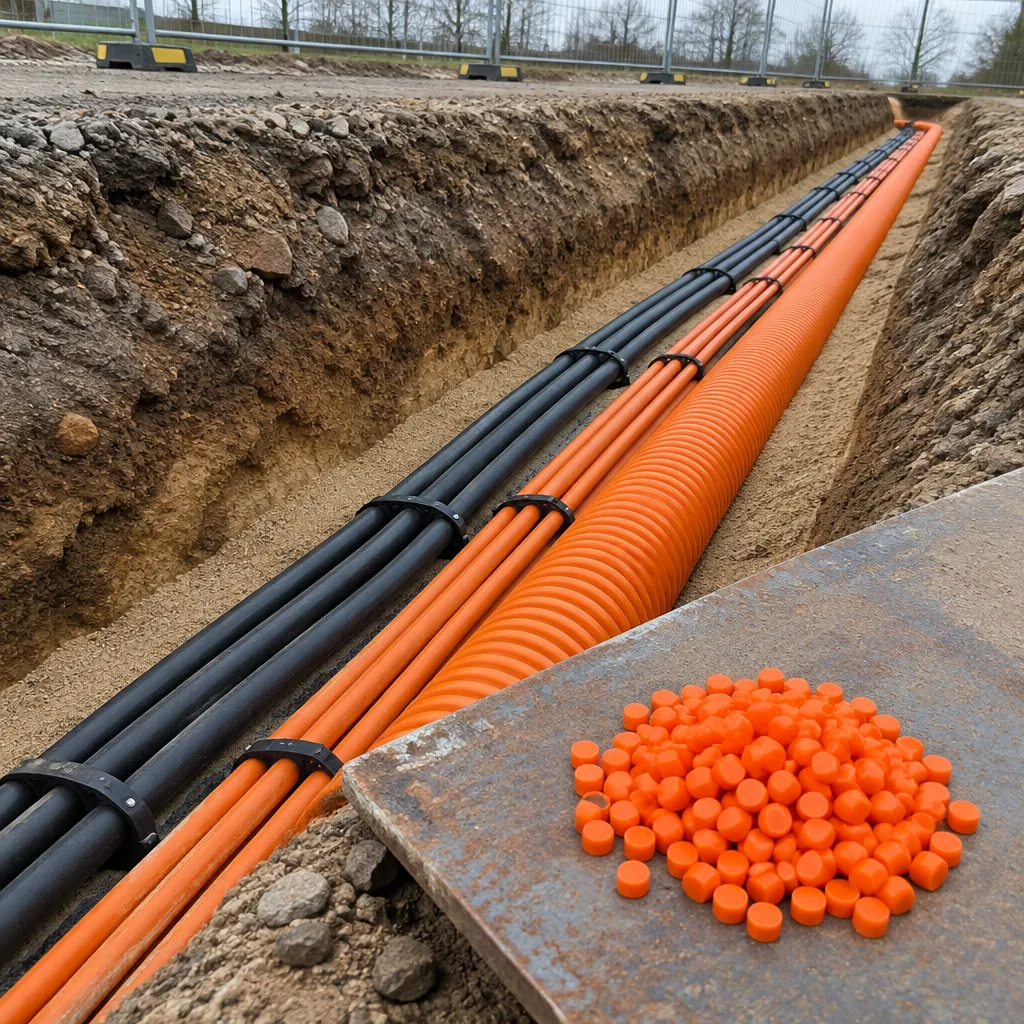
Rodent and Pest Repellent (Anti-Rodent / Anti-Termite) Masterbatch
Power and fiber optic cables, solar power plant (PV) installations, agricultural drip irrigation pipes, automotive engine-compartment hose/cable harnesses and agricultural storage packaging are constantly at risk of gnawing attacks by mice, rats, voles, martens and termites (white ants). Rodents gnaw on plastic jackets and pipes out of an instinct to wear down their continuously growing incisors, causing power outages, data loss, water waste, high repair costs and fires caused by electrical arcing.
The Colorex Rodent and Pest Repellent (Anti-Rodent / Anti-Termite) Masterbatch series has been developed with advanced bittering and sensory repellent components that contain no poison (non-toxic) and do no harm to the environment or living creatures. By creating an intense taste and odor deterrent the moment a rodent or pest first contacts the plastic, it immediately stops gnawing behavior and keeps your systems safe for years without the need for heavy metal armor or expensive mechanical protection conduits.
Colorex Rodent and Pest Repellent Masterbatch Technologies
1. Ultra-Bittering and Sensory Deterrent (Non-Toxic Anti-Rodent) Series
Working PrincipleContains intensely bitter and pungent sensory components with high thermal stability, released in a controlled manner from the polymer matrix. The moment a rodent first bites the plastic, it encounters a sharp, intolerable taste-sensory reaction and permanently moves away from the product.
Technical AdvantagesContains no toxic chemicals or heavy metals; it drives animals away through a natural learning response without killing them. Its long-lasting structure is not quickly washed away by rain, irrigation water or soil moisture.
Recommended ApplicationsDrip irrigation pipes, underground and overhead cables, solar power plant (PV) cables, automotive cable conduits, silage films and waste containers.
2. Termite Repellent (Anti-Termite) and Combined Series for Cables and Underground Infrastructure
Working PrincipleCreates a double barrier against rodents and termite colonies that eat through and destroy underground cables and pipes, especially in hot-climate regions (the Middle East, Africa, Southern Europe, Australia and hot agricultural land).
Technical AdvantagesMeets international export specifications without impairing the cable's electrical insulation resistance, dielectric strength or flame-retardant (HFFR / FR) performance.
Recommended ApplicationsMedium/high-voltage power cables, fiber optic telecom cables, railway signaling cables and underground protective conduits.
3. Low-Odor / Encapsulated High-Temperature Processing Series
Working PrincipleThe active repellent components are stabilized within a heat-resistant carrier structure. This minimizes the risk of pungent fumes, coughing or eye irritation that could disturb operators during extrusion and injection molding.
4. UV + Color + Rodent Repellent Combined Masterbatches
Working PrincipleCombines black/color pigment, UV stabilizer and rodent repellent additive in a single pellet for drip irrigation pipes, agricultural films and outdoor cables used in open fields.
Technical AdvantagesImproves dosing accuracy, reduces the need for multiple feeders and simultaneously ensures outdoor sun protection and rodent protection.
Key Benefits for Your Production Plant and the End User
Non-Toxic, Environmentally Friendly ProtectionContains no rodenticide or banned agricultural pesticides; leaves no toxic residue in soil, groundwater or the ecosystem and drives animals away without killing them.
Savings on Heavy Metal Armor CostsOffers a lightweight, economical solution as an alternative or complement to the expensive steel tape, wire armor or glass fiber wrapping layers used for rodent protection in cable manufacturing.
Uninterrupted Infrastructure and Agricultural ProductivityEliminates water leakage and pressure loss in drip irrigation lines, and the risk of rodent-induced short circuits, failures and fires in fiber optic, power and solar power plant installations.
Low Cost in Multilayer (Co-Ex) ProductionApplied only to the outermost cable jacket or the outer layer of the pipe, it provides full protection without the cost of dosing the entire wall thickness.
Controlled Effect Lasting Many YearsThanks to the controlled diffusion mechanism, the active components migrate slowly and evenly from within the polymer to the surface, delivering a long service life underground and in open fields.
Full Compliance with Export SpecificationsGives your brand a competitive edge by meeting the anti-rodent and anti-termite technical specifications required in energy/telecom tenders, especially in the Middle East, Africa and Europe.
Main Applications and Target Industries
Cable and Telecommunications IndustryFiber optic cables, energy/power cables, solar power plant (PV) DC/AC cables, railway and metro signaling cables, data center cables.
Agricultural Irrigation and Infrastructure PipesThin- and thick-walled drip irrigation pipes, sprinkler pipes, PE100 underground pipes, drainage and cable protection (corrugated/coiled) pipes.
Automotive and Commercial VehiclesEngine-compartment wiring harness sleeves (spiral conduits), wiper/fuel/coolant hoses, sound insulation parts and underbody plastic shields (against marten and mouse damage).
Agricultural Packaging and StorageAnimal feed, grain and seed sacks (outer protective layer), agricultural silage stretch films, greenhouse covers and warehouse pallets/crates.
Building, Construction and Waste ManagementIndoor/outdoor cable trunking, thermal insulation foams/boards, protective under-roof membranes and municipal/industrial waste containers.
Supported Polymer Carriers
Colorex Rodent and Pest Repellent Masterbatches are produced with polymer-specific carriers that preserve the mechanical and electrical properties of the base polymer:
Cable and Pipe PolymersLDPE, LLDPE, HDPE, PE100, MDPE, PVC (Flexible and Rigid), HFFR (LSZH), XLPE, TPU, PA12
Injection and Engineering PolymersPP (Homopolymer and Copolymer), ABS, PA6/PA66, PBT, EVA, TPE/TPV and recycled (PCR/PIR) polyolefins
Colorex Laboratory Assurance
Every batch of Colorex Rodent and Pest Repellent Masterbatch is tested in our laboratory to ensure stable performance and line safety in serial production:
Thermal Stability TestConfirmation that the active repellent component retains its structure without degrading, burning or volatilizing at cable, pipe and injection processing temperatures.
FPV (Filter Pressure Value) and Dispersion ControlVerification of homogeneous distribution that causes no screen clogging or surface roughness in thin-walled drip irrigation pipes, thin-jacketed cables and films.
MFI / MVR and Surface Quality AnalysisRheological compatibility check ensuring that extrusion speed, surface gloss and cable/pipe outer diameter stability are not impaired.
Moisture, Color and Compatibility VerificationFormulation check for low moisture, no shade deviation in black and colored jackets, and compliance with REACH/RoHS criteria.
Feed, grain and seed sacks, silage stretch films and greenhouse covers
Cable trunking, insulation boards, roofing underlay membranes and waste containers
Affected Properties / Effects on the Final Product
Rodent damage: Repels animals without killing them; prevents cables, pipes and hoses from being gnawed.
Environmental safety: Contains no poisons or banned pesticides; leaves no toxic waste in soil or groundwater.
Duration of effect: Active components migrate slowly to the surface by controlled diffusion, delivering a long service life underground and in open fields.
Failure and fire risk: Eliminates leaks and pressure loss in drip irrigation lines, and the risk of short circuits, failures and fires in power and solar PV lines.
Specification compliance: Meets the rodent and termite protection specifications required in power and telecom tenders.
Effect on the Process and Production Line
Applied only to the outer sheath or outer layer; in multilayer production there is no need to dose the entire wall thickness.
Offers a lightweight, economical alternative or complement to steel tape, wire armor or glass fiber wrapping layers.
Frequently Asked Questions
Page-specific technical questions and answers about Rodent and Pest Repellent (Anti-Rodent / Anti-Termite) Masterbatch.
What is Rodent and Pest Repellent (Anti-Rodent / Anti-Termite) Masterbatch?
It is a non-toxic, long-lasting functional additive concentrate designed to protect plastic cables, irrigation pipes, automotive parts and packaging from gnawing damage caused by mice, rats, voles, martens and termites.
Why do mice, martens and other rodents gnaw on plastic cables and pipes?
Rodents' incisors grow continuously throughout their lives, so they must gnaw on surfaces that are hard yet flexible enough to bite in order to wear these teeth down. In addition, sensing the sound/moisture of water in underground irrigation pipes, the heat given off by hot engine compartments or electrical cables, and certain plastic/lubricant odors strongly trigger the urge to gnaw.
How does Rodent Repellent Masterbatch work?
The active components create an extremely intense bitter taste and deterrent sensory effect on the surface and within the structure of the polymer. The moment a rodent first bites into the cable or pipe (before it can damage the insulation or the pipe interior), it encounters intense bitterness and a burning sensory reaction, stops gnawing immediately, memorizes this negative experience and leaves the area.
Does this masterbatch kill mice or termites? Is it toxic?
No. Colorex Rodent and Pest Repellent Masterbatch contains absolutely no lethal rodenticide, heavy metals or banned pesticides. It works entirely on a non-toxic deterrence principle; it only prevents gnawing and drives the animal away without causing it permanent harm.
Do rodents stay away because of the odor without touching the cable or pipe, or do they react at the first bite?
Depending on the formulation type, two mechanisms work together or individually: odor-deterrent components reduce the urge to approach, while the main long-lasting protection takes effect at contact and the first micro-bite (taste/trigeminal sensation). As soon as the rodent makes its first millimetric tooth contact with the outer jacket, it recoils from the bitter reaction and abandons the cable/pipe without piercing it.
What is the difference between Anti-Rodent and Anti-Termite?
Rodents (mice, rats, martens, squirrels) are mammals and are extremely sensitive to bitter/pungent taste receptors. Termites (white ants), on the other hand, are insects that live in underground colonies and chew through cables and pipes in their path with their mandibles while searching for cellulose. Colorex offers both rodent-specific series and combined series that are also effective against termites.
Why is Rodent Repellent Masterbatch preferred in the cable industry instead of, or together with, steel armor?
Steel tape or wire armor significantly increases the cable's weight, diameter, bending stiffness and production cost, and also makes installation more difficult. Colorex Rodent Repellent Masterbatch provides much more economical protection while preserving the cable's flexibility and light weight; in projects with demanding specifications, it is used in the outer jacket over the mechanical armor as a double safeguard.
Why is rodent repellent critical for solar power plant (PV) cables?
Because solar power plants are built on rural and open land, they are located where voles and other rodents are most abundant. Gnawed DC cables lead both to high-voltage arc fires and to energy production losses worth thousands of dollars. Using Colorex Rodent Repellent in the outer jacket secures solar plant cables for many years.
Why is it widely used in fiber optic and telecom cables?
Because fiber optic cables consist of very thin glass fibers, a single mouse bite can instantly cut the internet and communication connections of thousands of subscribers, and locating and splicing the fault underground is very costly. Using Colorex Anti-Rodent in the outer PE/MDPE/HDPE jacket largely prevents these outages.
Does it impair the electrical insulation and dielectric strength of the cable's outer jacket?
No. Colorex formulations developed specifically for the cable industry contain non-conductive, high-purity components; they do not adversely affect volume resistivity, dielectric strength or insulation test values.
Is it compatible with HFFR (Halogen-Free / LSZH) and flame-retardant (FR) PVC cables?
Yes. We offer series fully compatible with HFFR (halogen-free flame retardant), XLPE, PVC, PE and TPU cable jackets; they do not impair the cable's flame retardancy (LOI, IEC 60332) or low smoke density performance.
Does it really prevent vole and mole damage in drip irrigation pipes?
Yes. In Türkiye, especially during the hot summer months, thirsty voles pierce drip irrigation pipes in hundreds of places where they hear and sense water, causing both water loss and significant labor/pipe replacement costs. Drip irrigation pipes containing Colorex Rodent Repellent drive the rodent away at first contact, dramatically reducing puncture damage in the field.
Does it work in thin-walled drip irrigation tapes (e.g., 6 mil / 8 mil / 150–200 microns)?
Yes. Because Colorex Rodent Repellent Masterbatch offers high dispersion and a low FPV value, it extrudes smoothly in thin-walled drip irrigation tapes without screen clogging, emitter bonding defects or burrs around the holes.
Does any bitterness, odor or harmful substance pass into the irrigation water flowing through the drip pipe?
No. The formulation has extremely low water solubility, and the active components are locked within the polymer matrix. It causes no harmful chemical transfer to crops, soil or irrigation water and does not adversely affect the taste or growth of the produce.
In which automotive parts is it used against marten and mouse gnawing?
Martens and mice that enter warm vehicle engines in winter most often gnaw on wiring harness spiral sleeves (PP/PA), washer fluid hoses, air intake ducts, fuel/brake line protectors and underbody plastic shields. Using Colorex Rodent Repellent at 2–4% in the production of these parts prevents costly authorized-service repairs.
Can it be used in animal feed, grain and seed sacks (PP raffia / PE bags)?
Yes. To prevent mice from piercing sacks and spilling feed and seed in warehouses, it can be used only in the outermost layer of multilayer packaging or laminated PP sacks. Thanks to this outer barrier layer, which has no direct contact with the contents, the feed or grain inside is protected.
Does it prevent rodent damage in agricultural silage stretch films and bale wraps?
Yes. When silage bales are pierced by mice and birds, air gets inside, causing the entire animal feed to mold and be discarded. Using Colorex Rodent Repellent in the outer layer of silage films preserves bale integrity and feed quality.
Can it be used in indoor cable trunking, corrugated pipes and thermal insulation boards?
Yes. It is effective in preventing rodents from nesting in and gnawing on PVC/PP cable trunking, corrugated pipes and insulation boards used especially in suspended ceilings, shafts and underground passages.
What does rodent repellent offer for municipal and industrial waste containers?
When mice gnaw through the bases and corners of waste containers, the containers become unusable and hygiene problems arise. Using Colorex Rodent Repellent in HDPE waste containers extends the container's service life.
What is the recommended let-down ratio (dosage) in percent?
Depending on the targeted level of protection, polymer type and wall thickness, it is generally used in the range of 1.5% to 5.0%:
Standard drip irrigation pipes and agricultural films: 2.0–3.0%
Underground fiber optic, power and solar plant cable jackets: 2.0–4.0%
Special tender projects with intense termite or heavy rodent pressure: 3.0–5.0%
Does increasing the dosage beyond what is needed keep strengthening the protection?
No. Greatly exceeding the optimum dosage (above 5%) raises costs unnecessarily, can increase odor intensity during production, and may cause surface blooming or a slight weakening of mechanical properties in some flexible PVC/PE jackets.
How many years does the rodent repellent effect last? Does it wash away underground or in the rain?
Unlike low-cost sprays or surface coatings that dissolve quickly in water, Colorex Rodent Repellent Masterbatch is incorporated directly into the internal structure of the polymer and has very low water solubility. Thanks to its controlled slow-diffusion structure, it maintains its protective effect in underground cables and pipes for 5 to 15+ years, depending on environmental conditions.
Should it be added to all layers of multilayer (co-ex) cables, pipes and films?
No. Since rodent contact occurs only on the outermost surface of the product, adding Colorex Rodent Repellent Masterbatch only to the outermost layer of multilayer cable jackets, corrugated/PE pipes or co-ex films provides 100% of the same protection at a much lower cost.
Does it cause coughing, eye irritation or skin irritation for operators working on the production line?
Conventional capsaicin powders or low-grade unencapsulated additives release dense, pungent fumes during extrusion and seriously disturb operators. Colorex's stabilized pellet formulations with high thermal stability are produced with low volatility; when the recommended processing temperatures are observed and standard local ventilation/fume extraction is operated above the die head, they ensure safe production.
What standard occupational safety precautions should operators take when using this masterbatch?
Because the additive contains an extremely bitter taste component, it is recommended that operators do not touch the pellets with bare hands (use gloves), avoid touching their eyes or face after work before washing their hands, and keep standard ventilation running in the extrusion/injection area.
What processing temperature (extrusion / injection) can it withstand? Does it degrade at high heat?
Depending on the polymer used, Colorex Rodent Repellent Masterbatch series are thermally stable at standard processing temperatures between 160 °C and 260 °C (280 °C for series designed for engineering plastics). Since operating at excessively high temperatures can increase evaporation of the active substance, the recommended temperature profile should not be exceeded.
In which polymers can Colorex Rodent and Pest Repellent Masterbatch be used?
We offer series with compatible carriers for all major polymers used in the cable, pipe, film and injection molding industries, primarily LDPE, LLDPE, MDPE, HDPE, PE100, PP, flexible/rigid PVC, HFFR, XLPE, TPU, TPE, ABS, PA6/PA66 and PA12.
Why is the choice of carrier resin important?
If the carrier resin is not compatible with the base polymer, surface roughness, loss of tensile strength/elongation or premature exudation of the active substance to the surface (blooming) may occur in the cable jacket. For example, a PVC/EVA-compatible Colorex carrier is used in PVC cable jackets, a PE-compatible carrier in PE100 pipes and cables, and a PA-compatible carrier in PA12 outer jackets.
Does it reduce the mechanical properties (tensile strength, elongation, impact) of the cable or pipe?
When used within the recommended dosage range (2–4%) and with a compatible carrier, it does not adversely affect the tensile strength or elongation at break (IEC 60811) of the cable jacket, nor the hydrostatic/impact resistance of the pipe.
Does it affect the color and surface gloss of black or colored cables/pipes?
No. At the recommended let-down ratios, it does not alter the shade of carbon black jackets, blue/yellow/orange pipes or brightly colored cables, and it causes no surface dulling or roughness.
Can it be used together with UV Stabilizer, Black Masterbatch and Processing Aid (PPA)?
Yes. It works in full compatibility with black masterbatch, color masterbatch, UV stabilizer, antioxidant and Processing Aid (PPA) additives and causes no adverse chemical interactions.
Does it affect inkjet or laser marking printed on cables and pipes?
At the correct dosage (2–4%), it causes no excessive surface greasiness or blooming, so it impairs neither inkjet ink adhesion nor Colorex Laser Marking performance.
Does it interact with plasticizer (DOP/DOTP) migration in PVC cable jackets?
Colorex's series formulated specifically for PVC jackets is designed to be compatible with plasticizer systems; it does not cause tackiness or rapid migration (exudation) on the surface of flexible PVC.
Is it resistant to moist soil and microbial conditions for underground cables and pipes?
Yes. The active components have a stable chemical structure that does not degrade quickly under soil moisture, acid/alkaline changes or bacterial/fungal activity.
How is it tested whether the rodent repellent additive really works?
International practice applies both chemical verification tests (determination of active component concentration and post-aging persistence by HPLC/GC) and cage gnawing resistance tests carried out in accredited biological laboratories (in which a control cable and an additive-containing cable are presented to rodents in the same cage and their damage scores are compared).
How is termite resistance tested?
Termite repellent performance is verified at accredited test centers (for example, using Australian AS/NZS or international underground/laboratory termite colony test protocols) by exposing additive-containing samples to active termite colonies and measuring the depth of surface erosion.
Is it dangerous for pets such as cats and dogs, or for farm animals?
Since it contains no toxic substances, it causes no poisoning harm to pets or farm animals. On the contrary, its intensely bitter taste also naturally deters pets and children from biting electrical cables and plastic parts.
Can it be used in plastics in direct contact with food (touched by unpackaged food)?
No. Because rodent repellent additives carry an intense bittering sensory effect, they must not be used on inner surfaces in direct contact with food (food containers, water bottles, etc.). They are used only in technical products such as cables, irrigation pipes, automotive parts and waste containers, or in the outermost, non-food-contact layer of multilayer grain/feed sacks.
Does Colorex Rodent and Pest Repellent Masterbatch comply with REACH, RoHS and environmental regulations?
Yes. Our products comply with the European Union REACH and RoHS directives; they contain no heavy metals, restricted SVHC substances or toxic rodenticides. The technical documentation required for export and project approval processes is provided.
How does it differ under the European Union Biocidal Products Regulation (BPR)?
Additives that kill organisms with toxic chemicals or insecticides (biocides) are subject to strict BPR restrictions and bans. Because Colorex's non-toxic bittering/sensory deterrent technology does not fall into the lethal poison category, it offers a major advantage in terms of environmental sustainability and international shipping.
How should the machine be cleaned after running rodent repellent on a cable or pipe production line?
This step is extremely important. If a food-contact product, drinking water pipe or ordinary household item is to be produced on the same machine immediately afterward, thorough cleaning with Colorex Machine and Screw Cleaner (Purging Compound) is strongly recommended so that not even the slightest trace of bitter taste remains in the barrel, screw or die head.
Can production scrap (stripped cable jacket, pipe regrind) be recycled again?
Yes. Being polymeric in structure, it can be reused as regrind in the production of technical products in the same category (for example, another rodent-repellent outer jacket or drainage/irrigation pipe). However, it must never be mixed into standard recycling streams destined for food contact and must be labeled separately.
Can it be used in recycled (PCR / regrind) PE and PP raw materials?
Does it clog extruder screen packs or hot runner molds?
No. Thanks to its fine, homogeneously dispersed structure, it has a low FPV value; it passes cleanly through fine cable/pipe screens and injection hot runner nozzles without clogging.
Why should I use pelletized masterbatch instead of liquid or powder rodent repellent additives?
Bittering/capsaicin-based raw materials in powder or liquid form become airborne in the plant, making the entire production area unworkable, causing severe eye/respiratory irritation and preventing homogeneous dosing. Colorex Masterbatch in pellet form, by contrast, is a completely dust-free, safe, professional solution that can be fed precisely with standard dosing units and protects worker health.
Outdoors (e.g., drip irrigation pipe laid out in the sun or overhead cable), do UV rays impair the repellent effect?
When used together with UV stabilizer and carbon black, Colorex Rodent Repellent Masterbatch shows high stability against sunlight and retains its effectiveness in open fields for many years.
Does it require drying before use, and how should it be stored?
PE-, PP- and PVC-compatible series do not require drying under normal conditions. Series with PA and TPU carriers, however, should be used immediately after opening their sealed moisture-barrier packaging and, if necessary, dried at a controlled low temperature compatible with the base polymer. It can be stored for at least 24 months in its original, tightly closed packaging in cool, dry and well-ventilated indoor warehouses.
Can you develop a formulation tailored to a cable or pipe tender specification?
Yes. In the Colorex R&D laboratory, we can formulate the special polymer, flame retardant, color and anti-rodent/anti-termite combinations required by power distribution companies, telecom operators, railways and international infrastructure tenders specifically for your project.
What should we pay attention to when running the first trial on our line?
For a smooth first run, it is sufficient to carry out the trial production at a starting dosage of 2.5–3.0% within your standard extrusion or injection temperature profile (without excessive heat), keep local ventilation above the die head running, have operators wear gloves, and clean the line separately at the end of the trial run.
How can we select the most suitable Colorex Rodent and Pest Repellent Masterbatch for our production line and request a sample?
Simply share your base polymer (PE, PP, PVC, HFFR, PA, TPU, etc.), the product you manufacture (cable, drip irrigation pipe, automotive part, sack, etc.), wall thickness, the target threat type (mouse/marten or termite) and any tender specification criteria via the contact channels on our website or our WhatsApp technical support line. Colorex engineers will identify the most suitable series for your project and send you a sample, the safety data sheet (SDS) and the technical data sheet (TDS).
Give Your Cable, Pipe and Infrastructure Systems Non-Toxic, Long-Lasting Protection
Contact our technical team now for a sample of Colorex Rodent and Pest Repellent Masterbatch: environmentally friendly, with high thermal stability, eliminating the risks of failures, water loss and fires caused by rodents and termites.