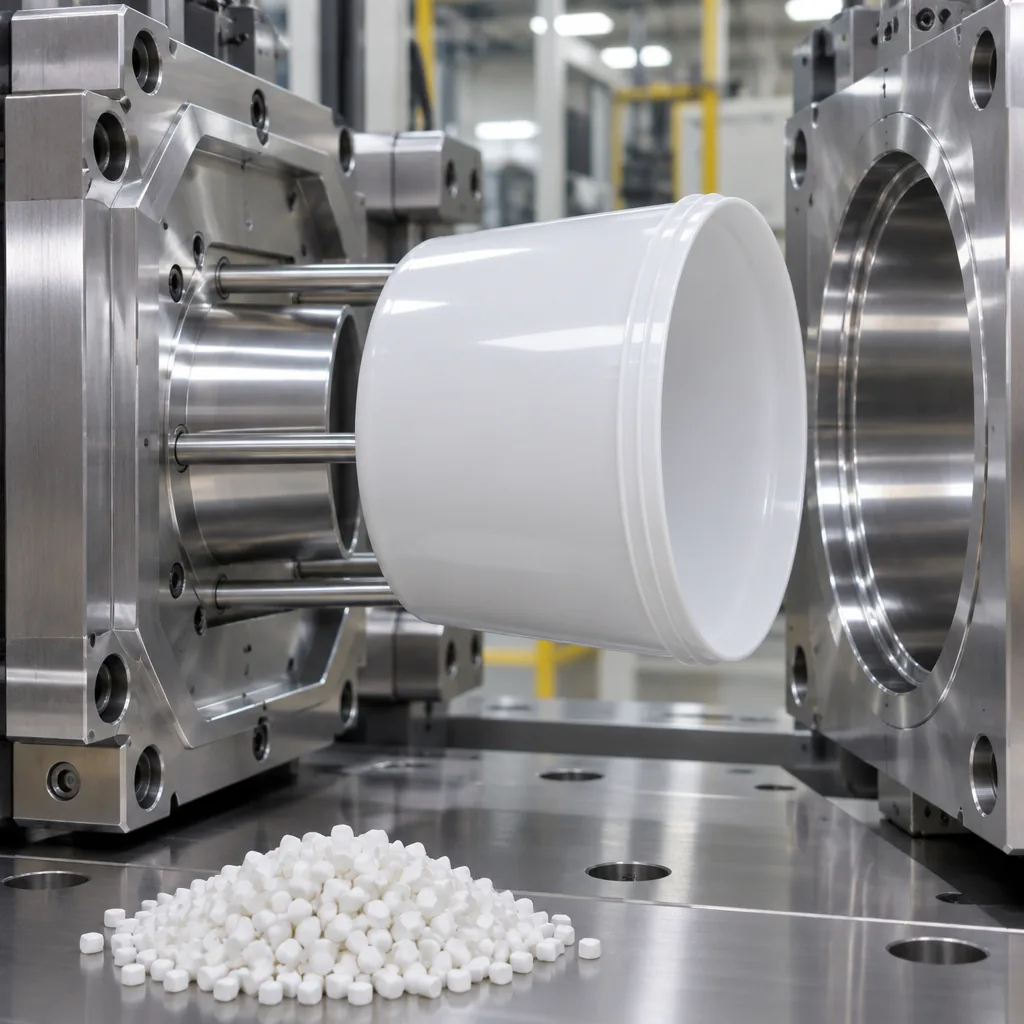
In plastic injection molding and thermoforming, parts sticking to the mold core in deep-draw, thin-wall, low draft angle or heavily textured (grained) molds lead to operator intervention, longer cycle times, ejector pin marks, part cracking and high reject rates. External mold release sprays, the traditional solution, both create a continuous consumable cost and reduce efficiency by stopping the production line every few shots; they also build up oily deposits in the mold cavities and impair subsequent painting, printing and bonding.
The Colorex Mold Release Masterbatch series completely eliminates the need for external spray with internal mold release technology dosed directly into the polymer melt. By supporting melt flow, it allows the narrowest corners of the mold to fill at low pressure and enables the part to release from the mold in a single stroke, without marks and fully automatically.
1. Silicone-Free Series (Paintable and Print-Compatible)
Working PrincipleThrough the synergy of special high-purity fatty acid esters, synthetic waxes and polymeric internal-external lubricants, it reduces the adhesion force between the mold metal and the plastic.
Technical AdvantagesContains absolutely no silicone oil; as a result, after demolding the part causes no adhesion issues in spray painting, screen printing, pad printing, IML/labeling, chrome plating or ultrasonic/vibration welding.
Recommended ApplicationsAutomotive exterior/interior parts to be painted, home appliance panels, printed food and paint pails, cosmetic packaging and ultrasonically welded technical housings.
2. Mold Release Series for High-Temperature Engineering Polymers (250 °C – 340 °C)
Working PrincipleFormulated with special esters and polymeric components of high thermal stability that do not evaporate or burn at high processing temperatures and leave no gas or deposits (plate-out) in the mold cavity.
Technical AdvantagesDelivers high release performance in tight-tolerance technical parts without clogging mold vents or degrading the polymer chain (no hydrolysis/degradation).
Recommended ApplicationsPA6/PA66 (natural and glass-fiber-reinforced), PC, PC/ABS, PBT, POM, PET and PMMA technical injection parts, electrical connectors and gears.
3. High-Performance Siloxane-Based Series for Demanding Molds
Working PrincipleWith ultra-high molecular weight siloxane (UHMW siloxane) technology, it provides maximum slip and surface protection in deep-draw, multi-cavity, very low draft angle or heavily matte-textured molds.
Technical AdvantagesSimultaneously provides strong mold release, scratch resistance (anti-scratch) and improved flow; it creates no greasiness or tackiness on the surface.
Recommended ApplicationsDeep injection-molded crates that require no painting or printing, garden furniture, technical automotive under-components, soft TPE/TPU parts and long-core closures.
4. Food- and Medical-Compliant Series that Preserves Optical Clarity
Working PrincipleProduced with high-purity, food-grade active agents that match the refractive index of the polymer and have verified migration limits.
Technical AdvantagesEnsures fast, quiet demolding in transparent PP, PS, PET, SAN and PC products without causing haze; it causes no odor or taste transfer.
Recommended ApplicationsThin-wall food containers, disposable cutlery and cups, bottle caps, medical syringes, test tubes and laboratory consumables.
Key Advantages for Your Production Operation
Eliminates External Release Spray Costs and DowntimeCompletely eliminates constantly purchased expensive spray cans, mold stoppages opened for spraying and waiting times on robotic lines.
5–15% Shorter Cycle TimeThanks to fast, snag-free part release and improved melt flow, your shots per hour increase.
Prevents Ejector Pin Marks, Stress Whitening and Part CrackingEliminates ejector push-through, stress whitening and distortion (warpage) caused by the excessive force ejectors apply to free a sticking part.
Seamless Fit with Fully Automatic and Robotic ProductionReduces to zero the machine alarms and night-shift line stoppages caused by parts hanging on the cavity or core side of the mold.
Lower Injection Pressure and Energy SavingsThrough its internal lubricant effect, it helps thin-wall molds with long flow paths fill completely at lower pressure and temperature.
Clean Mold and Clean Working EnvironmentPrevents spray mist from entering the air of the production area, floors from becoming slippery and oily deposits from accumulating in mold cooling channels and vents.
Automotive and Home Appliance Technical PartsHeavily ribbed housings, deep-pocket electrical boxes, clips, plugs/connectors, door/dashboard trims and glass-fiber-reinforced mechanical parts.
Crates, Pails, Waste Containers and Garden FurnitureDeep pails with high-friction surfaces, fruit and vegetable crates, pallets, flower pots and plastic chairs.
Medical, Cosmetic and Laboratory ProductsSyringe barrels, pipette tips, blood collection tubes, lipstick/mascara mechanisms, transparent perfume caps and jars.
Thermoforming and Blow MoldingEasier denesting and demolding on high-speed PP/PS/PET thermoformed cup and container lines; clean surface release in blow molds.
TPE, TPU and Soft Elastomer PartsSeals, soft grips (overmolding), shoe soles and protective covers, which by nature have a strong tendency to vacuum-adhere to the mold metal.
Supported Polymer Carriers
Colorex Mold Release Masterbatches are produced with polymer-specific carriers so as to preserve the mechanical and visual properties of the base polymer:
PolyolefinsPP (Homopolymer, Copolymer, Random Clear PP), HDPE, LDPE, LLDPE
Styrenic and Transparent PolymersPS, HIPS, ABS, SAN, PMMA, PC, PC/ABS, PET and PETG
Engineering and Flexible PolymersPA6, PA66 (natural and glass-fiber-reinforced), PBT, POM, PVC, EVA, TPE, TPV, TPU and recycled (PCR/PIR) polymers
Colorex Laboratory Assurance
Every batch of Colorex Mold Release Masterbatch is tested in our laboratory to deliver mold cleanliness and stable release performance in series production:
Heat Resistance (TGA / Thermal Stability) CheckVerification that no smoke, odor, color yellowing or mold fouling (plate-out) occurs at the target injection temperature.
MFI / MVR and Flow AnalysisStable rheological performance check that improves melt viscosity and filling pressure.
Optical and Surface TestingHaze check in transparent polymers, gloss verification on glossy parts and surface tension/printability analysis for silicone-free series.
Food and Regulatory VerificationFull compliance check against the relevant food contact (EU 10/2011, FDA), REACH and RoHS criteria.
TPE and TPU seals, soft-touch grips and shoe soles
Affected Properties / Effects on the Final Product
Mold release: The part releases from the cavity or core side without hanging up or sticking.
Ejector marks and whitening: Prevents pin marks, push-through and whitening caused by excessive ejector force.
Dimensional stability: Prevents warpage and part cracking caused by demolding force.
Mold filling: Helps thin-walled molds with long flow paths fill completely at lower pressure and temperature.
Denesting of stacked products: Stacked thermoformed cups and containers separate from each other easily.
Effect on the Process and Production Line
Eliminates external spray costs, mold stoppages for spraying and waiting times on robotic lines.
Cycle time is shortened by 5% to 15%, increasing the number of shots per hour.
Alarms for hanging parts and shift stoppages are reduced; no oily deposits build up in mold channels.
Frequently Asked Questions
Page-specific technical questions and answers about Mold Release Masterbatch.
What is Mold Release Masterbatch?
It is a functional additive concentrate dosed directly into the polymer melt in plastic injection molding, blow molding and thermoforming processes; by preventing the part from adhering to the metal surface of the mold, it allows the part to release quickly, smoothly and without damage, with no external spray.
Why should I use an internal Mold Release Masterbatch instead of an external release spray?
External sprays create a continuous consumable cost, lengthen the cycle time while the operator or robot sprays, build up sticky deposits on the mold surface and in the vents, and contaminate the factory air and floor. Colorex Mold Release Masterbatch, by contrast, provides uniform protection automatically with every shot, brings spray costs and stoppages down to zero and enables fully automatic production.
How does Mold Release Masterbatch work inside the injection mold?
The active release molecules, which mix homogeneously with the base polymer in the barrel, migrate during injection to the interface between the melt and the cold mold wall. They form a microscopically thin slippery barrier between the metal surface and the plastic, reducing vacuum/friction adhesion after cooling and allowing the ejectors to release the part from the mold effortlessly.
What is the difference between an internal lubricant and an external lubricant?
Internal lubricants reduce friction between polymer chains, increasing melt flow and lowering injection pressure. External lubricants reduce friction between the polymer and the mold metal, allowing the part to release easily from the mold. Colorex Mold Release Masterbatches offer the most balanced synergy of these two effects according to the polymer type.
What is the difference between silicone-based and silicone-free mold release masterbatch?
Silicone-free series work with high-purity esters, waxes and polymeric agents; they do not impair subsequent painting, pad/screen printing, hot stamping, labeling, bonding or ultrasonic welding of the part. Siloxane-based series offer the highest release power and additional scratch resistance in very deep or demanding molds where no printing or painting will be done.
Our part will be painted, printed or bonded after demolding; can we use Mold Release Masterbatch?
Yes. In all projects involving such secondary operations (painting, printing, coating, labeling, bonding), Colorex’s special Silicone-Free Mold Release Masterbatch series can be used with confidence. When used at the correct dosage, it does not impair surface tension or prevent paint/ink adhesion.
Does it prevent ejector pin marks and stress whitening in the ejector area?
Yes. Ejector marks and whitening occur when the part grips the mold core tightly and the ejector pins apply excessive force to free it. Because Colorex Mold Release Masterbatch lowers the friction force, the ejectors release the part with much less force, leaving no marks or whitening.
Does it solve parts cracking, bending or warping (warpage) in the mold?
Especially in thin-wall containers, deep crates and technical parts with long ribs, forcibly stripping the part from the mold bends it mechanically or cracks it at the corners. By ensuring smooth release, mold release masterbatch eliminates deformation and cracking caused by demolding.
Does it really shorten the injection cycle time?
Yes. It shortens the cycle time in three ways: it eliminates waiting for external spraying, speeds up ejector movement and part drop, and improves the holding/cooling balance by lowering the mold filling pressure. Many plants achieve a direct increase of 5% to 15% in shots per hour.
How does it perform in deep-draw pail, flower pot and pipe fitting molds?
In deep molds, as the part cools it shrinks onto the core and locks on tightly, and the vacuum effect makes ejection very difficult. Colorex Mold Release Masterbatch lowers the static coefficient of friction on the core surface, allowing the part to slide off in a single stroke with a stripper plate or air valve.
Does it eliminate drag marks in textured (grained) molds?
In matte-textured automotive and home appliance molds with a low draft angle, the part rubs against the mold texture during ejection and leaves glossy streaks (drag marks / scuff marks) on the surface. Mold release masterbatch reduces this friction so that the grain texture comes out crisp and intact.
What does it offer in threaded closure molds (unscrewing molds)?
In unscrewing (rotational ejection) or forced stripping (bump-off) molds for beverage, cosmetic and detergent closures, it reduces thread crushing, cap distortion and the torque load on the rotation mechanism, enabling uninterrupted high speed in multi-cavity molds.
What should the recommended let-down ratio (dosage) be?
Depending on the base polymer, the difficulty of the mold and the surface texture, it is generally used in the range of 0.5% to 2.0%. While 0.5–1.0% is often sufficient in standard molds, a dosage of 1.5–2.5% may be preferred in very deep molds, molds with difficult draft angles or tacky TPE/TPU molds.
Does increasing the dosage beyond what is needed make demolding even easier?
No. Unnecessarily exceeding the recommended dosage (above 2.5–3.0%) may lead to pellet slippage in the screw feed zone (longer screw recovery time), an oily/hazy surface appearance (blooming), mold fouling and a slight reduction in the mechanical strength of the part. The highest efficiency is achieved with an optimum low dosage.
Can it be used safely in very high-temperature engineering plastics (PA6, PA66, PC, PBT, POM)?
Yes. Standard low-melting waxes burn in engineering plastics above 260 °C, producing smoke and mold deposits. Because Colorex’s high-temperature series is produced with high-thermal-stability components suited to a 250 °C – 340 °C operating range, it runs cleanly and safely on PA, PC, PBT and POM lines.
Does it cause yellowing or cloudiness in sensitive transparent engineering plastics such as polycarbonate (PC) and PMMA?
PC and PMMA are extremely sensitive to heat, moisture and alkaline/acidic additives; the wrong mold release agent causes molecular weight loss (cracking) and yellowing. Colorex’s special optical and PC/PMMA-compatible mold release series works while preserving glass-like clarity, light transmission and impact resistance.
Does it cause haze in transparent PP, PS, SAN and PET products?
No. Formulated for transparent applications with a matched refractive index and high purity, Colorex series do not impair the gloss and optical clarity of the product at the recommended low dosages (0.5–1.0%).
Does it make demolding easier for tacky elastomers such as TPE, TPV, TPU and soft PVC?
Absolutely. Soft elastomers (especially low Shore A hardness TPE and TPU) cling to mold steel as if by vacuum and require manual removal. Colorex’s elastomer-specific mold release series breaks this adhesion, enabling you to move to fully automatic, fast production.
Does it impair adhesion in two-component (2K / overmolding) injection parts?
In two-component injection molding (for example, TPE over PP or TPU over ABS), the chemical/mechanical bonding of the two polymers is critical. For this reason, in 2K projects a special adhesion-compatible Colorex series at a tightly controlled low dosage should be selected instead of standard high-migration release agents, and a peel test should be performed in a pilot run.
What advantage does it provide in glass-fiber-reinforced parts (PP GF30, PA6 GF30, PBT GF30)?
Glass-fiber-filled melts both create high flow resistance and cling to the mold wall under high pressure. Colorex Mold Release Masterbatch eases melt flow, reduces mold wear, smooths the rough appearance caused by glass fibers on the surface (fiber blooming) and provides easy demolding.
Are Slip Masterbatch and Mold Release Masterbatch the same thing?
Although their working principles are similar, their goals differ: slip masterbatches migrate to the surface over time, mainly in packaging films, so that two plastic films slide over each other (low COF). Mold release masterbatches, on the other hand, act instantly at the melt-metal interface during injection and thermoforming, allowing the part to release from the hot/cold mold steel.
If we already use Anti-Scratch Masterbatch, do we also need a mold release additive?
UHMW siloxane-based Colorex Anti-Scratch Masterbatch already provides a noticeable mold release side effect; in most standard molds no additional release agent is needed. However, in very deep, extremely demanding molds or molds where silicone-free paintability is required, Colorex Mold Release Masterbatch should be chosen directly.
Does it cause clogging or flow imbalance in hot-runner and multi-cavity molds?
No. Thanks to its clean structure, which melts completely and contains no solid minerals, it passes smoothly even through hot-runner nozzles as narrow as 0.5 mm; on the contrary, by lowering flow resistance it helps all cavities fill evenly (balance) in multi-cavity molds.
Does it lower injection pressure and holding pressure?
Yes. Thanks to its internal and external lubricant effect, the resistance of the melt advancing through the mold cavity decreases. As a result, injection pressure can typically be lowered by 5–15%, short shots in thin-wall parts are reduced and flash is brought under control.
Does it adversely affect the weld line strength of the part?
If overdosed, it can cause weakening at the point where the melt fronts meet. However, within the low optimum dosage range recommended by Colorex (0.5–1.5%), weld line strength and the overall tensile/impact strength of the part are preserved.
Does it affect ultrasonic welding, vibration welding and hot plate welding?
Silicone-based release agents can reduce weld strength. For parts that will be ultrasonically or vibration welded, the Colorex Silicone-Free series should always be preferred at a low dosage (0.5–1.0%).
Does it cause the label to shift or not adhere in IML (In-Mold Labeling) production?
In IML pails and food containers, using external spray completely ruins label adhesion. When Colorex’s IML-compatible, silicone-free and low-migration mold release series is used, the label stays stable on the mold wall, integrates seamlessly with the melt and the pail releases quickly from the mold.
How is it used in thermoforming sheet production (cups, plates, food containers)?
When added at 0.5–1.5% to PP, PS and PET thermoforming sheets, it not only ensures fast release from the forming mold but also prevents stacked cups and containers from vacuum-locking into each other, supporting easy separation (denesting).
Does it cause deposits or fouling on the mold surface over time (plate-out / mold deposit)?
Low-cost stearate or low-melting paraffin additives build up a white/oily layer in the mold cavity. Because Colorex Mold Release Masterbatches are formulated with high-purity, thermally stable active components, they do not foul the mold at the recommended dosage and temperature; they extend maintenance intervals.
Does it cause gas entrapment or burning (diesel effect) in the mold?
No. Because it contains low-volatility components, it generates no extra gas in the mold; on the contrary, by enabling operation at lower injection pressure and temperature, it helps reduce the risk of burning.
Does it change the surface gloss of the part or its matte grain appearance?
At the recommended let-down ratios (0.5–1.5%), it tends to increase gloss on glossy surfaces and softens flow marks; on matte-grained surfaces, it ensures smooth release without impairing the texture.
Does it affect the shade of black, white or vivid color masterbatches?
No. With its colorless/natural composition, Colorex Mold Release Masterbatch does not cause yellowing in white products and does not change the target shade or Delta-E value of black and RAL color masterbatches.
Can you produce color masterbatch and mold release additive in a single pellet (combined)?
Yes. For demanding molds you run frequently, we can formulate your target RAL/custom color together with the Colorex mold release additive best suited to that polymer as a single combined masterbatch. This eliminates the need for a second doser and removes dosing deviation entirely.
Is it compatible with other additives (UV stabilizer, antistatic, nucleating agent, flame retardant FR, foaming agent)?
Yes. It works in full compatibility with UV stabilizer, antioxidant, antistatic, nucleating and flame retardant (FR) additives. Particularly in high-speed PP container production, maximum cycle speed is reached when it is used together with nucleating additives.
Why is mold sticking more pronounced with recycled (PCR / regrind) raw materials, and does this additive help?
Contaminants, degraded low-molecular-weight chains and high calcite/talc fillers in recycled raw materials increase the tendency to stick to mold metal. Colorex Mold Release Masterbatch both eases flow in regrind/PCR raw materials and eliminates mold sticking and ejector marks.
Can runners and production waste containing Mold Release Masterbatch be reground and reused?
Yes. Because of its high thermal stability, runners and flash can be reground and returned to production. However, since the regrind will already contain a certain amount of release agent, the fresh masterbatch dosage can be reduced slightly in proportion when a high share of regrind is used.
Does it cause screw slippage during screw recovery (dosing) on the injection molding machine?
Within the recommended dosage range of 0.5–2.0%, it causes no screw slippage at the feed throat. If a very high dosage (3% or more) is used or the hopper temperature rises excessively, slippage may occur; in that case the dosage should be optimized and feed throat cooling checked.
Does it cause greasiness, a slippery feel to the touch or dust attraction on the part surface?
Unlike external silicone sprays, it leaves no wet or oily layer on the part. At the recommended dosage, the part surface stays completely dry, clean and smooth, with no greasy feel to the touch.
Is it safe for food-contact packaging, closures and kitchenware?
Yes. We offer food-grade Colorex Mold Release Masterbatch series produced with raw materials fully compliant with the relevant food contact regulations (EU 10/2011, FDA) for food containers, beverage closures, disposable cutlery and kitchenware.
Can it be used in medical and pharmaceutical packaging production (syringes, tubes, stoppers)?
Yes. Our special high-purity, heavy-metal-free and low-migration series meet the demanding quality expectations of manufacturers of medical consumables, laboratory containers and pharmaceutical packaging.
Does Colorex Mold Release Masterbatch comply with REACH, RoHS and SVHC regulations?
Yes. All our products fully comply with the European Union REACH and RoHS directives and contain no heavy metals or restricted SVHC substances. The declarations required for export and OEM approval processes are provided.
Does it cause any change in odor or taste?
No. Because it is produced with high-purity components, it causes no odor or taste transfer; it can be used with confidence for water/beverage closures and automotive interior parts (low VOC/fogging).
Why is the choice of carrier resin critical?
If the carrier resin is not compatible with the base polymer, splay, layer separation (delamination) or, in transparent products, cloudiness occurs on the molded surface. Colorex produces with each polymer’s own carrier for PP, PE, PS, ABS, PC, PA, PBT, POM, PET and TPE/TPU.
Why should I use pelletized Mold Release Masterbatch instead of blending in zinc/calcium stearate powder?
Stearate powders create heavy dusting in the mixer and around the machine, settle to the bottom of the pellets and cause dosing imbalance (excessive lubrication in some shots, sticking in others), impair transparency and cause mold fouling/yellowing at high temperatures. Colorex Masterbatch in pellet form, by contrast, is completely dust-free, homogeneously dispersed and highly efficient.
How should the machine be cleaned after using Mold Release Masterbatch?
With silicone-free series, the barrel can be emptied with the natural base resin during standard production changeovers. However, if a run that will be painted or involves sensitive bonding follows immediately after a high-performance siloxane-based series, cleaning with Colorex Machine and Screw Purging Compound is recommended so that no traces remain in the barrel.
Is drying required before use, and how should it be stored?
Series with PP, PE and PS carriers require no drying. Engineering series with PA, PC, PBT, PET, ABS or TPU carriers should be used at a temperature compatible with the base resin (or immediately after opening the sealed packaging). In its original sealed packaging, stored in cool, dry conditions away from direct sunlight, it has a shelf life of at least 24 months.
What dosage and settings should we start with for the first trial on the injection molding machine?
We recommend starting production at an initial dosage of 1.0% without changing your current temperature profile, and allowing 10–15 shots for the melt to fill the barrel and condition the mold surface. Once the part begins to release easily, external spray is discontinued completely, and the dosage is then optimized down to 0.5–0.8% to find the most economical point.
How can we measure numerically on the production line that Mold Release Masterbatch is working?
From the injection molding machine display (and the hydraulic/electric ejector pressure or torque graph, if available), you can measure the tangible gain within the first hour by comparing the drop in ejector pressure, the reduction in injection filling pressure, the shortening of cycle time (in seconds) and the number of parts stuck in the mold/alarms per shift.
Does it also help with old, worn or scratched mold surfaces?
Yes. Micro-roughness in the mold steel and polish gloss that diminishes over time increase part adhesion. Until the mold is serviced, using Colorex Mold Release Masterbatch offsets this friction and keeps production running without stoppage.
How can we select the right Colorex Mold Release Masterbatch for our mold and polymer and obtain a sample?
Simply share the base polymer you use (PP, PE, ABS, PC, PA6, TPE, etc.), whether the part undergoes any secondary operation such as painting/printing/bonding/welding, your food-contact or optical clarity requirements, and the demolding issue you are experiencing via the contact channels on our website or our WhatsApp technical support line. Colorex engineers will determine the most suitable series for your project and send you a sample and the technical data sheet (TDS).
End Spray Costs and Mold Sticking, Increase Your Cycle Speed
Contact our technical team now for a sample of Colorex Mold Release Masterbatch, which delivers mark-free release, fully automatic production and paintable/food-compliant performance in your deep, thin-wall and textured molds.