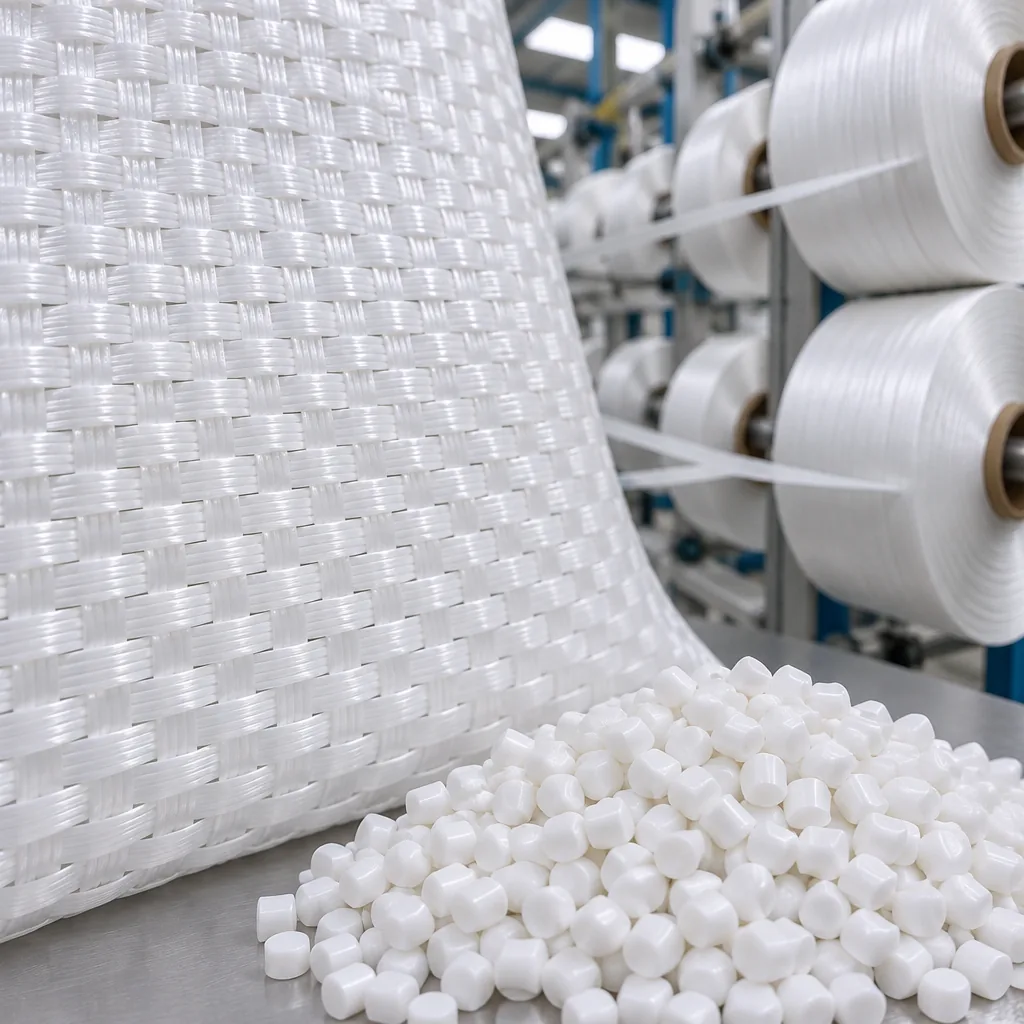
In the production of polypropylene (PP) raffia, woven sacks, BigBags (FIBC), carpet backing and geotextiles, tapes are subjected to high draw ratios (orientation). Due to high stretching speeds, increasing calcite (CaCO₃) filler loadings or the use of recycled (regrind) PP, the polymer chains become excessively aligned in the longitudinal direction only, and bond strength in the transverse direction weakens. As a result, the tapes begin to tear and fibrillate longitudinally (splitting / fibrillation), leading to heavy dusting (snowing), weft/warp breaks and serious efficiency losses on circular looms.
The Colorex Anti-Split Masterbatch series stops splitting at its source by strengthening the transverse bond strength of tapes with special copolymer and highly compatible elastomer technology. It ensures uninterrupted high speed on your extrusion and weaving lines and lets you lower your production cost per ton by using higher calcite and recycled content without loss of strength.
Colorex Anti-Split and Anti-Fibrillation Masterbatch Technologies
1. Anti-Split Series for High-Calcite PP Raffia and Woven Sacks
Working PrincipleIn PP tapes with a high calcium carbonate (CaCO₃) content, it prevents micro-voids from forming around the mineral particles and stops these voids from turning into longitudinal cracks in the stretching oven.
Technical AdvantagesHelps you raise the calcite loading, which normally hits a ceiling at 10–15% in standard production, to the 20–30% range without tape breaks or loom dusting.
Recommended ApplicationsFlour, sugar, feed, fertilizer and grain sacks, standard PP woven fabrics and large woven sheet (haral) production.
2. BigBag (FIBC) and High-Tenacity Technical Tape Series
Working PrincipleProvides controlled elongation and zero fibrillation without reducing tensile strength in heavy-duty tapes that require high tenacity (breaking strength / g/denier) and safety factors (5:1, 6:1).
Technical AdvantagesPrevents tape edges from fraying at high draw ratios (1:6 – 1:7) and works in full compatibility with UV stabilizer and color masterbatches.
Recommended ApplicationsHeavy-duty BigBag (FIBC) bodies and lifting loops, construction/mining sacks, geotextile fabrics and container liners.
3. Recycled (Regrind / PCR) Raffia and Carpet Backing Series
Working PrincipleBalances the molecular weight fluctuations and melt weakness of regrind and recycled PP raw materials, preventing tapes from breaking on the stretching rolls.
4. Tear Resistance Enhancing Series for Films and Packaging
Working PrincipleIncreases machine direction (MD) and transverse direction (TD) tear resistance (Elmendorf tear strength) in mono- and multilayer PE/PP films, preventing bags and films from tearing when packing heavy or sharp-edged products.
A Definitive Solution to Tape Splitting (Fibrillation)Eliminates longitudinal splitting, fibrillation and fraying of tapes after the slitting blades and in the stretching oven.
High Efficiency on Circular LoomsDramatically reduces warp and weft breaks; minimizes loom stoppages and increases the square meters woven per shift.
Eliminates Snowing and DustingGreatly reduces the white calcite/fiber dust that accumulates on loom shuttles, reeds and bobbin edges, preventing machine wear and shortening cleaning and maintenance time.
Cost Advantage Through Higher Calcite and Regrind UseLets you increase the calcite or regrind ratio in your formulation while maintaining tape quality and weaving efficiency, delivering direct savings on raw material costs.
High Line Speed and Stable StretchingHelps increase take-off speed (m/min) on extrusion tape lines and ensures edge uniformity and consistent denier in bobbin winding.
Helps Reduce Water Carry-OverOn water bath cooling lines, it balances the film surface tension and helps reduce the amount of water carried out of the bath with the tapes and the resulting process fluctuations.
Main Applications and Target Industries
PP Woven SacksSacks for flour, sugar, pulses, animal feed, fertilizer, cement and chemicals.
BigBag (FIBC) and Heavy-Duty SacksBody fabrics, high-strength lifting loops and laminated BigBag constructions.
Carpet and Artificial Grass BackingPrimary and secondary PP backing fabrics subjected to high-speed needling and tufting.
Tarpaulins, Shade Nets and Geotextile FabricsAgricultural shade nets, ground covers, construction tarpaulins and drainage geotextiles.
Packaging and Agricultural Twine (Twine / Rope)Binding and packaging twines that require controlled fibrillation or smooth tape.
Industrial Films and Heavy-Duty SacksCourier, fertilizer, pellet and waste sacks where tear and puncture resistance are critical.
Supported Polymers and Production Lines
PolymersPP homopolymer (raffia grade, MFI 2.5–5.0), HDPE tape grade, LDPE, LLDPE and recycled (PCR/PIR) PP/PE raw materials.
ProcessesWater bath and chill roll raffia tape extrusion lines, circular looms, flat weaving, extrusion lamination and blown/cast film lines.
Colorex Laboratory Assurance
Every batch of Colorex Anti-Split Masterbatch is tested in our laboratory to ensure uninterrupted performance on raffia and film lines:
FPV (Filter Pressure Value) and Dispersion TestStrict dispersion control to prevent screen clogging and micro-gel-induced tape breaks on thin tape and film lines.
MFI / MVR (Melt Flow Index) VerificationVerification of flow behavior and melt curtain stability fully compatible with raffia-grade PP base resin.
Tensile Strength and Elongation AnalysisMeasurement of the balance between transverse tear and elongation while preserving breaking strength (tenacity).
Moisture and Ash Furnace AnalysisConfirmation of low moisture, cleanliness and a consistent active ingredient content in every production lot.
PP woven sacks for flour, sugar, animal feed, fertilizer, cement and chemicals
BigBag body fabrics, lifting loops and laminated constructions
Carpet and artificial grass backing fabrics
Agricultural shade nets, ground covers, construction tarpaulins and geotextiles
Binding and packaging twines, heavy-duty bags where tear resistance is critical
Affected Properties / Effects on the Final Product
Tape integrity: Prevents longitudinal splitting, fibrillation and fraying of tapes after slitting and stretching.
Weaving continuity: Markedly reduces warp and weft breaks.
Dusting: Greatly reduces the calcite and fiber dust that builds up on shuttles, reeds and bobbin edges.
Bobbin uniformity: Provides even edges and consistent denier in bobbin winding.
Quality in filled formulations: Tape quality is maintained while the calcite or regrind content is increased.
Effect on the Process and Production Line
Loom stoppages decrease and the square meters woven per shift increase.
Take-off speed on tape lines can be increased and stretching becomes stable.
On water bath lines, it helps reduce the amount of water carried out with the tapes and the resulting fluctuations.
Frequently Asked Questions
Page-specific technical questions and answers about Anti-Split / Anti-Fibrillation Masterbatch.
What is Anti-Split (Anti-Fibrillation) Masterbatch?
It is a functional polymer additive concentrate used mainly in the production of PP raffia, woven sacks, BigBags and carpet backing to prevent tapes from splitting longitudinally (splitting / fibrillation) under high stretching and to reduce dusting and breaks on weaving looms.
Why does splitting (fibrillation) occur in PP raffia tapes?
After extrusion, PP tapes are stretched longitudinally at a ratio of 1:5 to 1:7 to gain strength. This process aligns the polymer crystals along the longitudinal axis only and weakens the bonds in the transverse direction. When excessive stretching, a high calcite ratio, high oven/roll speed or the wrong choice of raw material come together, the tape begins to separate into longitudinal fibers (splitting).
How does Anti-Split Masterbatch prevent splitting?
Its special copolymer and elastomer components form controlled microstructures within the PP matrix, counterbalancing excessive one-directional crystal alignment and building strong bonds in the transverse direction. At the same time, it dampens the stress around calcite particles and prevents micro-cracks from developing into longitudinal tears.
Does it solve the "snowing / dusting" problem on circular looms?
Yes. The white dust seen on looms consists of fibers torn from the tape edges and calcite particles shed as the tapes rub through reeds, shuttles and guides. Colorex Anti-Split Masterbatch strengthens the tape edges and calcite adhesion, dramatically reducing dusting.
Why does increasing the calcite (CaCO₃) ratio trigger tape splitting?
Calcite is a hard, inorganic mineral; while the PP elongates in the stretching oven, the calcite particles cannot stretch, and micro-voids (cavitation) form around them. As the calcite ratio increases, these voids merge, causing the tape to split longitudinally and break.
How much can I increase my calcite ratio with Colorex Anti-Split Masterbatch?
Depending on the condition of your line equipment, the micron fineness of the calcite and the sack type, it helps you safely raise a calcite ratio that runs in the 10–15% range in a standard formulation to 20–30% without tape breaks or loom dusting.
Does using Anti-Split Masterbatch reduce sack and tape costs?
Yes. The Anti-Split additive delivers direct profit through two channels: first, it lowers recipe costs by allowing higher calcite or recycled PP use; second, it reduces breaks on the tape line and weaving looms, cutting waste and increasing hourly output.
What is the recommended let-down ratio (dosage)?
Depending on the calcite percentage, recycled content and draw ratio of the formulation, it is generally used in the range of 1.0% to 4.0%. A dosage of 1.0–2.0% is commonly preferred for standard production with 10–15% calcite, and 2.0–4.0% for high-calcite (20% and above) or regrind-intensive production.
Does increasing the dosage beyond what is needed further improve tape quality?
No. Using more Anti-Split than necessary (above 5%) may slightly reduce the tape's tensile strength (tenacity / g/denier), make the tape softer than required and increase unit cost. The best result is achieved with the optimum dosage that delivers the target strength and zero splitting.
Does it reduce the breaking strength of the tape (tenacity / g/denier)?
Correctly selected Colorex Anti-Split Masterbatch used at the optimum dosage (1–3%) preserves the tape's breaking strength; in fact, by preventing micro-cracks and edge tears, it increases the practical drop and burst resistance of the sack after weaving.
How does it affect the elongation of the tape?
It prevents tapes from becoming overly brittle with low elongation; it typically keeps elongation at break within the ideal weaving window of 15–25%, allowing weft and warp tapes to absorb loom tension shocks without breaking.
What is the relationship between draw ratio and Anti-Split performance?
As the draw ratio increases (for example, 1:6.5 or 1:7 instead of 1:5.5), the tape's tendency to split rises exponentially. Colorex Anti-Split Masterbatch preserves tape integrity even at high draw ratios, enabling both high strength and high line speed.
Does it meet 5:1 and 6:1 safety factors in BigBag (FIBC) production?
Yes. Our high-strength-compatible Anti-Split series, developed specifically for BigBag body and loop tapes, maintains high tenacity requirements (5.5–6.5 g/denier) while preventing tapes from fibrillating along weaving and stitching lines.
Why is Anti-Split used in carpet backing and artificial grass backing?
In carpet and artificial grass production, tufting needles penetrate the woven backing hundreds of times per second. If the backing tapes tend to split, the needles cut through them and tear the backing. Colorex Anti-Split provides high tear and puncture resistance against needle impacts.
Is Anti-Split effective when drawing raffia tape from recycled (regrind / PCR) PP?
Absolutely. In recycled PP the polymer chains are shorter and traces of foreign/mixed polymers may be present, so the risk of splitting and breaks is very high. Colorex Anti-Split Masterbatch restores melt strength and transverse bond strength in regrind-containing tapes, ensuring stable line operation.
What is its effect on "water carry-over" on water bath raffia lines?
High calcite content and low-quality additives disturb the surface tension in the water bath, causing excessive water to be dragged along on the tape (water carry-over); this leads to steam bursts and breaks in the hot oven. High-purity Colorex Anti-Split Masterbatch, free of surface-active contaminants, does not trigger water carry-over and helps keep the line stable.
Can it be used in the same way on chill roll raffia lines?
Yes. It performs at a high level on all water bath and chill roll raffia tape lines.
Does it reduce rough cuts and edge fraying at the slitting blades?
Yes. As tapes pass through the blades, brittle and over-crystallized film edges are cut with serrations; these micro-serrations split the entire tape in two during stretching in the oven. Because Anti-Split makes the film structure tougher and more homogeneous, blade-cut edges come out smooth.
Does it help increase extrusion line speed (m/min)?
Yes. When you increase line speed, tape breaks and splitting normally rise quickly. Because Colorex Anti-Split strengthens melt stability and tape integrity, it allows you to raise extruder and winder speeds more safely.
Does it change the thermal shrinkage of the tape?
At the recommended dosages (1–3%), with oven and annealing zone temperatures set correctly, it does not adversely affect the tape's dimensional shrinkage; it maintains dimensional stability in laminated and hot-fill sacks.
Does it affect the bond strength of extrusion lamination (coating)?
Conventional slip or wax-based additives migrate to the surface and weaken lamination (PE/PP coating) adhesion. Because Colorex Anti-Split Masterbatch has a non-migrating polymeric structure, it does not impair bond strength in sack and BigBag lamination.
Does it affect flexo print quality and corona (dyne) level on sacks?
No. Since it contains no oily substances that migrate to the surface, it does not lower the surface tension of the tape or fabric; corona treatment and flexo ink adhesion take place without issues.
Does it contribute to stitching and the strength of the sack mouth/bottom?
Yes. Splitting of tapes where the sewing needles pass causes the sack to open at the seam. Stitch retention strength rises markedly in woven fabrics containing Anti-Split.
Can it be used together with UV Stabilizer Masterbatch?
Yes. It works in full compatibility with Colorex UV & Light Stabilizer masterbatch, especially in BigBags, fertilizer sacks, agricultural shade nets and construction tarpaulins stored outdoors; it does not weaken UV protection in any way.
Can it be used simultaneously with White Masterbatch, Color Masterbatch and Calcite (Filler)?
Yes. It can be safely used in the feeding unit at the same time as the calcite filler masterbatch, white/color masterbatch, optical brightener and UV stabilizer in your standard raffia recipe.
Can Calcite (Filler) Masterbatch and Anti-Split be produced as a single combined product?
Yes. For raffia lines with a limited number of dosing units, special combined recipes that unite calcite, white/color pigment or UV additive with the Anti-Split function can be developed in the Colorex laboratory.
Does Anti-Split Masterbatch cause yellowing or dullness in white sacks?
No. Colorex Anti-Split Masterbatch is produced with optically clean, colorless/natural polymer carriers; it does not impair the gloss or whiteness index of white sacks and does not cause yellowing.
Does it reduce transparency in transparent (natural) PP sacks?
When the Colorex Anti-Split series with a refractive index matched to PP is used at low and medium dosages (1–2.5%), the clarity of natural/transparent sacks is preserved and no undesirable haze forms.
Does it cause clogging in thin tapes and raffia extruder screen packs?
Absolutely not. Thanks to its pure polymeric structure free of solid fillers and its high dispersion quality, it has a low FPV; it does not increase screen pressure and extends screen change intervals.
What is the difference between Processing Aid (PPA) Masterbatch and Anti-Split?
PPA (Processing Aid) eases flow by preventing die build-up at the extruder die lips and surface roughness. Anti-Split, on the other hand, directly regulates the internal crystal structure of the tape and prevents longitudinal tearing (fibrillation) during stretching and weaving. On demanding high-calcite raffia lines, the two together create excellent synergy.
Is an Impact Modifier the same as Anti-Split?
Although they draw on similar elastomer/copolymer families, raffia tapes are subjected to high uniaxial stretching (orientation), so Anti-Split formulations are designed specifically for the raffia process with a dedicated MFI, a narrow molecular weight distribution and compatibility with the water bath and oven.
Why should I use Colorex Anti-Split instead of adding standard LDPE or LLDPE to prevent splitting?
Adding plain LDPE or incompatible LLDPE creates coarse phase separation in PP, rapidly lowering the tape's breaking strength (tenacity), causing die pressure fluctuations and creating edge weave in the melt curtain. Colorex Anti-Split, with its special copolymer structure compatible with PP at the molecular level, provides maximum splitting protection at low dosages (1–3%) without loss of strength.
Can it be used in HDPE tape production (shade nets, raschel sacks, technical nets)?
Yes. We also offer HDPE-compatible Anti-Split series that prevent longitudinal splitting and breaks on knitting/weaving machines in HDPE tape and net production.
Is it used only in raffia, or does it also prevent tearing in packaging films and bags?
While raffia and woven sacks are its main application, it is also used in heavy-duty sacks, courier bags and regrind-containing PE/PP films produced on blown and cast film lines to increase machine direction (MD) and transverse direction (TD) tear (Elmendorf) and puncture resistance.
Is it necessary to change the extruder temperature profile or stretching oven settings?
Generally, no major change to the existing raffia line temperature profile (220 °C – 250 °C) is required. Because the Anti-Split additive makes the melt more stable, many plants can optimize the annealing ratio and stretching roll speeds more easily.
What should the MFI of the PP base resin be for raffia tapes?
Standard raffia tape production generally uses homopolymer PP with an MFI between 2.5 and 4.5 g/10 min (230 °C / 2.16 kg). Colorex Anti-Split Masterbatch is produced with a rheology that matches this MFI range exactly.
Does it cause edge instability (neck-in / edge weave) or thickness variation in the melt curtain?
No. Because its flow properties are balanced specifically for the raffia process, it keeps the melt curtain stable at the T-die (flat die) exit and maintains consistent tape width and denier.
Does it affect tape breaks and bobbin collapse on winders?
Because tape edges come out smooth without splitting and tape tension remains constant, breaks at the winder heads decrease, resulting in more uniform, tighter bobbins that do not collapse.
How is it used in agricultural and baler twine?
It is used at 1–3% in smooth packaging twines that do not require controlled fibrillation and in agricultural twines that require high knot strength, to prevent breakage and fibrillation at the knot.
Is it safe for food-contact sack products (flour, sugar, rice, salt sacks)?
Yes. For food sacks, we offer Colorex Anti-Split formulations that fully comply with the relevant food contact regulations (EU 10/2011, FDA) and carry no risk of heavy metals or harmful migration.
Is Colorex Anti-Split Masterbatch compliant with REACH, RoHS and SVHC regulations?
Yes. All our products fully comply with the European Union REACH and RoHS directives and contain no restricted SVHC substances. The necessary declarations of conformity are provided for sack and BigBag manufacturers that export.
Does it cause any change in odor or taste?
No. Because it is produced from completely odorless, high-purity virgin polymer and copolymer raw materials, it causes no odor or taste transfer in food and feed sacks.
Can sacks and edge trim containing Anti-Split be recycled again?
Absolutely. Thanks to its polyolefin-compatible structure, edge trim from the line head and weaving waste can be pelletized directly and fed back into production without any incompatibility; on the contrary, it improves the tape quality of the recycled material.
What dosing method should be used? Does it work with gravimetric or volumetric feeders?
Because its granule size is compatible with standard raffia raw material and it is dust-free, it is dosed precisely without bridging in both gravimetric and volumetric dosing units; if desired, it can also be pre-mixed with the base resin and calcite in a mixer before feeding.
Is drying required before use, and how should it be stored?
Because it has a non-hygroscopic polyolefin structure, it does not require drying. It can be stored in its original, closed 25 kg bags or BigBag packaging in a cool, dry, enclosed warehouse away from direct sunlight, with a shelf life of at least 24 months.
What is the most practical way to test whether Anti-Split works on our production line?
First, produce tape with your standard recipe without the additive and, over 24 hours, record the number of tape breaks on the extruder, blade/oven dusting, and the number of weft-warp breaks and dust accumulation on the circular loom fed with the same bobbins. Then add 1.5–2.5% Colorex Anti-Split and repeat the same tests; the difference becomes clearly visible both in the manual tape bending/fingernail separation test and in loom efficiency.
What is the "Fingernail / Bending Fibrillation Test" (Fibrillation Test)?
It is a quality control test that observes after how many strokes a raffia tape separates into fibers when you fold and rub it several times along its longitudinal axis by hand, or pass it through a standard abrasive/needle fibrillation tester. Tapes containing Colorex Anti-Split withstand far more bending and rubbing without tearing than standard tapes.
Does it improve the burst/drop resistance of sacks during filling and stacking?
Yes. Because it prevents woven tapes from splitting longitudinally, it significantly increases the fabric's tear and burst resistance, especially when heavy 25–50 kg sacks are dropped from a height or lifted by forklift/crane.
Is a special machine cleaning procedure required after using Anti-Split?
No. Because it is 100% compatible with the PP/PE base resin, it requires no extra chemical cleaning during changeovers; transitions take place smoothly within the standard production flow.
How can we select the right Colorex Anti-Split Masterbatch for our raffia or film line and request a sample?
Simply share your base polymer and its MFI, the calcite and recycled content of your recipe, tape thickness/denier, draw ratio and line type (water bath / chill roll / film) through the contact channels on our website or our WhatsApp technical support line. Colorex engineers will determine the most suitable series and starting dosage for your line and send you the sample and technical data sheet (TDS).
End Tape Splitting and Loom Dusting, Boost Your Calcite Efficiency
Contact our technical team today for a sample of Colorex Anti-Split Masterbatch, which reduces breaks and increases loom speed and raw material savings on your raffia, woven sack, BigBag and carpet backing lines.