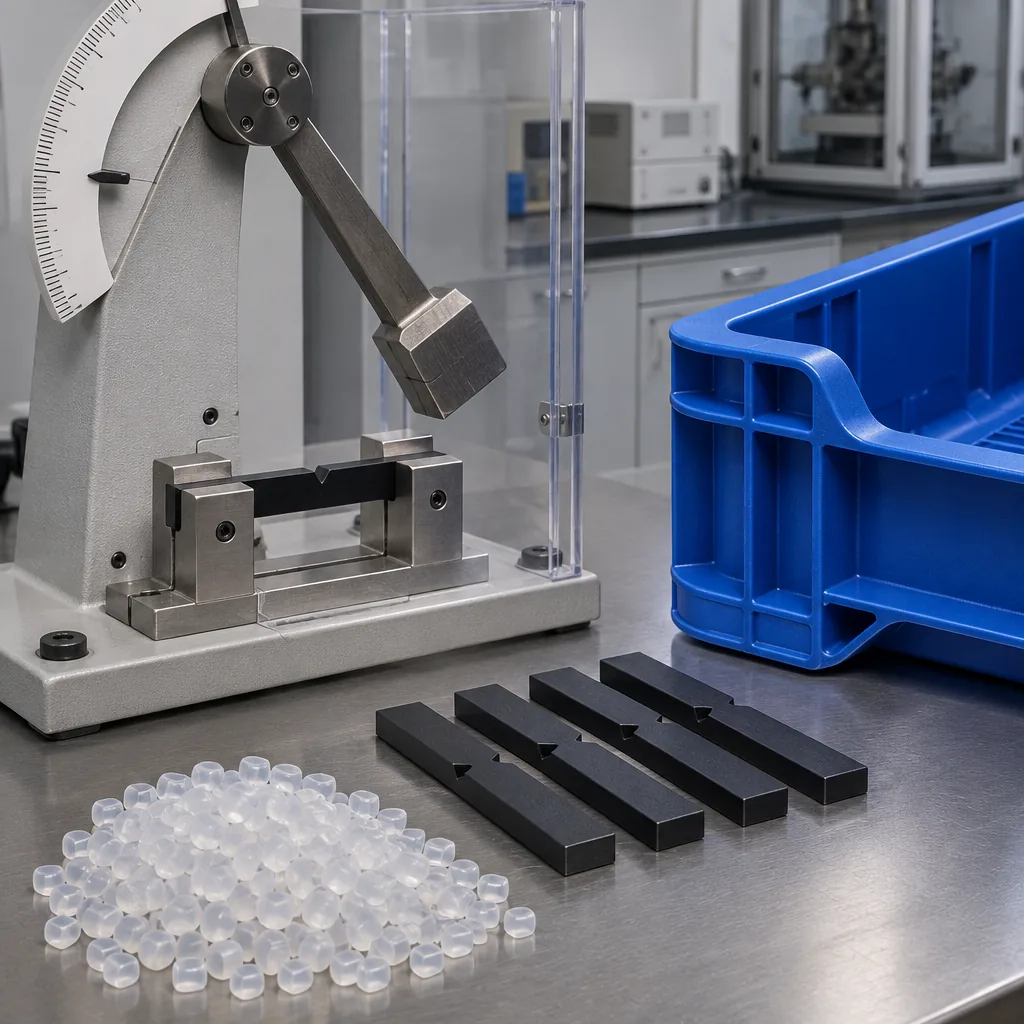
Recycled (PCR/PIR) and regrind feedstocks used for cost optimization in plastics production, high calcite/talc filler loadings and cold-weather conditions all make finished products stiff, brittle and vulnerable to impact. In particular, when chemically immiscible recycled polymers such as PP+PE are processed in the same melt, phase separation occurs; parts crack and break during transport, in cold storage or on the first drop.
The Colorex Impact Modifier and Compatibilizer Masterbatch series combines elastomer technology with reactive coupling (maleic anhydride-grafted) polymer chemistry to multiply the impact energy absorption capacity of plastics. It eliminates breakage in the cold (-20 °C / -40 °C) and turns mixed recyclates and highly filled formulations into durable, high value-added industrial products.
Colorex Impact Modifier and Compatibilizer Technologies
1. Polyolefin Elastomer (POE) and EPDM-Based Impact Modifiers
Working PrincipleCreates microscopic elastic phases within the rigid polymer matrix that stop crack propagation and dissipate impact energy when the part is struck.
Technical AdvantagesProvides superior notched impact resistance even at low temperatures (-20 °C to -40 °C), high flexibility, a smooth surface and excellent flowability.
Working PrincipleThrough reactive groups chemically bonded to the polymer chain, it builds strong chemical bridges between immiscible polymers, or between inorganic fillers (calcite, talc, glass fiber, wood flour) and the base polymer.
Technical AdvantagesStrengthens filler-polymer interfacial adhesion, increasing impact strength and tensile/flexural strength at the same time.
Recommended ApplicationsGlass fiber-reinforced PP/PA compounds, WPC (wood-polymer composite) profiles, highly calcite/talc-filled parts, recycling of multilayer barrier films (PA/PE, EVOH/PE) and engineering plastics (PA, PBT, PET).
3. Special Compatibilizer Series for Recycling (Mixed PP + PE Regrind / PCR)
Working PrincipleLowers the interfacial tension between the PP and PE phases coming from mixed household or industrial waste, locking the two polymers into a single, homogeneous structure.
Technical AdvantagesEliminates layer separation (delamination), surface flaking and brittleness in mixed regrind feedstocks that are impossible or costly to sort; brings the mechanical properties of recycled material closer to those of virgin resin.
4. Styrenic Elastomer (SEBS / SBS) and Engineering Polymer Impact Modifier Series
Working PrincipleProvides high impact damping and environmental stress cracking resistance (ESCR) in rigid or brittle polymers such as PS, HIPS, ABS, PC/ABS, PA and PET.
A Definitive Solution to Breakage and Return CostsEliminates returns caused by breaking or cracking during transport, stacking and drops, protecting customer satisfaction and brand trust.
Cold-Weather Performance (-20 °C / -40 °C)Keeps impact strength high in PP and HDPE parts that would otherwise shatter like glass in winter and in deep-freeze/cold storage facilities.
Cost Advantage Through Recycling and High Filler LoadingLets you use mixed regrind/PCR feedstocks and higher calcite/talc loadings without compromising mechanical strength, significantly reducing your raw material costs.
Copolymer Performance from HomopolymerWhen costly impact copolymer resin is hard to source or the price gap widens, it lets you flexibly raise the impact strength of standard homopolymer PP.
Protection Against Environmental Stress Cracking (ESCR)Prevents stress cracks that develop over time in jerrycans, pipes and crates exposed to detergents, chemicals, oils and long-term loads.
Superior Surface Quality and Process StabilityEliminates flow fluctuations in recycled feedstocks and surface peeling (delamination) marks.
Main Applications and Target Industries
Crates, Buckets, Pallets and Logistics PackagingFruit and vegetable crates, cold storage crates, paint/chemical buckets, heavy-duty pallets, waste containers and jerrycans.
Recycling (PCR / PIR) and Compounding PlantsMixed PP/PE regrind pellet production, waste film/sack recycling, recovery of multilayer barrier packaging and automotive/home appliance recycling compounds.
Automotive and Home AppliancesBumpers, hoods, battery boxes, under-engine covers, interior trim parts, vacuum cleaner housings and washing machine tub/lid components.
Garden Furniture and Household GoodsPlastic chairs and tables, toolboxes, flower pots, children's products and heavily used household goods.
Pipes, Profiles and WPC Building MaterialsCorrugated and drainage pipes, high-impact PVC/PP profiles, WPC wood-composite decking and facade cladding.
Film, Sheet and ThermoformingHeavy-duty sacks, puncture-resistant PE films, rPET/HIPS/PP thermoforming sheets and suitcase shells.
Supported Polymers
Colorex Impact Modifier and Compatibilizer Masterbatches are offered in compatible formulations tailored to the target polymer family:
Styrenics and Engineering PlasticsPS, HIPS, ABS, PC/ABS, PA6, PA66, PBT, PET / rPET and PVC
Colorex Laboratory Assurance
Every batch of Colorex Impact Modifier and Compatibilizer is verified with mechanical and rheological tests in our laboratory before series production:
Izod and Charpy Impact TestMeasurement of notched/unnotched impact energy (kJ/m²) at room temperature and at low temperatures.
Tensile Strength and Elongation TestNumerical control of the increase in elongation at break and the balance of elastic modulus.
MFI / MVR (Melt Flow Index) AnalysisVerification of stable flowability that does not disrupt mold filling or extrusion speed.
Ash Furnace, Moisture and Dispersion ControlAnalysis of homogeneous elastomer/compatibilizer distribution and phase compatibility in highly filled formulations.
Fruit and vegetable crates and cold storage crates, paint and chemical buckets, pallets
Mixed PP/PE regrind pellets and recycling compounds
Bumpers, battery boxes, under-engine covers, washing machine tub and lid components
Plastic chairs and tables, toolboxes, flower pots and products for children
Corrugated and drainage pipes, PVC and PP profiles, heavy-duty sacks
Affected Properties / Effects on the Final Product
Impact strength: Prevents breakage and cracking caused by transport, stacking and drops.
Low-temperature toughness: Prevents PP and HDPE parts from shattering like glass at -20 °C to -40 °C.
Stress cracking resistance: Prevents stress cracks that develop over time under detergents, chemicals, oils and long-term loads.
Homopolymer PP performance: Standard homopolymer PP achieves impact performance close to that of copolymer.
Surface quality: Eliminates surface peeling marks caused by recycled raw materials.
Effect on the Process and Production Line
Mixed regrind, PCR and higher levels of calcite or talc filler can be used without compromising mechanical strength.
Balances flow fluctuations in recycled raw materials and improves process stability.
Frequently Asked Questions
Page-specific technical questions and answers about Impact Modifier and Compatibilizer Masterbatch.
What is an Impact Modifier Masterbatch?
It is an elastomer/polymer-based functional additive concentrate used to prevent cracking and breakage by increasing the impact energy absorption capacity of plastic resins that are rigid, brittle or prone to fracture at low temperatures.
What is a compatibilizer and how does it differ from an impact modifier?
An impact modifier increases the toughness and impact resistance of a single polymer (for example PP) by adding an elastic phase. A compatibilizer, by contrast, binds two immiscible polymers (for example PP with PE, or PA with PE), or a filler (calcite, glass fiber, wood flour), to the base polymer through chemical/physical bridges, eliminating phase separation and increasing mechanical strength.
Why do plastic parts break easily, and why does brittleness increase in cold weather?
Every polymer has a glass transition temperature (Tg). The glass transition temperature of homopolymer PP in particular is around 0 °C; as the temperature drops, the mobility of the polymer chains decreases and the material breaks suddenly like glass instead of flexing. In addition, chain shortening during recycling and the use of high mineral filler loadings increase brittleness even further.
How does an impact modifier masterbatch work inside the plastic?
It forms rubbery/elastomeric droplets of submicron size that are homogeneously dispersed within the base polymer matrix. When the part is struck, the resulting microcracks run into these elastic particles, lose their energy and stop, preventing the part from splitting in two.
When should an elastomer-based impact modifier be chosen, and when a reactive (MAH-grafted) compatibilizer?
To increase the cold-weather impact resistance and flexibility of neat PP, PE or PS, POE-, EPDM- or SEBS-based impact modifiers are chosen. Where different materials need to be bonded together, as in mixed recyclates (PP+PE, PA+PE, PET+PO), high calcite/talc loadings, glass fiber reinforcement or WPC, maleic anhydride-grafted (MAH-g) or block copolymer compatibilizers are preferred.
What are the advantages of POE (polyolefin elastomer)-based impact modifiers?
POE elastomers have a very low glass transition temperature (below -50 °C); they are highly compatible with PP and PE, deliver outstanding cold impact strength even at low dosages, are easy to process, are colorless and odorless, and do not impair surface gloss.
In which applications do EPDM-, SEBS- and SBS-based impact modifiers stand out?
EPDM offers high heat and weather resistance, particularly in automotive bumpers and outdoor PP/TPO applications. SEBS provides excellent compatibility and UV resistance both in PP/PE blends and in PS/ABS/engineering plastics. SBS delivers a cost-effective impact boost, especially in PS, HIPS and footwear/sheet applications.
What is a maleic anhydride-grafted (MAH-g-PP / MAH-g-PE) compatibilizer?
These are functional polymers in which polar maleic anhydride groups are attached to polypropylene or polyethylene chains by chemical reaction. They form strong chemical bonds between non-polar PP/PE and polar glass fiber, calcite, talc, wood flour, polyamide (PA) or EVOH, multiplying adhesion and strength.
Why is mixed PP and PE recycled feedstock (regrind/flash) brittle on its own?
Although PP and PE are chemically similar, in the melt they do not mix, much like water and olive oil. On cooling, weak boundary surfaces form between them; at the slightest impact a crack travels rapidly along these weak boundaries and the part breaks, or shell-like peeling (delamination) appears on the surface.
How does Colorex Compatibilizer solve the problem in PP + PE recycling blends?
Colorex's PP+PE compatibilizer series lowers the tension between the two phases with a special block copolymer/elastomer structure, one end of which anchors in the PP phase and the other in the PE phase. It ends layer separation and dramatically increases elongation at break and impact strength, turning mixed regrind into a quality raw material for finished products.
Can the brittleness caused by high calcite (CaCO₃) or talc loadings be eliminated?
Yes. In PP/PE formulations with 20–40% calcite or talc, the mineral particles create stress concentrations that make the part brittle. When Colorex Impact Modifier and/or an MAH-grafted compatibilizer is added at the right dosage, the cost advantage of high filler loading is retained and the breakage problem disappears.
How does it prevent cracking in crates, buckets and pallets used in cold storage (-20 °C / -40 °C)?
With its elastic phase that stays flexible even at very low sub-zero temperatures, POE-based Colorex Impact Modifier Masterbatch prevents frozen food crates, meat/fish crates and paint buckets transported in winter conditions from shattering when dropped.
What do notched and unnotched Izod / Charpy impact tests mean?
They are laboratory tests that measure how much energy (kJ/m²) a standard plastic test bar absorbs before breaking when struck by a pendulum hammer. The notched test shows the material's resistance to crack propagation from an existing scratch or sharp corner, while the unnotched test shows its general fracture resistance.
How does it affect drop test performance in buckets, jerrycans and crates?
In a drop test, where a water- or sand-filled bucket/jerrycan is released vertically and at an angle from a defined height (for example 1.2–2 m) onto a concrete floor, parts containing Colorex Impact Modifier flex and absorb the impact without cracking at the base and corners, passing the test successfully.
What is the recommended usage rate (dosage) in percent?
It depends on the targeted impact improvement, the base polymer and the recycled content/filler ratio:
For mild impact improvement and regrind stabilization: 2–4%
For crates, buckets, garden furniture and cold-weather applications: 4–8%
For automotive parts, pallets or very brittle mixed regrind requiring heavy-duty impact: 8–15%
For reactive MAH-grafted compatibilizers (WPC, glass fiber, barrier recycling): a range of 1–5% is sufficient.
Does raising the dosage beyond what is needed keep increasing part strength?
Beyond a certain threshold (above 15–20%), impact strength plateaus while the part's stiffness (rigidity) and heat deflection temperature (HDT) begin to drop noticeably. The goal is to determine the optimum dosage: the most economical one that passes the target impact test while preserving rigidity.
Does the part's stiffness (rigidity / flexural modulus) drop as impact strength increases?
Because elastomeric impact modifiers by nature make plastic tougher and more flexible, at high dosages they may cause a slight decrease in flexural modulus (stiffness). However, with correctly selected low-dosage POE/compatibilizer combinations, the loss of rigidity is kept to a minimum.
How is the balance between stiffness (rigidity) and impact strength achieved?
In crates, buckets and pallets that require both high stacking strength (stiffness) and high drop resistance (impact), a mineral filler (talc or fine micronized calcite) and Colorex Impact Modifier / Compatibilizer are formulated together in balance; the mineral provides rigidity while the elastomer absorbs impact energy.
What is environmental stress cracking resistance (ESCR), and does this additive improve ESCR?
ESCR is the resistance a plastic shows to cracking over time under external factors such as detergents, chemicals, oils or internal pressure. Particularly in HDPE jerrycans, closures and pipes, Colorex impact modifier and compatibilizer additives strengthen chain bonding and noticeably extend ESCR life.
Can it be used in thin-wall injection molding (paint buckets, IML food containers)?
Yes. The high-flow (high MFI) POE-based Colorex Impact Modifier series increases drop resistance in thin-wall buckets and containers, as well as resistance to rim cracking during lid fitting, without making mold filling more difficult.
What does it offer in thick-wall injection-molded parts (pallets, waste containers, fruit crates)?
In pallets, waste containers and agricultural crates exposed to forklift impacts, cold shocks and being thrown from height, it both extends breakage life and enables the use of a high share of recycled (PCR/regrind) raw material, delivering significant cost savings.
How is it used in automotive bumpers, hoods and interior/exterior trim parts?
Exterior automotive parts must flex without shattering under stone chipping and impacts at low temperatures (-30 °C). Colorex's automotive-grade POE- and EPDM-based impact modifiers provide the OEM balance of impact and scratch resistance in PP/TPO and talc-filled automotive compounds.
Does it prevent leg breakage in garden furniture, plastic chairs and table production?
Yes. Especially in plastic chairs containing high levels of calcite and regrind, the combination of Colorex Impact Modifier with a UV & Light Stabilizer is the most effective solution for preventing leg cracks and breakage under sudden loads and after sun aging.
What does an impact modifier do in pipe and profile extrusion (PE, PP, PVC, WPC)?
It prevents pipes and profiles from cracking on impact during handling and unloading on the construction site and during installation in the cold winter months. It ensures that PVC window profiles and corrugated/drainage pipes pass cold impact (falling weight) tests without issues.
Why is an MAH-grafted compatibilizer essential in WPC (wood-polymer composite) profiles?
Wood flour is water-loving (hydrophilic), whereas PP/PE plastic is water-repellent (hydrophobic); without a compatibilizer the two do not adhere, and the profile soon absorbs water, swells and cracks. Colorex MAH-g-PP / MAH-g-PE compatibilizer chemically bonds the wood fibers to the plastic, multiplying impact, flexural and water resistance.
What does an MAH-grafted compatibilizer provide in glass fiber-reinforced (PP GF, PA GF) engineering plastics?
By strengthening the interfacial bond between the glass fiber and the polymer matrix, it prevents the fiber from being pulled out of the polymer under load (pull-out); as a result, the tensile, flexural and impact strength of the part increases by 20% to 50%.
Does it eliminate the dry-as-molded brittleness of engineering plastics such as polyamide (PA6 / PA66) and PBT?
Yes. Polyamide (nylon) parts are very brittle fresh out of the mold (before moisture conditioning). Colorex's reactive (MAH-grafted elastomer) impact modifiers designed for engineering plastics enable PA6/PA66 and PBT to reach super-tough impact strength even in the dry state and at low temperatures.
How does an impact modifier work in ABS, HIPS and PC/ABS blends?
Recycled ABS and HIPS become brittle because they partially lose their rubber (butadiene) phase during previous thermal processing. Colorex's styrenic and engineering-compatible impact modifiers restore this lost rubber phase, renewing the impact resistance of suitcases, home appliance and electronics housings.
Can a compatibilizer be used in recycled PET (rPET) and PET+PO blends?
Yes. We offer special reactive compatibilizer and chain extender solutions to eliminate the brittleness of rPET, whose chain length is shortened during recycling, to prevent cracking in bottle/sheet production, and to compatibilize the polyolefin (PP/PE) residues from caps and labels.
Does it increase puncture and tear resistance in film and bag extrusion (LDPE, LLDPE, HDPE)?
Yes. Especially in heavy-duty bags, garbage bags and industrial films containing regrind/PCR, using POE-based Colorex Impact Modifier significantly raises dart drop (dart impact) and puncture resistance and prevents the film from tearing at low temperatures.
How does it improve drop resistance in blow-molded (Blow Molding) jerrycans and bottles?
In chemical jerrycans, detergent bottles and agrochemical packaging, the weld line (pinch-off) areas are the weakest points in a drop. Impact modifier masterbatch increases the toughness and environmental stress cracking resistance (ESCR) at these seams, eliminating the risk of leaks and bursting.
Does it affect the melt flow index (MFI) of the base polymer and mold filling?
Colorex offers series with different MFI values according to the process type. When medium-to-high-flow (MFI 5–30) series are selected for injection molding and low-flow (MFI 0.5–3) series for extrusion and blow molding, machine filling pressure or extruder head pressure is not adversely affected.
Does it change cycle time or shrinkage on the injection molding machine?
At the recommended dosages (2–8%), it does not noticeably extend cycle time. On the contrary, in some homopolymer PP and recycled parts it reduces internal stresses, balancing warpage and uneven shrinkage.
Does it affect the part's surface gloss or color?
High-dispersion Colorex series do not alter the part's color at low and medium dosages (2–6%) and cause no shade shift in black, white or vividly colored parts. At very high elastomer levels (above 10%), a slight, modern satin/matting tendency may appear on the surface.
Does it cause haze in transparent PP or PS products?
If the refractive index of the elastomer differs from that of the base polymer, it may slightly reduce transparency at high dosages. In transparent or translucent applications, optical loss is minimized with special Colorex POE/SEBS series whose refractive index is selected to closely match the base polymer.
Can it be used together with color masterbatch, white/black masterbatch and UV stabilizers?
Yes. It can be used in the same formulation in full compatibility with all Colorex color, white and black masterbatches, UV stabilizers, antioxidants and desiccants.
Does it cause odor or yellowing in recycled (regrind) material?
No. Because it is produced with high-purity virgin elastomer and reactive polymer carriers, it does not create additional plastic odor, smoke, or yellowing in white products.
Can using an impact modifier allow a switch to more economical resin or higher calcite levels?
Yes, this is the additive's greatest financial benefit in industry. For example, by using homopolymer + Colorex Impact Modifier instead of costly high-impact copolymer, or by increasing the calcite/regrind ratio by 10–15% and compensating for the impact loss with this additive, a significant raw material cost advantage per ton is achieved.
Can copolymer PP performance be achieved by adding an impact modifier to homopolymer PP?
Yes. When 5–10% of POE-based Colorex Impact Modifier is added to homopolymer PP of a suitable MFI, room-temperature and cold-weather impact strength very close to that of standard block copolymer PP can be achieved.
Is a compatibilizer effective in recycling multilayer (co-ex) barrier films (PA/PE or EVOH/PE)?
Absolutely. Edge trim from multilayer food packaging normally goes to waste or yields very low-quality products because PA or EVOH does not mix with PE. With Colorex MAH-g-PE compatibilizer, these layers are chemically bonded to each other and can be reused at high quality in film/injection molding production.
Does it require a special screw or extra mixing equipment on the injection or extrusion machine?
No. On standard single-screw injection molding and extrusion machines, it is fed directly from the hopper or a dosing unit just like a normal masterbatch. For compounding mixed recyclates, however, a twin-screw extruder provides maximum homogeneity.
How should the processing temperature and back pressure be set?
The normal processing temperature of the base polymer is kept unchanged. Applying a moderate, balanced back pressure during injection molding, so that the elastomer or compatibilizer phase disperses homogeneously at micron level within the base polymer, noticeably improves impact performance.
Does it cause clogging or residue in hot runner molds?
No. Thanks to its fully melting, clean polymeric structure that contains no solid minerals, it passes smoothly through hot runner manifolds and fine nozzles without clogging or leaving burnt residue.
Can it be used in buckets, crates and packaging that come into contact with food?
Yes. For food packaging, fruit and vegetable crates and food buckets, we offer food-compatible Colorex Impact Modifier series produced with raw materials that comply with the relevant food contact regulations (EU 10/2011, FDA).
Are Colorex Impact Modifier and Compatibilizer Masterbatches REACH and RoHS compliant?
Yes. All our formulations fully comply with the European Union REACH and RoHS directives and contain no heavy metals or restricted SVHC substances.
Do runners, flash and products made with this additive cause problems when recycled again?
No. Because it has a thermoplastic elastomer and polyolefin-compatible structure, it does not crosslink (vulcanize); when runners and production scrap are ground and returned to production, they continue to retain the same impact performance.
Does it need drying before use, and how should it be stored?
POE- and polyolefin-based impact modifiers do not absorb moisture and require no drying. Reactive MAH-grafted compatibilizers, however, must be stored in their original, tightly closed moisture-barrier packaging in a cool, dry place so that their reactive groups do not interact with moisture, and opened bags should be used up promptly.
Is any special procedure required for cleaning the machine after production?
With standard polyolefin-based series, the barrel can be emptied with the normal base resin at the end of production. However, if the machine will be idle for a long time after using a high level of reactive MAH-grafted compatibilizer, cleaning the barrel with a standard natural polymer or Colorex machine and screw cleaner (Purging Compound) is recommended to prevent gel formation inside the barrel.
How can we test the increase in impact strength at our own plant and at the Colorex laboratory?
At your own plant, you can see the difference immediately by subjecting an unmodified reference part and a Colorex-modified part to a standard drop or falling weight test under the same conditions (if necessary, after conditioning them in a deep freezer at -20 °C for 4–6 hours). In addition, when you send your samples to the Colorex laboratory, we carry out a scientific comparison with a standard Izod/Charpy impact energy and tensile-elongation report.
How can we select the most suitable Colorex Impact Modifier or Compatibilizer series for our project and obtain a sample?
Simply share your base polymer (for example homopolymer PP, mixed PP/PE regrind, PP with 30% calcite, PA6, etc.), your production process (injection molding, extrusion, blow molding), the temperature conditions the part will operate in and your target mechanical requirements via the contact channels on our website or our WhatsApp technical support line. Colorex engineers will determine the most suitable series and starting dosage for your project and send you a sample.
Put an End to Brittle Products and Strengthen Your Recycling and Filler Formulations
Contact our technical team today for a sample of Colorex Impact Modifier and Compatibilizer Masterbatch, which delivers superior impact strength in cold storage, under demanding transport conditions and in mixed regrind/high-calcite production.