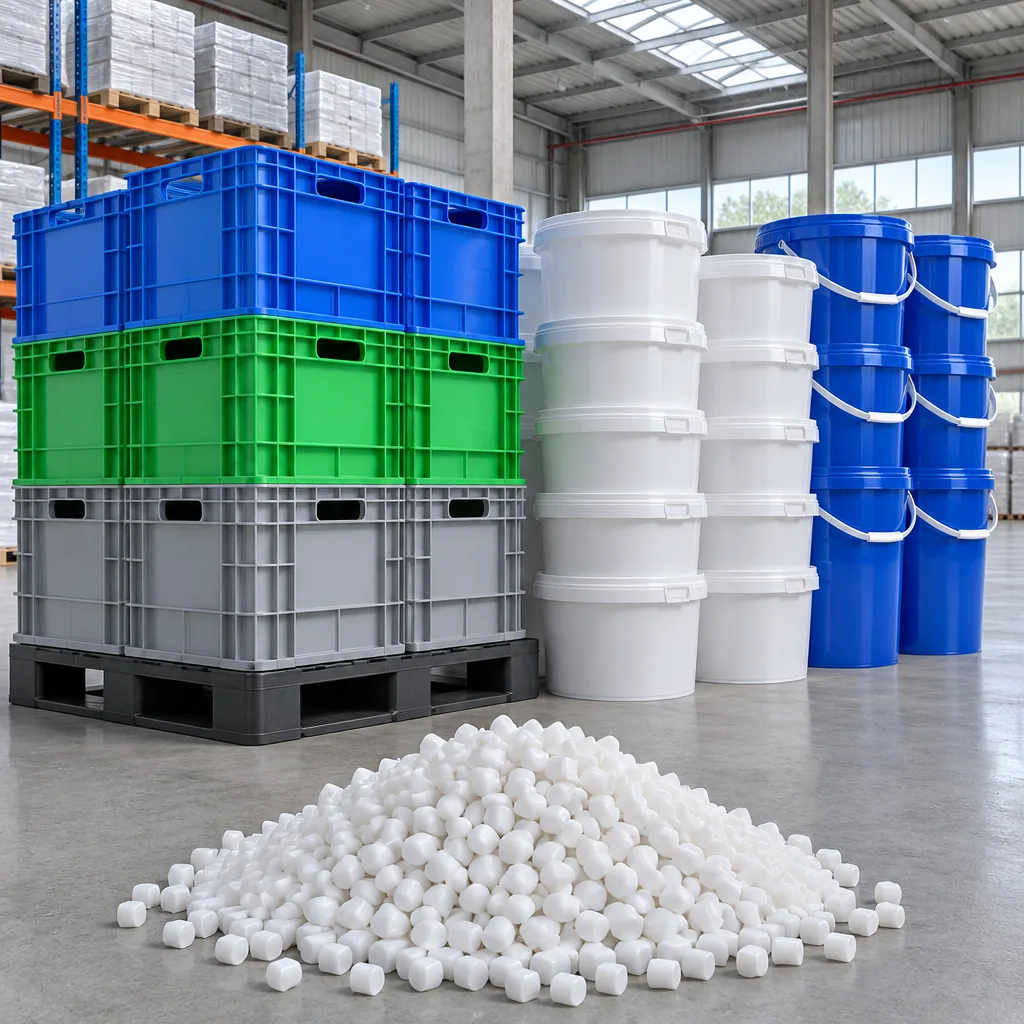
Masterbatch Solutions for the Crates & Buckets Industry
Food buckets (yogurt, cheese, pickles, ice cream, olives), industrial paint and construction chemical buckets, agricultural and cold storage crates, heavy-duty pallets, automotive KLT logistics containers and waste containers face some of the toughest mechanical, thermal and hygienic tests in the plastic injection industry. A thin-walled IML yogurt bucket demands cycle times measured in seconds and complete leakproofness, while a 20-kilogram paint bucket must withstand drops from meters high, resist collapse under stacking loads 8–10 high and resist chemical cracking.
Drawing on its expertise in polymer physics and rheology gained since 2006, Colorex produces masterbatch and functional additive systems tailored to every process, from high-speed thin-wall injection to high-tonnage pallet and crate molds, that do not cause warpage (low-warpage), preserve cold impact strength, are fully compatible with food contact and deliver zero shade deviation in every lot.
The Polymer Science of Crate, Bucket and Pallet Production (Engineering Fundamentals)
Field failures in crate and bucket production (lids that do not close, cracked bucket rims, brittle fracture in the cold, collapse in the stack) are rooted directly in polymer physics and crystal morphology. Colorex formulations are designed around the following 5 fundamental scientific principles:
1. Crystallization Kinetics and Anisotropic Shrinkage (The Physics of Warpage)
Polypropylene (PP) and high-density polyethylene (HDPE) are semi-crystalline polymers; as they pass from melt to solid they shrink by forming ordered crystalline regions (spherulites). Many standard organic pigments (in particular certain copper phthalocyanine blues/greens and some azo red/yellow types) act as uncontrolled heterogeneous nucleating agents in the melt. This widens the difference (anisotropy) between the shrinkage ratio in the flow direction (S∥) and the shrinkage ratio perpendicular to the flow (S⊥), leading to ovality distortion of bucket lids, loss of sealing and severe warpage of flat crate/pallet walls. For large and lidded molds, Colorex uses low-warpage pigment architectures with minimized nucleation effect.
2. Glass Transition Temperature (Tg) and Ductile-Brittle Transition (The Physics of Cold Impact)
The fundamental physical boundary that determines whether a plastic yields under impact (ductile) or shatters like glass (brittle) is the glass transition temperature (Tg). The Tg of standard homopolymer PP is around 0°C; when the ambient temperature drops below this threshold (for example in winter transport or a -20°C cold store), the segmental motion of the polymer chains freezes and the material switches to sudden fracture. HDPE, with a Tg of about -110°C, is naturally more resistant to cold, but an incompatible carrier or poor pigment dispersion creates a microscopic notch effect (stress concentration) that dramatically reduces impact resistance. Using carriers fully compatible with the polymer and POE elastomer systems with a very low Tg, Colorex activates cavitation and shear yielding mechanisms to dissipate impact energy safely.
3. Viscoelastic Creep and Long-Term Stacking Strength
Plastics are viscoelastic materials; when a constant load is applied to them for a long time (for example paint or pickle buckets stacked 8 high in a warehouse), they show time-dependent permanent deformation (creep) even if they remain below the elastic limit. In hot summer warehouses (35–45°C) the flexural modulus (E) of the polymer drops, and the buckets in the bottom row can buckle and topple. Low-cost masterbatches with a weak carrier resin or excessive plasticizer/wax accelerate the creep rate. Colorex formulations are developed with high-molecular-weight carriers that preserve the crystalline rigidity and long-term stacking resistance of the base polymer.
4. Environmental Stress Crack Resistance (ESCR) and Tie Chains
In buckets containing paint, thinner emulsions, agrochemicals, liquid detergents and oils, surface-active chemicals weaken the tie molecules (tie chains) that link the crystalline lamellae of a semi-crystalline polymer, causing slow crack growth (ESCR) even under low stress. Undispersed coarse pigment or filler clusters (agglomerates) in the masterbatch act as initial flaws according to Griffith crack mechanics. Colorex’s high-shear dispersion technology eliminates these stress concentrators and secures the ESCR life of buckets and jerrycans.
5. Optical Opacity (Mie Scattering) and the Physics of Food Migration (Fick Diffusion)
In a thin-walled (0.4–0.8 mm) white food bucket, maximum opacity is essential so that the contents are not exposed to light and do not spoil. In optical physics, maximum light scattering (Mie scattering) depends on a high refractive index difference between pigment and polymer (n(rutile TiO₂) ≈ 2.73 and n(PP/PE) ≈ 1.50) and on homogeneous dispersion of TiO₂ particles with a diameter around half the wavelength of visible light (0.20–0.30 µm). At the same time, in food contact the transfer of small molecules from the polymer matrix into food is governed by Fick’s laws of diffusion; Colorex food-grade formulations use high-molecular-weight, non-migrating components to provide safe protection well below the EU 10/2011 overall migration limit (10 mg/dm²).
Colorex Solutions by Crate, Bucket and Logistics Product Group
Full Food Contact ComplianceSafe pigment and carrier systems that comply with EU 10/2011 and Turkish Food Codex criteria, contain no heavy metals, and cause no odor, taste or color transfer (migration) into fatty/acidic foods (olive oil, pickle brine, milk fat).
High Opacity and Light BarrierColorex White Masterbatches with a high rutile TiO₂ loading that prevent light-induced oxidation (rancidity) of dairy and fat-based foods even at wall thicknesses below 0.5 mm.
High-Speed Thin-Wall Injection (High MFI)Clean formulations compatible with high-flow PP copolymers/homopolymers in the MFI 35–70 range that cause no flow marks or gate blush at the mold gate and do not impair IML label adhesion.
2. Paint, Construction Chemicals, Lubricant and Industrial Buckets
Drop Test and UN PerformanceHighly dispersed color and white masterbatches that preserve the impact strength of the polymer, ensuring that the bucket base and handle attachment points do not crack in drop tests at a filled weight of 15–25 kg.
Lid Sealing and Low Warpage (Low-Warpage)Special pigment selection that does not trigger warpage and keeps the bucket body and lid in a perfectly circular fit (ovality close to zero).
Corporate Brand Color ConsistencySpectrophotometric ΔE < 1.0 precision in the corporate Pantone/RAL colors of major paint and lubricant brands, across production batches and in lid-to-body matching.
3. Agriculture, Fruit & Vegetable, Meat, Fish, Bread and Cold Storage Crates
Cold (-20 °C / -40 °C) Impact ProtectionCarriers compatible with HDPE and impact-resistant PP, together with POE-based Colorex Impact Modifier solutions, that prevent breakage in deep-freeze and cold-chain logistics.
Stable Color with Regrind / PCR and High CalciteHigh-hiding black, blue, green, yellow and red masterbatches that cover the graying and fluctuations in the base color of regrind HDPE/PP raw materials widely used in agricultural and market crates.
Outdoor UV ProtectionHALS UV stabilizer combinations that prevent embrittlement and fading of crates left under the sun in open fields and on transport trucks during harvest.
4. Heavy-Duty Pallets, Automotive KLT Containers and Municipal Waste Containers
Forklift and Mechanical Impact ResistanceFormulations that do not weaken the polymer chain and withstand heavy impact, lifting loads and environmental stress in heavy pallets molded on very high-tonnage machines and in 120–1100 liter waste containers.
ESD / Antistatic KLT Logistics ContainersAntistatic solutions that prevent dust pick-up, or conductive black masterbatch solutions that protect electronic boards from static discharge, for transport containers used in automotive and electronics plants.
High UV and Odor/Rodent ProtectionStrong UV packages for outdoor sun resistance in municipal waste containers, high-opacity green/blue/anthracite/yellow colors and, on request, rodent repellent/odor eliminating additive support.
5. Housewares, Storage Containers and Laundry/Cleaning Buckets
High Gloss and Vivid Pastel/Trend ColorsHigh surface gloss, modern pastel shades, pearlescent/marble effects and resistance to dishwasher hot water/detergent for kitchen storage containers, laundry baskets and bathroom sets.
Performance-Enhancing Colorex Additive Solutions for Crate and Bucket Production
Impact Modifier and Compatibilizer MasterbatchBinds mixed PP+PE regrind raw materials into a single phase; improves the cold and drop test performance of high-calcite or homopolymer crates and buckets.
Mold Release MasterbatchEliminates the need for external spray in deep-draw paint/food buckets and multi-cavity crate molds, prevents ejector marks and shortens cycle time by 5–15% (with silicone-free options compatible with IML and printing).
Antistatic (Dust-Repellent) MasterbatchPrevents stored white food and paint buckets from attracting dust/dirt through static electricity on the shelf and during transport; reduces static-induced label shifting on IML labeling lines.
UV & Light StabilizerPrevents sun-induced chalking and cracking of agricultural crates, waste containers, pallets and outdoor buckets stored in open yards.
Desiccant and Odor Eliminating MasterbatchEliminates moisture-induced surface bubbles and unpleasant plastic odor in economical crates made with regrind and PCR raw materials.
Foaming MasterbatchPrevents sink marks and warpage in thick-walled heavy pallets and thick-ribbed crates, and saves 10–15% of raw material in part weight.
Machine and Screw Cleaner (Purging Compound)Cuts transition losses and downtime by more than half when changing from dark colors to white/transparent on crate and bucket injection machines with frequent color changes.
Common Field Problems in Crate and Bucket Production and Their Scientific Solutions
ProblemBucket Lids That Do Not Close, Leakage and Ovality Distortion (Warpage)
Scientific Root Cause: The organic pigment used causes directional nucleation in semi-crystalline PP/HDPE, creating an anisotropic shrinkage difference between the flow direction and the transverse direction.
Colorex Solution: Selection of low-warpage pigments with a nucleation coefficient close to zero and controlled carrier rheology.
ProblemBucket/Crate Breakage in the Drop Test or in Cold Weather
Scientific Root Cause: The glass transition temperature (Tg) of homopolymer PP around 0°C, an incompatible masterbatch carrier, micro stress concentrators created by poor pigment dispersion, or PP/PE phase separation in regrind material.
Colorex Solution: Highly dispersed masterbatches with carriers fully compatible with the polymer, and support from the low-Tg, POE-based Colorex Impact Modifier / Compatibilizer.
ProblemLight Transmission and High Dosage Cost in Thin-Walled Food Buckets
Scientific Root Cause: A reduced refractive index difference and lower Mie scattering efficiency in white masterbatches containing low-grade TiO₂ or excessive calcite.
Colorex Solution: Maximum opacity at low dosage with Colorex White Masterbatch based on high-concentration rutile TiO₂ with optimum particle size (0.20–0.30 µm).
ProblemBase/Corner Cracking Over Time in Chemical or Detergent Buckets (ESCR)
Scientific Root Cause: Surface-active chemicals weakening the polymer tie chains, and coarse pigment/filler clusters forming crack initiation points.
Colorex Solution: Homogeneous dispersion with low FPV, clean carrier selection and polymer compatibility that supports ESCR.
ProblemSticking, Ejector Whitening and Slow Cycles in Deep Bucket and Crate Molds
Scientific Root Cause: The polymer clamping onto the male core with a high normal force as it shrinks on cooling, and a rise in the static friction coefficient.
Colorex Solution: Low ejection force, mark-free demolding and shorter cycle time with silicone-free Colorex Mold Release Masterbatch compatible with IML and printing.
ProcessesHigh-speed thin-wall injection (including IML), high-tonnage standard and multi-cavity injection molding, hot runner systems and blow-molded containers.
Colorex Laboratory Tests Specific to the Crate and Bucket Industry
Spectrophotometric ΔE and Opacity (Contrast Ratio) MeasurementNumerical verification of target opacity in thin-walled buckets and zero-metamerism control between body and lid under different light sources.
Izod / Charpy Impact and Tensile-Elongation Tests (ISO 179 / ISO 180)Measurement of the balance between impact energy and flexural modulus at room temperature and at low temperatures.
MFI / MVR (ISO 1133) and Thermal Stability AnalysisVerification of flow balance in thin-wall high-speed molds and of color stability at high injection temperatures.
FPV (Filter Pressure Value) and Ash Furnace AnalysisHomogeneous dispersion that does not clog screens/hot runners, and a guaranteed exact TiO₂/pigment/filler ratio in every production lot.
Food Compliance and Regulatory VerificationDocumentation for EU 10/2011, FDA, REACH, RoHS and heavy-metal-free content.
Page-specific technical questions and answers about Masterbatch Solutions for the Crates & Buckets Industry.
Why do crate and bucket production require low-warpage masterbatch instead of standard color masterbatch?
In semi-crystalline polymers such as PP and HDPE, some organic pigments disturb the rate and direction of crystallization, causing the part to shrink at different ratios in the flow direction and the transverse direction (anisotropic shrinkage). This leads to warpage and loss of sealing, especially in wide flat lids, bucket rims and large crates. Low-warpage Colorex formulations prevent this crystalline deviation.
What is anisotropic shrinkage (differential shrinkage), and how does it distort bucket lids?
During injection, long polymer chains align in the flow direction. If a pigment with a nucleating effect excessively accelerates crystallization along this alignment axis, the lid shrinks more or less in the flow direction, loses its circular form and becomes elliptical (ovality defect). As a result, the lid does not lock onto the bucket rim or it leaks.
Which color pigments are most prone to warpage in HDPE and PP crates and buckets?
Scientifically, copper phthalocyanine blue (PB 15:1, PB 15:3) and green (PG 7) pigments, as well as some high-performance organic red, yellow and violet pigments, show a strong nucleating effect. For crate, pallet and bucket projects, the Colorex laboratory formulates these shades with special surface-modified or alternative inorganic/hybrid pigment systems that do not cause warpage.
How is color matching achieved when the bucket body and lid are molded on different machines or from different polymers (for example a PP body and an LLDPE lid)?
Because different polymers differ in refractive index, surface gloss and base transparency, the same masterbatch can give a different shade in two different polymers. The Colorex R&D laboratory takes samples of your body and lid raw materials and prepares separate formulations calibrated specifically to the optical structure of each polymer, matching at ΔE < 1.0 on the spectrophotometer.
How is high opacity achieved scientifically in thin-walled (0.4–0.7 mm) white food buckets?
Opacity is provided by the back-scattering of light by pigment particles within the film/wall (Mie scattering). The highest scattering efficiency is achieved by homogeneously dispersing, without agglomeration, high-concentration rutile TiO₂, which has a very high refractive index (n ≈ 2.73) and a narrow particle size distribution in the 0.20–0.30 µm range.
Why is light-blocking critical in white food buckets to prevent the contents from spoiling?
When foods such as dairy products (yogurt, cheese, butter), olive oil and ice cream are exposed to visible and UV light, riboflavin (vitamin B2) and fatty acids undergo photo-oxidation; the food turns sour or rancid and its shelf life is shortened. Colorex White Masterbatch with a high rutile TiO₂ content creates a strong light barrier even at low wall thickness.
Why does an economical white masterbatch with a high calcite (CaCO₃) content not offer a cost advantage in thin-walled buckets?
Because the refractive index of calcium carbonate (n ≈ 1.59) is very close to that of PP and PE (n ≈ 1.50), it provides almost no optical opacity. When a low-cost white masterbatch with calcite is used, the dosage must be raised from 2% to 6–8% to achieve the same whiteness and light blocking; this both increases the total cost and reduces the impact strength of the bucket.
Why is high-flow (MFI) compatibility vital in thin-wall molding?
Thin-walled food buckets are filled within milliseconds at very high injection speed and shear rate (10⁴–10⁵ s⁻¹). If the MFI of the masterbatch carrier is much lower than that of the base polymer (MFI 35–70), it creates resistance at the flow front and causes dullness/gate blush at the gate and short shots. Colorex thin-wall series are produced with high-flow carriers.
What does masterbatch selection affect in buckets produced with IML (in-mold labeling)?
In IML molds, the polypropylene label is held against the mold wall by static electricity. If the masterbatch contains low-cost lubricants that migrate rapidly to the surface, or incompatible antistatic agents, both the hold of the label in the mold is impaired and the melt does not fully fuse with the label, causing edge lifting (delamination). Colorex produces clean formulations fully compatible with the IML process.
What does the EU 10/2011 Overall Migration Limit (OML) mean for food buckets?
Under European Union Regulation 10/2011 and the Turkish Food Codex, the total amount of non-volatile substances transferred from a plastic food contact material into food may not exceed 10 milligrams per square decimeter of food contact surface (10 mg/dm²). Colorex food-compliant masterbatches are formulated with pure, non-migrating components that remain well below this limit.
Why is pigment selection more sensitive for fatty and acidic foods (olives, pickles, cooking oil, tomato paste)?
According to Fick’s diffusion principles, oils and acids penetrate the amorphous regions of the polymer (swelling effect) and accelerate the leaching of low-molecular-weight organic colorants out of the plastic. Colorex uses pigments with high migration fastness that show absolutely no color bleeding (bleeding/migration) in fatty and acidic food simulants (Simulant B, C, D2).
How do you prevent taste and odor changes (organoleptic testing) in food buckets?
Some low-grade carrier waxes, recycled content or thermally unstable additives oxidize at high injection temperatures, generating aldehyde/ketone-type odor molecules that spoil the taste of sensitive foods such as milk and water. Colorex food series use only high-purity primary (virgin) polymer carriers and odorless/low-volatility pigments.
What does masterbatch have to do with paint and construction chemical buckets failing the drop test?
When a bucket filled with 20 kg of paint falls from a height of 1.2–1.8 meters, a very high instantaneous stress builds up at the base corner. If the masterbatch contains poorly dispersed coarse pigment/filler clusters or a carrier incompatible with the base PP copolymer, the crack starts precisely at this micro flaw and the bucket bursts. Highly dispersed Colorex masterbatches with polymer-specific carriers preserve the impact energy of the bucket.
Does the use of masterbatch affect certification of UN-approved buckets carrying hazardous goods and chemicals?
In UN-certified buckets, every formulation change directly affects the drop, stacking and leakproofness tests. Colorex supports certification security with consistent MFI, high dispersion and formulation stability that does not change from lot to lot (lot-to-lot consistency), preserving the UN test criteria.
What is Environmental Stress Crack Resistance (ESCR), and why is it critical for detergent/chemical buckets?
ESCR is a plastic’s resistance to forming hairline cracks over time under surface-active substances (detergent, shampoo, agrochemicals, paint additives) and internal mechanical stress. Poorly dispersed fillers or low-molecular-weight carriers weaken the tie chains and shorten ESCR life (ASTM D1693). Colorex’s clean, highly dispersed formulations preserve ESCR resistance.
Why do meat, fish and frozen food crates used in cold storage (-20°C / -40°C) break?
The glass transition temperature (Tg) of standard homopolymer PP is around 0°C; below freezing it loses its flexibility completely and breaks like glass. Cold-chain crates should use either HDPE or high-impact block copolymer PP; if homopolymer or regrind is used, POE-based Colorex Impact Modifier Masterbatch with a very low Tg (<-50°C) must be added.
How are viscoelastic creep and stack collapse prevented in buckets and crates?
Filled buckets stacked on top of each other remain under a constant compressive load for months. Masterbatches containing excessive plasticizer, paraffin wax or an incompatible low-modulus carrier reduce the flexural modulus (E) of the polymer, causing the side walls to buckle in hot warehouses. Colorex supports long-term stacking strength with formulations that preserve carrier stiffness and crystalline structure.
Can copolymer PP performance be achieved by adding an impact modifier to homopolymer PP?
Yes. In periods when copolymer raw material costs rise or supply becomes difficult, adding 4–10% POE-based Colorex Impact Modifier to homopolymer PP with a suitable MFI can achieve cold impact and drop resistance very close to that of block copolymer, especially in crates, buckets and lids.
How is breakage prevented in the hinge area (tamper-evident / safety lock) of bucket lids?
In bucket lids with a safety lock, the tear-off strip must be flexible yet tear in a controlled way. Masterbatches with heavy mineral filling or incompatible carriers make this thin hinge area brittle, and the lid breaks when it is fitted onto the bucket. Highly dispersed, polymer-specific Colorex color masterbatches preserve hinge flexibility.
What causes the whitening mark (stress whitening) that appears when a handle or corner of black and dark-colored crates and buckets is bent?
When plastic is bent excessively, microscopic voids (cavitation / crazes) form in the polymer matrix, and these micro voids scatter light so that the bent area of a black or blue part looks like a white line. Using fine-particle carbon black, high dispersion and an elastomer-compatible carrier markedly reduces the contrast of this whitening.
How is brittleness resolved when using mixed PP + PE regrind in agricultural and fruit & vegetable crates?
PP and PE are thermodynamically immiscible and form two phases; as the melt cools, the weak interface between them cracks at the slightest impact and breaks the crate. Adding 2–5% Colorex Compatibilizer and Impact Modifier to the formulation binds the two phases at the molecular level, eliminating brittleness and surface peeling.
How is strength maintained in economical fruit crates and paint buckets with high calcite (CaCO₃) content?
Adding 15–35% calcite increases stiffness (rigidity) but rapidly reduces impact strength. When fine micronized (coated) calcite is selected and combined with a balanced amount of Colorex Impact Modifier / MAH-grafted compatibilizer, the mineral-polymer bond is strengthened; the cost advantage is preserved and the crates do not break in transport.
What should be done to stabilize color fluctuation in recycled (PCR / regrind) raw material?
Regrind raw materials can darken or yellow from batch to batch. The Colorex laboratory measures the base color of your regrind and prepares high-pigment-density covering formulations; by supporting them with an optical brightener additive that neutralizes yellowing in light/gray shades, it keeps shade deviation under control.
How are moisture bubbles and bad plastic odor eliminated in crates made with regrind and PCR raw material?
Trace moisture left over from recycling wash processes causes silver streaks (splay) and bubbles on the surface during injection; 1–3% Colorex Desiccant Masterbatch is used for this. For the unpleasant regrind plastic odor in closed warehouses or hot vehicles, Colorex Odor Eliminating (Anti-Odor) Masterbatch is effective.
Why is a UV stabilizer mandatory in agricultural crates, pallets and municipal waste containers?
HDPE/PP crates and waste containers left under the sun in open fields undergo photo-oxidation due to UV radiation (290–400 nm); polymer chains are cleaved, the surface chalks (chalking) and within a few months the crate becomes so brittle that it crumbles when touched. Colorex HALS-based UV & Light Stabilizer masterbatch stops this chain scission and extends service life by years.
What is the UV protection effect of carbon black in waste containers and outdoor pallets?
Fine-particle (<25 nm), homogeneously dispersed carbon black is the strongest natural UV screen, protecting the polymer by absorbing UV rays and converting them into harmless heat. In black pallets and containers, Colorex’s highly dispersed outdoor black masterbatches alone provide very high sun resistance; in green, blue, yellow and gray containers, high-lightfastness pigments must always be used together with a HALS UV package.
How is fast demolding achieved in thin-walled and deep bucket molds without external mold release spray?
Deep buckets shrink as they cool and grip the male mold core tightly. When 0.5–1.0% silicone-free Colorex Mold Release Masterbatch, compatible with IML and food contact, is added to the formulation, the part drops out of the mold fully automatically without leaving ejector marks and without waiting for spray; the cycle speed increases.
How is black dust pick-up (static contamination) prevented on white food and paint buckets in storage?
Polyolefins are excellent insulators with a very high surface resistance (>10¹⁵ Ω); as they are demolded and stacked, they accumulate electrostatic charge through friction and attract all the dust in the air. Colorex Antistatic Masterbatch lowers surface resistance to the 10⁹–10¹¹ Ω band, dissipating static charge and keeping buckets perfectly clean on the shelf.
Do you have a solution for ESD / conductive KLT logistics containers used in automotive and electronics plants?
Yes. For KLT containers carrying sensitive electronic boards and automotive sensors, we produce Colorex Conductive Black Masterbatch solutions that safely conduct electrostatic discharge (ESD) to ground, with surface resistance controllable in the 10³–10⁶ Ω range.
How are sink marks and weight reduced in thick-walled heavy pallets and thick-ribbed crates?
In the thick feet and junction areas of heavy-duty pallets, cooling shrinkage leads to deep sink marks and warpage. Using 0.5–2.0% endothermic Colorex Foaming Masterbatch creates micro closed cells inside, eliminating sink marks, lowering the clamping tonnage and saving 10–15% of raw material in part weight.
How is surface gloss increased in buckets and crates?
For high surface gloss, in addition to mold polishing, the masterbatch must be highly dispersed (so that coarse particles do not roughen the surface), a carrier compatible with the polymer must be used and the calcite/filler ratio must be balanced. Colorex offers micronized-dispersion series for housewares and paint buckets where high gloss is targeted.
Is offset printing, screen printing or hot stamping on buckets and crates affected by the masterbatch?
Low-quality additives containing silicone or excessively migrating slip agents lower the surface tension (dyne level), causing the ink to scrape off the bucket surface. Colorex’s printing- and IML-compatible masterbatches fully support corona treatment and ink adhesion without impairing surface energy.
How is clarity preserved in transparent PP food containers and storage containers?
In transparent random copolymer PP containers, haze must not increase when color or additives are added. The Colorex Transparent Masterbatch series, with colorants that dissolve at the molecular level in the polymer and additives matched in refractive index, enables the production of colored storage containers with glass-like crystal clarity.
What is the risk of color carry-over and clogging in hot runner molds for crate and bucket injection?
In multi-cavity (4–16 cavity) hot runner bucket and lid molds, pigment agglomerates or products with a high FPV clog the narrow nozzles and create weight differences between cavities. Colorex masterbatches, with homogeneous dispersion verified by FPV testing, do not clog hot runners.
How is material loss reduced when switching from a dark-colored (black, navy, red) crate or bucket to a white food bucket?
On high-tonnage crate and bucket machines, a color change using natural PP/HDPE means tens of kilos of material loss and hours of downtime. Using Colorex Machine and Screw Cleaner (Purging Compound) during the changeover cleans both the barrel and the hot runner manifold within minutes, reducing raw material loss by 50–80%.
What percentage should the masterbatch usage rate (dosage) be in crates and buckets?
It varies with the wall thickness of the part and whether the base polymer is virgin or regrind:
Black heavy pallets and regrind crates: 1.5% – 3.0%
Functional additives (UV, antistatic, mold release, impact modifier): Optimized in the 0.5% – 8.0% range depending on the additive type.
Why is it wrong to raise the masterbatch dosage without a plan to get more opacity?
Adding more than the necessary dosage does not just inflate the cost per ton; it changes the filling pressure in the mold, reduces the impact strength of the part, and can alter cooling shrinkage and impair lid fit. The right solution is not to raise the dosage but to choose a high-pigment-concentration Colorex formulation suited to your wall thickness.
Can color + UV stabilizer + antistatic / mold release be produced in a single pellet (combined masterbatch)?
Yes. For high-capacity crate and bucket plants where working with multiple dosing units is difficult or that want to eliminate operator error, we produce the target RAL color and the required additives combined in a single combined masterbatch (combi-batch).
Can permanent lot numbers, dates or barcodes be applied to buckets and crates by laser marking?
Yes. Colorex Laser Marking Masterbatch (standalone or combined with color) can be used for indelible production dates, serial numbers and QR/barcode coding, particularly on returnable logistics crates, automotive KLT boxes, pallets and paint/chemical buckets.
Is a metal detectable solution possible for plastic crates used in food plants?
Yes. Against the risk of a crate breaking and a small plastic fragment getting into food in meat, dairy, bakery and nut processing facilities, special formulations detectable by metal detectors or X-ray devices on the production line can be developed on a project basis.
How does barrel temperature affect color shade in crate and bucket injection?
Some organic yellow, orange and red pigments undergo thermal degradation at high injection temperatures above 240–260°C (especially with long residence times), darkening or shifting in shade. For high-speed thin-wall and hot runner lines, Colorex uses pigment systems with heat resistance of 280–300°C.
Why does metamerism cause problems in crates and buckets, and how is it prevented?
A bucket body and lid that look exactly the same under cool white factory lighting on the production line can look like two different shades under warm LED lighting on a store shelf or in daylight (metamerism). In the Colorex laboratory, every color match is tested in a multi-light booth (D65, TL84, A, UV) to eliminate metamerism.
Do housewares and food storage containers washed in the dishwasher suffer color fading or staining?
Colorex’s housewares series is produced with non-migrating pigments that withstand highly alkaline dishwasher detergents and 70–85°C hot water cycles; it shows no dulling or color bleeding after washing.
Do you guarantee REACH, RoHS, SVHC and heavy-metal-free production for your products?
Yes. All our crate, bucket and housewares masterbatches are free of heavy metals such as lead, cadmium, mercury and chromium VI, and fully comply with the European Union REACH, RoHS and SVHC regulations.
Can production remnants (runners, faulty moldings) be ground and reused in crate and bucket production?
Yes. Colorex pigment and carrier systems with high thermal stability retain their color through the second and third heat cycles; runners and production remnants can be ground and safely recovered into production within their own color group (in line with food regulation rules).
What are the storage conditions and shelf life of crate and bucket masterbatches?
In the original, tightly closed 25 kg moisture-barrier bags or big bag packaging, they can be stored for at least 24 months without loss of performance in a cool, dry, closed warehouse out of direct sunlight.
Do you offer fast delivery from stock and flexible batch production for bucket and crate plants?
Yes. We offer short-lead-time production for white, black, commonly used standard RAL crate and bucket colors and basic additives; for brand-specific Pantone/RAL projects we offer laboratory color matching and flexible batch production within 2–5 working days.
Which documents do you provide for supplier audits by corporate food and paint chains?
Lot-based traceability, Certificate of Analysis (COA), Technical Data Sheet (TDS), Safety Data Sheet (SDS), Food Contact Declaration (EU 10/2011), and REACH and RoHS compliance declarations are delivered in full with every shipment.
What technical information should we share when sending a sample to Colorex for a custom color development?
For a flawless result, along with a target color sample or RAL/Pantone code, it is sufficient to share the base polymer type and MFI (for example MFI 45 PP copolymer, MFI 8 HDPE or 50% regrind), the part wall thickness, food/UN/cold storage requirements, whether IML or printing is used, and whether the mold is sensitive to warpage (lidded/flat surface).
How can we determine the most suitable Colorex Masterbatch and additive package for our crate, bucket or pallet line and request a sample?
Simply share your product group (IML food bucket, paint bucket, cold storage crate, pallet, waste container, etc.), your base raw material, your current mold/field problems (warpage, breakage, opacity, demolding) and your color targets through the contact channels on our website or our WhatsApp technical support line. Colorex polymer engineers will determine the most suitable scientific solution for your line and promptly send you the sample and TDS document.
Produce Warp-Free Lids, Cold-Resistant Crates and Buckets with Maximum Opacity
Contact the Colorex engineering team now for low-warpage color technology based on polymer physics, cold impact and ESCR resistance, food compliance and uninterrupted cycle speed.