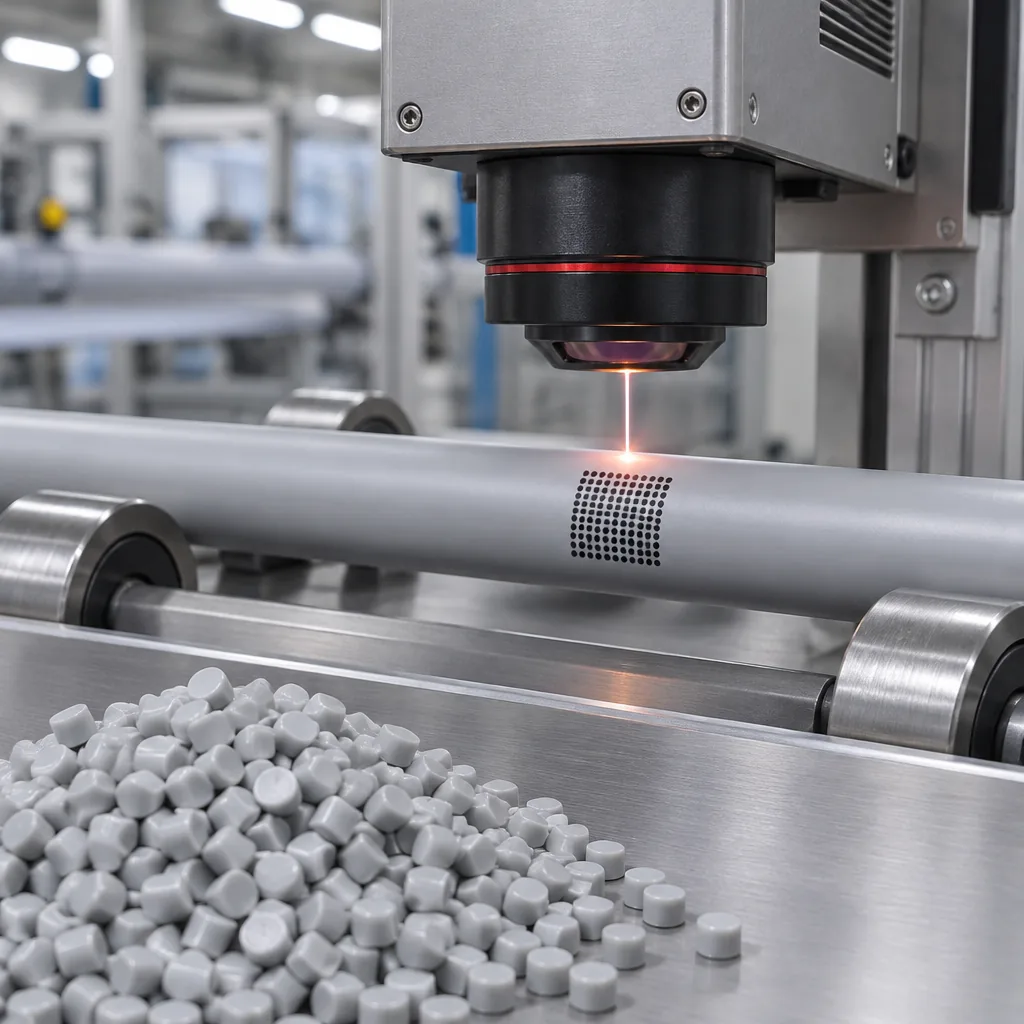
In modern production lines, serial numbers, lot/batch codes, meter marking, expiry dates, QR codes and DataMatrix coding have become mandatory for product traceability, anti-counterfeiting, standards compliance and brand visibility. However, ink-based (inkjet) printers create serious operational problems such as continuous consumable and solvent costs, line stoppages caused by nozzle clogging, and markings that wear off through friction or chemical contact. Common plastics such as polyethylene (PE) and polypropylene (PP), by their nature, cannot absorb laser light and therefore cannot be marked clearly without an additive.
The Colorex Laser Marking Masterbatch series precisely absorbs the laser beam, enabling you to create high-contrast, razor-sharp and lifetime-indelible text, logos and micro barcodes on the polymer surface. By completely eliminating ink, solvent and label costs, it delivers clean, environmentally friendly and uninterrupted coding performance on high-speed extrusion and injection lines.
1. Dark / Black Marking on Light and Colored Backgrounds (Dark-on-Light)
Working PrincipleActive additive molecules hit by the laser beam convert the energy into heat, creating controlled carbonization or color darkening on the surface.
Technical AdvantagesDelivers high black contrast, sharp edge definition and a smooth surface on white, yellow, orange, gray, blue and natural plastic surfaces.
Recommended ApplicationsFuse and electrical switch housings, animal ear tags, home appliance parts, cosmetic/food closures, medical devices and light-colored cables.
2. Light / White-Gray Marking on Black and Dark Backgrounds (Light-on-Dark)
Working PrincipleThe laser pulse creates controlled micro-foaming or a light-tone contrast reaction in the dark polymer matrix, producing bright white/silver-gray markings on a black background.
Technical AdvantagesHighly readable barcode/DataMatrix codes, high marking speed at low laser power, and the original deep black color of the part remains unaffected.
Recommended ApplicationsBlack PE100/corrugated pipes, black power and data cables, under-the-hood automotive parts, black connectors and electronic housings.
3. Transparent and Colorless (Clarity-Preserving) Laser Marking Series
Working PrincipleSpecial optically compatible laser-sensitive additives leave a dark, sharp mark only where the laser strikes, without graying or hazing the base color of natural, white or transparent products.
Recommended ApplicationsTransparent PP/PET/PC packaging, medical syringes and tubes, clear closures and electrical components requiring high whiteness.
4. Antimony-Free and Food/Medical-Compatible Series
Working PrincipleFormulated with new-generation safe mineral/additive systems free of heavy metals and antimony.
Recommended ApplicationsFood packaging, beverage closures, single-use medical parts, toys and export products subject to strict environmental/health regulations.
5. Combined Color + Laser Marking Masterbatches
Working PrincipleCombines your required RAL/Pantone color formulation and the laser marking additive that gives maximum contrast in that color in a single granule.
Technical AdvantagesEliminates the need for two separate dosing units and the risk of dosing deviation; guarantees consistent color and laser contrast in every production lot.
Advantages for Your Business Compared to Ink-Based (Inkjet) Coding
Lifetime Permanent, Indelible CodingThe marking is not ink applied on top of the surface but a permanent mark formed within the plastic itself. It cannot be removed by abrasion, oil, solvents, detergents, sterilization, water or sunlight.
Zero Ink, Solvent and Label CostsEliminates recurring expensive consumables, thinner/solvent and maintenance expenses, allowing the laser investment to pay for itself in a short time.
High Line Speed and Uninterrupted ProductionNo stoppages for ink drying, print head clogging or ribbon changes; fully suited to high-speed cable, pipe and closure lines.
Micro Detail and High Barcode ReadabilityEnables high-resolution QR codes, 2D DataMatrix, micro text and sharp brand logos even on very small areas.
Environmentally Friendly and Safe OperationAs no solvents emitting volatile organic compounds (VOC) are used, air quality in the production area is preserved and the recyclability of the plastic part is not compromised.
Full Protection Against Counterfeit ProductsSince the marking cannot be erased and reprinted, it provides original product verification and legal traceability for automotive spare parts, cables, pipes and medical products.
Main Applications and Target Industries
Cable IndustryHigh-speed, indelible meter and standard marking on power, telecom, fiber optic and automotive cables with PVC, XLPE, HFFR (Halogen Free), PE and TPU jackets.
Pipe and Profile ExtrusionPermanent printing of brand, diameter, PN pressure class and production date on PE100 water/gas pipes, PPRC plumbing pipes, PVC drainage pipes and window profiles.
Automotive and Defense IndustryConnectors, fuse boxes, under-the-hood PA/PBT parts, control buttons (day/night illuminated keys), fuel/brake line clips and part traceability codes.
Electrical-Electronics and Home AppliancesMiniature circuit breakers, contactors, switches, socket/switch mechanisms, distribution boxes, plug housings and control panels.
Animal Ear Tags (Agriculture and Livestock)High-contrast black tag numbers and barcodes on TPU and PP ear tags that withstand sun, mud, abrasion and outdoor weather for years.
Packaging, Cosmetic and Beverage ClosuresExpiry dates, batch/lot numbers and promotional codes on beverage closures, cosmetic jars/tubes, pharmaceutical bottles and food containers.
Medical and Healthcare ProductsAutoclave/sterilization-resistant UDI coding on syringes, IV set connectors, laboratory tubes, diagnostic kits and medical device housings.
Supported Polymers and Laser Systems
Polymer CarriersPP, LDPE, LLDPE, HDPE, PE100, PVC (Rigid and Flexible), HFFR, XLPE, ABS, HIPS, PS, PA6/PA66 (Natural and Glass-Fiber Reinforced), PBT, POM, PC, PC/ABS, PET, PMMA, TPU and TPE.
Every batch of Colorex Laser Marking Masterbatch is checked in Our Laboratory to ensure it always delivers the same contrast and speed on mass production lines:
High Dispersion and FPV ControlHomogeneous additive distribution for a smooth surface and consistently sharp marking on thin-wall cable jackets, films and micro-injection parts.
Base Color and Delta-E VerificationSpectrophotometer measurement confirming that the laser additive does not affect the part's original whiteness or target RAL shade.
Contrast and Parameter VerificationConfirmation of the sharpest dark or light contrast performance in the target polymer across different power/frequency/speed ranges.
Electrical and Safety ComplianceInsulation compatibility for cables and electrical components; verification of heavy-metal-free content for packaging and medical applications.
PVC, XLPE, PE and TPU sheaths of power, telecom, fiber optic and automotive cables
PE100 water and natural gas pipes, PPRC plumbing pipes, PVC window profiles
Connectors, fuse boxes, under-the-hood PA and PBT parts, control buttons
Miniature circuit breakers, power switches, socket and switch mechanisms, plug bodies
TPU and PP animal ear tags, beverage closures and cosmetic packaging
Affected Properties / Effects on the Final Product
Code permanence: The mark forms within the plastic itself; it is not erased by abrasion, oil, solvents, detergents, sterilization, water or sunlight.
Readability: High-resolution QR codes, 2D DataMatrix, micro text and sharp logos can be marked even on small areas.
Contrast: Ear tags carry high-contrast black numbers and barcodes that withstand outdoor conditions for years.
Recyclability: As no ink or solvent is used, the recyclability of the part is not impaired.
Traceability: The code cannot be erased and reprinted; it enables genuine product verification and legal traceability.
Effect on the Process and Production Line
Ink, solvent and label consumption is eliminated.
No stoppages due to ink drying, print head clogging or ribbon changes; suits high-speed cable, pipe and closure lines.
As no solvents emitting volatile organic compounds are used, air quality in the production area is preserved.
Frequently Asked Questions
Page-specific technical questions and answers about Laser Marking Masterbatch.
What is Laser Marking Masterbatch?
It is a special functional additive concentrate that enables plastic raw materials to absorb the laser beam effectively so they can be marked permanently with high contrast and sharp edges.
Why can't plastics be marked clearly by laser without an additive?
Common polymers such as PP, LDPE, HDPE, POM and natural PBT absorb almost none of the 1064 nm Fiber and Nd:YAG laser light most widely used in industry; the beam either passes through the plastic or melts and burns the surface without creating legible contrast. Colorex Laser Marking Masterbatch absorbs this energy in a controlled way to create clear, fast contrast.
How does Laser Marking Masterbatch work?
When the laser beam hits the plastic surface, the active energy-absorbing particles in the masterbatch instantly convert the light into local heat. Depending on the polymer and formulation, this localized heat produces carbonization (dark/black mark), controlled micro-foaming (light/white mark) or a pigment color change, forming permanent text and patterns.
What is the difference between carbonization (dark marking) and foaming (light marking)?
In carbonization, the laser energy chars the polymer and active additive on the surface at micro level, creating dark gray/black markings on light-colored plastic. In foaming, the laser energy creates microscopic gas bubbles on the dark plastic surface that scatter light, producing bright white or light gray markings on a black/dark background.
How is black/dark marking achieved on light-colored (white, yellow, gray, natural) parts?
To obtain high-contrast deep black markings on a light background, the Colorex Dark-on-Light Laser Marking Masterbatch series, which works through carbonization or dark color change, is used.
How is bright white/light gray marking achieved on black and dark-colored parts?
For bright, sharp light-colored markings on black PE100 pipes, black cables or black automotive parts, the Colorex Light-on-Dark Laser Marking series, which creates micro-foaming or a special light contrast, is preferred.
Which laser devices is Colorex Laser Marking Masterbatch compatible with?
It is fully compatible with all 1064 nm Fiber Laser and Nd:YAG / Nd:YVO4 laser systems, the most widely used for plastic coding in industry. We also offer series specially optimized for 532 nm Green Laser and 355 nm UV Laser systems.
Is there a difference between a fiber laser (1064 nm) and an Nd:YAG laser in terms of masterbatch selection?
Since both lasers operate at the 1064 nm near-infrared (NIR) wavelength, essentially the same Colorex 1064 nm series deliver high performance with both. Thanks to their high pulse frequency and focus precision, fiber lasers achieve sharp results at much higher speeds.
Is laser marking masterbatch needed on lines using a CO₂ laser (10,600 nm)?
CO₂ lasers (10,600 nm) are absorbed directly by most plastics and burn and ablate the surface (creating an engraving), but do not create distinct color contrast. For high-contrast, smooth and fast coding, the combination of a 1064 nm Fiber/Nd:YAG laser with Colorex Laser Marking Masterbatch is the standard solution.
What is "cold marking" with a UV laser (355 nm) and when is it preferred?
Because the UV laser works through photochemical bond breaking rather than heat, it leaves an extremely precise and smooth mark without melting or foaming the plastic surface. It gives excellent results with Colorex's UV-compatible series, especially for high-speed medical parts, thin packaging films and home appliance/electronic parts where zero surface swelling is required.
What are the biggest advantages of switching from inkjet printers to laser marking?
Recurring consumable costs such as ink, solvent, cleaning fluid and filters drop to zero. Nozzle clogging and ink drying problems end, markings become indelible, the production environment is free of solvent odor and maintenance-related line stoppages are eliminated.
Does laser marking really reduce operating costs?
Yes. Especially in cable, pipe, closure and automotive plants running 3 shifts, inkjet ink/solvent expenses and downtime losses are very high. Since the cost of laser marking masterbatch per part is only a fraction of a cent, the laser device investment pays for itself completely within 6 to 18 months in most factories.
Do laser-marked text and barcodes fade over time?
No. Because the marking is a permanent physical/chemical change formed below and within the plastic surface, it absolutely cannot be removed by fingernail scratching, oil, gasoline, alcohol, cleaning detergents, sweat or washing.
What is the recommended usage rate (dosage) in percent?
Depending on the base polymer, part color, laser device power and target line speed, it is generally used in the range of 0.5% to 3.0%. In the vast majority of standard injection and pipe/cable applications, a dosage of 1.0–2.0% is sufficient for high contrast.
Does increasing the dosage beyond what is needed keep improving marking contrast?
No. Excessively high dosage can cause the laser energy to concentrate in a very shallow surface layer, unnecessary surface swelling, or slight graying of the base color in light-colored/white parts. The clearest result is achieved with the optimum dosage and correct laser parameters.
Does Laser Marking Masterbatch gray the original color of white or light-colored products?
Low-quality laser additives can cause noticeable graying or yellowing in white parts. When used at the recommended dosages (1–2%), Colorex's high-purity series compatible with white/light colors preserve the product's whiteness and target RAL shade, creating deep black contrast only where the laser strikes.
Can transparent parts be laser marked without causing haze?
Yes. Low-dosage (0.3–1.0%) optically compatible Colorex Laser Marking series developed for transparent PP, PET, PC, PMMA and PS parts largely preserve the part's transparency while producing legible dark markings.
Can you produce color masterbatch and laser marking additive in the same granule (combined)?
Yes. We formulate the RAL/Pantone Color Masterbatch you need together with the laser marking additive best suited to that color as a single combined masterbatch. This lets you work with a single dosing unit, eliminate mixing errors and reduce your inventory costs.
On colored products (yellow, red, blue, green), which contrast direction gives better results?
On yellow, orange, light gray, light blue and light green backgrounds, deep black marking offers excellent contrast. On navy, dark green, dark gray and black backgrounds, light white/silver-gray marking gives the highest readability. The Colorex laboratory determines the contrast direction that gives the highest contrast for your color.
In which polymers can Colorex Laser Marking Masterbatch be used?
We offer polymer-specific carrier solutions for all standard and engineering plastics, including PP, LDPE, LLDPE, HDPE, PE100, PVC, HFFR, XLPE, ABS, HIPS, PS, PA6, PA66, PBT, POM, PC, PC/ABS, PET, PMMA, TPU and TPE.
Is it difficult to achieve high black contrast on PP and PE (polyolefin) products?
Because polyolefins have low carbon content and are transparent to 1064 nm light, they cannot be marked at all without an additive. However, with Colorex's high-efficiency laser additives formulated specifically for polyolefins, deep black or bright white markings with ink-print quality are easily obtained even on PP and PE surfaces.
In the cable industry, is clear marking possible at very high extrusion line speeds (e.g. 100–400 m/min)?
Yes. On high-speed cable lines, the laser's contact time with the cable surface is measured in milliseconds. Colorex's fast-reacting (high-sensitivity) PVC, HFFR, PE and TPU laser masterbatches developed for the cable industry provide continuous, legible meter/standard marking even at high line speeds.
How is laser marking applied in pipe and profile extrusion (PE100, PPRC, PVC)?
With a laser unit positioned on the pipe extrusion line right after the drying point following the haul-off or cooling tank, the brand, diameter, SDR/PN class, production date and meter information are continuously marked on the moving pipe. Bright white markings are obtained especially on black PE100 pipes, and deep black markings on gray/white PPRC and PVC pipes.
Which parts in the automotive industry use laser marking masterbatch?
It is widely used for lifetime-readable part/lot traceability (DataMatrix) on PA6/PA66 and PBT connectors exposed to under-the-hood oil, heat and chemicals, fuse boxes, hose clips, sensor housings, interior control buttons and wiring harness parts.
Why is smooth marking important in the electrical-electronics industry (fuses, switches, sockets)?
Ampere ratings, circuit diagrams and CE/TSE marks on the front of miniature circuit breakers and switches are exposed to hand contact and friction, so they must not wear off and must not create roughness or swelling on the surface that would trap dirt. Colorex's high-resolution series offer perfectly smooth, razor-sharp technical diagram marking.
Why has laser marking become the standard for animal ear tags (TPU and PP)?
In agriculture and livestock farming, ear tags are exposed to sun, rain, manure, mud and abrasion for years; ink prints wear off quickly. Colorex's high-contrast, UV-compatible laser masterbatches developed for TPU and PP ear tags ensure that tag numbers and barcodes remain as legible as on the first day throughout the animal's entire life.
Can laser marking be used on food packaging and beverage closures?
Yes. Food-contact-compliant Colorex Laser Marking Masterbatches are used safely on food and beverage closures to mark expiry dates, hour/minute-based lot codes and under-the-cap promotional codes ink-free, hygienically and without contact.
Which features make laser marking stand out for medical and pharmaceutical products?
In medical products, the risk of ink migration (leaching) is strictly unacceptable, and UDI (Unique Device Identification) codes must remain readable even after autoclave, ethylene oxide or gamma sterilization. Colorex's medical/food-compatible series offer zero ink risk and high sterilization resistance.
Can barcodes, QR codes and 2D DataMatrix codes be laser printed in machine-readable quality?
Yes. Thanks to the high dispersion of the laser marking masterbatch, sharp pixel boundaries form without bleeding or blurring at the edges; this provides high reading accuracy of grade A/B (ISO/IEC 15415) on industrial barcode and camera readers.
Does surface swelling (roughness) occur during laser marking, and is completely smooth marking possible?
While very slight micro-level swelling may occur with the foaming mechanism, with the carbonization and color change mechanisms, optimizing laser power and frequency achieves marking so smooth (smooth / flat) that it cannot be felt with a finger. Our zero-roughness formulations are preferred especially in medical and electrical/fuse applications.
Does using masterbatch increase the marking speed of the laser machine?
Yes. Because high-efficiency Colorex Laser Marking Masterbatch provides full contrast with lower laser energy (lower wattage), it allows you to significantly increase the laser device's scanning speed (mm/s), shorten cycle time and extend the life of the laser source.
How do laser parameters (power, frequency, speed, focus) affect contrast quality?
For each polymer and color, the sharpest contrast is obtained within a specific window of power (% Watt), frequency (kHz) and scanning speed (mm/s). For example, very high power and low speed can burn and swell the surface, while high frequency and optimum speed produce smooth, deep black, sharp-edged markings.
If marking that should be black comes out yellowish or brownish on a light-colored part, what is the cause?
This is usually caused by insufficient laser energy (power/frequency density) for carbonization or by an excessively high scanning speed. Gradually increasing laser power, reducing speed slightly, optimizing frequency or increasing the masterbatch dosage by 0.5% turns the marking deep black.
How can white marking that comes out dull or gray on a black background be improved?
For bright white contrast on a black part, the laser must create controlled micro-foaming on the surface. Slightly reducing the frequency and adjusting the pulse energy, testing the focus distance slightly (1–2 mm defocus) and keeping the carbon black content in the black masterbatch at a laser-compatible level noticeably increase whiteness.
Does Laser Marking Masterbatch reduce the mechanical strength (impact, tensile, elongation at break) of the part?
At the recommended low usage rates (0.5–2.5%) and with a carrier compatible with the base polymer, it has no negative effect on the tensile, flexural and impact strength of the part.
Does it adversely affect insulation (CTI, dielectric strength) in cable and electrical-electronic parts?
Colorex Laser Marking series developed for the electrical and cable industries are formulated with non-conductive components; they do not impair the insulation resistance of cable jackets or the CTI (Comparative Tracking Index) values of fuse/switch housings.
Is it compatible with flame-retardant (FR / UL94 V-0) plastics?
Yes. We offer compatible formulations that provide high-contrast marking in PA, PBT, ABS, PP and cable compounds containing halogenated or halogen-free (HFFR) flame retardants without reducing flame-retardant performance (UL94 V-0 / LOI).
Do you have antimony-free and heavy-metal-free laser marking masterbatch?
Yes. While some conventional laser additives contain antimony derivatives, Colorex offers antimony-free and heavy-metal-free laser marking solutions fully compliant with new-generation regulations, food/medical standards and environmental policies.
Is it safe to use in food-contact packaging (EU 10/2011, FDA)?
Yes. For food packaging, closure and kitchenware projects, we offer laser marking formulations produced with raw materials compliant with the relevant food-contact regulations; simply state the food-contact requirement at the inquiry stage.
Does Colorex Laser Marking Masterbatch comply with REACH, RoHS and SVHC regulations?
Yes. All our products fully comply with the European Union REACH and RoHS directives; they do not contain restricted SVHC substances or heavy metals. The necessary declarations are provided for export and corporate supplier approval processes.
Can it be used together with a UV stabilizer in outdoor products, and does laser marking fade in sunlight?
Yes, it works in full compatibility with Colorex UV & Light Stabilizer masterbatch. Since the laser marking is not a paint/ink pigment but a permanent structure formed directly within the polymer, it does not fade, flake or peel off under UV radiation as ink does.
In multilayer (co-ex) films, sheets, cables or pipes, should it be added to all layers?
No. The laser beam only affects the micron-level top layer of the outermost surface. Therefore, in multilayer pipes, profiles, sheets, films or cable jackets, adding the laser marking masterbatch only to the outermost layer provides 100% of the same performance at a much lower cost.
Does laser marking work with recycled (PCR / regrind) raw materials?
Yes. Colorex Laser Marking Masterbatch also works reliably in recycled PP, PE and ABS raw materials. However, if the base color of the regrind is dark or gray, the dark or light marking direction required for sufficient contrast is determined by laboratory testing according to the base color.
Can runners and production scrap containing Laser Marking Masterbatch be recycled again?
Yes. Since it does not crosslink the polymer structure and does not create ink/label contamination, production scrap and end-of-life parts can be ground and recycled like standard plastic.
Does it cause screen/nozzle clogging in thin films, thin-wall cables or hot runner molds?
Colorex Laser Marking Masterbatches are produced with micronized particle size and high-shear dispersion technology; thanks to their low FPV value, they run cleanly without clogging in thin cable crossheads, film screens and hot runner nozzles.
Why does carrier resin selection affect laser marking quality?
If the carrier resin is not compatible with the base polymer, the active laser particles do not disperse homogeneously on the surface; this causes some letters of the marking to come out dark and other parts faint (uneven). Colorex produces with polymer-specific compatible carriers to achieve the same contrast sharpness in every letter.
Does smoke or odor occur during the laser marking process?
Since the laser energy affects a very small surface area, minimal local vapor may form. Especially on high-speed continuous cable, pipe and injection lines, using a standard laser fume extractor keeps the laser lens clean and maintains the hygiene of the working environment.
Is drying required before use and how should it be stored?
PP and PE carrier series do not require drying. Engineering series with PA, PBT, PET, PC, ABS or TPU carriers should be dried under conditions compatible with the base raw material before use. Products can be stored in their original sealed packaging in a cool, dry place away from sunlight with a shelf life of at least 24 months.
How can we quickly find the best setting for a Colorex sample on our existing laser device?
Using the standard "parameter matrix (test grid)" feature of the laser software on a sample plaque or part, different speeds on the X axis and different frequency/power values on the Y axis are scanned side by side in one pass. With this 30-second test, the ideal machine setting giving the sharpest contrast by eye and by barcode reader is determined instantly.
How can we select the most suitable Colorex Laser Marking Masterbatch for our production line and obtain a sample?
Simply share your base polymer (PP, PE, PVC, HFFR, PA, PBT, ABS, TPU, etc.), the part color, the type of laser device you use (Fiber, Nd:YAG, UV, etc.), the desired marking color (dark or light) and, if applicable, your line speed via the contact channels on our website or our WhatsApp technical support line. Colorex engineers will determine the most suitable series for your line and send you a sample and the technical data sheet (TDS).
Contact our technical team now for a sample of high-contrast Colorex Laser Marking Masterbatch that eliminates consumable costs on your cable, pipe, automotive, electrical-electronics, animal ear tag and packaging lines.