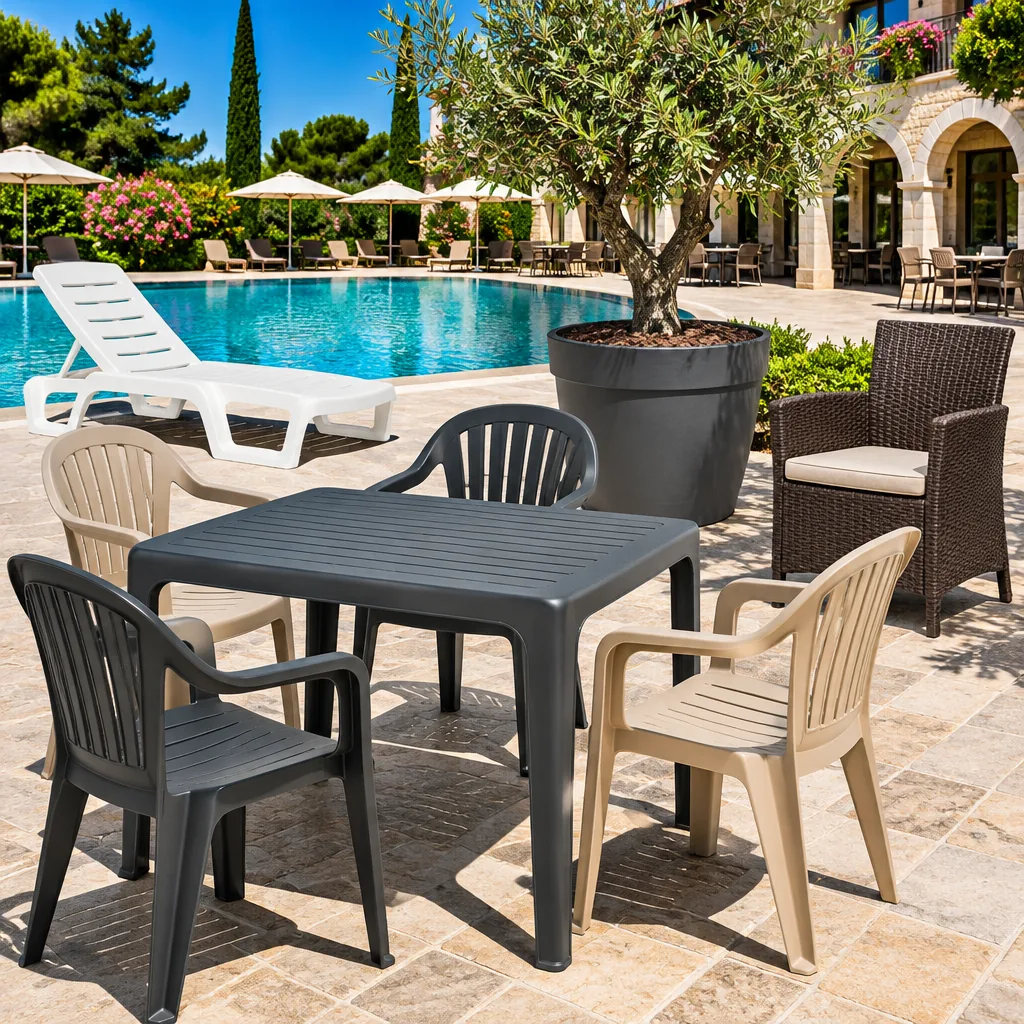
High-Performance Masterbatch Solutions for the Garden Furniture Industry
Plastic garden furniture is exposed outdoors all year round to scorching sunlight (UV radiation), rain, high humidity and temperature swings, pool chlorine, sea salt, stacking impacts and heavy mechanical loads. Under these harsh conditions, tables, chairs, sun loungers and planters produced with standard indoor pigments or inadequate protection systems fade within a single summer season, their surfaces chalk, they become brittle and break at the legs, damaging brand reputation.
With the outdoor polymer engineering expertise and advanced laboratory infrastructure it has developed since 2006, Colorex produces masterbatch and functional additive solutions with high lightfastness and UV protection that keep exactly the same shade in every production lot and in every piece of a set, for manufacturers of chairs, tables, rattan sets, hotel/beach (HORECA) sun loungers, glass-fiber design furniture and large planters.
Colorex Solutions by Garden Furniture Product Group
1. Plastic Chairs, Tables, Armchairs and Stools (Injection and Gas-Assisted Injection)
High-Lightfastness Trend ColorsNon-fading outdoor color formulations with lightfastness of 7–8 on the Blue Wool Scale in anthracite (RAL 7016), white, sand beige, cappuccino, taupe, anthracite gray, olive green, terracotta and custom architectural shades.
Color Consistency Within a SetSpectrophotometric Delta-E control and metamerism analysis so that tabletops, table legs, chairs and armchairs molded on different injection machines and at different wall thicknesses look exactly the same shade in daylight.
Glass Fiber Reinforced (PP GF) and Gas-Assisted Design FurnitureSpecial carrier formulations that provide high thermal stability, low surface fiber marks (fiber blooming) and high impact strength in glass-fiber-filled (15–30% GF) modern design chairs.
2. Rattan-Textured Garden Sets and Extruded Rattan Strips
Injection-Molded Rattan SetsHighly dispersed color and additive packages that leave no flow marks in deep, densely woven-texture molds, release easily from the mold and cause no stress whitening at corners.
Synthetic Rattan Weaving Strips (PE / PP Extrusion)Multi-tone/effect extrusion masterbatches with high UV resistance that give a natural wicker and bamboo look, retain their flexibility and do not break after years in the sun.
3. Hotel, Beach and Poolside Furniture (HORECA / Sun Loungers)
Resistance to Harsh Climate, Chlorine and SaltReinforced HALS + UV Absorber combinations for sun loungers and side tables permanently exposed outdoors in high solar radiation (high KLY) tourism regions such as the Mediterranean, the Aegean and the Middle East.
Chemical and Stain ResistanceSafe pigment systems that do not bleed (migrate) or degrade the surface on contact with pool chlorine, sea salt, sunscreen, tanning oils and industrial cleaning detergents.
Superior Whiteness and Anti-YellowingOutdoor white masterbatches with high rutile TiO₂ content and optical balance that slow down yellowing of white sun loungers and tables in the sun.
4. Large Outdoor Planters and Decorative Garden Accessories
Natural Stone, Marble, Terracotta and Wood EffectsColorex Special Effect Masterbatches that create authentic granite, marble, stone, earth and wood textures directly in the mold, with no paint or additional coating required.
Soil Moisture and Fertilizer ResistanceStable formulations that do not fade or chemically degrade on indoor/outdoor planter surfaces in constant contact with water, moisture and plant nutrients.
Transparent Design ChairsOptical UV stabilizers that prevent yellowing, transparent color masterbatches that preserve crystal clarity and anti-scratch solutions for wedding, event and modern garden chairs.
WPC (Wood-Polymer Composite) Benches, Tables and PergolasMAH-grafted compatibilizers that chemically bond wood flour to the polymer, natural wood grain effects and IR-reflective pigment systems that reduce heat buildup in dark shades.
Colorex Functional Additive Solutions That Make a Difference in Garden Furniture
UV & Light Stabilizer (HALS / UV Absorber) MasterbatchStops the sun's ultraviolet rays from breaking down polymer chains; prevents surface chalking, cracking, color fading and leg breakage for years.
Heat-Reflective (IR Reflective) Dark Color TechnologyEspecially in anthracite (RAL 7016), black and dark brown furniture, it reflects the sun's infrared heat instead of absorbing it, markedly reducing seat surfaces overheating enough to burn the hand and tabletops warping.
Impact Modifier and Compatibilizer MasterbatchPrevents leg/backrest breakage under sudden loads and in cold winter months in chairs containing highly calcite/talc-filled or recycled (PCR/regrind) PP.
Antistatic (Dust-Repellent) MasterbatchReduces stubborn dust, pollen and black dirt marks that accumulate on the surface through static electricity in store displays, warehouses and open gardens, keeping furniture easy to clean and looking new.
Anti-Scratch MasterbatchPrevents friction scratches on stacked chairs during transport and use, as well as white scratch marks on dark colors.
Foaming MasterbatchEliminates sink marks on thick-walled chair legs, armrests and table joints, while delivering weight savings and faster cycle times.
Mold Release MasterbatchEliminates the use of external sprays in large molds with deep rattan textures and many ribs; enables fast, fully automatic ejection without ejector pin marks or part distortion.
Common Field Problems in Garden Furniture Production and Colorex Solutions
ProblemColor Fading and White Surface Chalking Within a Single Summer Season
Cause: Use of indoor-grade organic pigments with low lightfastness, insufficient UV stabilizer, or a high calcite content weakening UV protection.
Colorex Solution: Outdoor pigments rated 7–8 on the Blue Wool Scale combined with a HALS + UV Absorber package optimized for the calcite content and the target climate zone.
ProblemAnthracite and Dark-Colored Tables/Chairs Overheating and Warping in the Sun
Cause: Standard carbon black strongly absorbs the sun's near-infrared (NIR) rays, raising the surface temperature above 70 °C.
Colorex Solution: Special Colorex IR-Reflective pigment formulations that reflect infrared rays, lowering surface temperature by up to 10 °C – 15 °C and ensuring dimensional stability.
ProblemCracking / Breakage at Chair Legs and Joints
Cause: Cold-weather brittleness of homopolymer PP, high calcite/regrind content, or a carrier resin incompatible with the polymer.
Colorex Solution: Color masterbatches with polymer-specific carrier resins, supported by POE/compatibilizer-based Colorex Impact Modifier.
ProblemShade Difference in Daylight Between the Table and Chairs of the Same Set
Cause: Different machine temperatures, regrind ratios varying from batch to batch, or metamerism caused by visual color control.
Colorex Solution: Series production with spectrophotometric Delta-E tolerances, metamerism verification in a multi-light booth (D65 daylight / TL84 store lighting) and stable high-opacity formulations.
ProblemSink Marks Behind Thick Armrests and Legs, and Scratching on Dark Colors
Cause: Cooling shrinkage in thick-section areas and frictional deformation during stacking.
Colorex Laboratory Tests Specific to the Garden Furniture Industry
Colorex puts every production lot shipped to outdoor furniture manufacturers through comprehensive testing in its advanced laboratory before delivery:
Spectrophotometric Delta-E and Multi-Light Booth AnalysisZero shade deviation and metamerism control under D65 daylight and store lighting for table, chair, armchair and side table sets.
Accelerated UV Aging and Lightfastness AssessmentControl of outdoor color stability, yellowness index (YI) of whites and surface gloss loss.
Mechanical Strength (Izod/Charpy Impact and Tensile) TestingVerification of load-bearing and impact strength in furniture formulations containing calcite, glass fiber and regrind.
Ash Furnace, MFI/MVR and Thermal Stability TestingAssurance of a constant pigment/TiO2 ratio in every batch, stable mold filling and production free of color shift at high temperatures.
Page-specific technical questions and answers about High-Performance Masterbatch Solutions for the Garden Furniture Industry.
How do garden furniture masterbatches differ from standard indoor color masterbatches?
Because indoor products are not exposed to direct sunlight, rain and extreme temperature changes, they can be produced with economical organic pigments. Garden furniture masterbatches, by contrast, are produced with outdoor pigments of high light and weather fastness (Blue Wool 7–8 / Grey Scale 4–5), formulations chemically compatible with UV stabilizer systems, and polymer-specific carriers that preserve mechanical strength.
Why do outdoor chairs and tables fade and chalk in the sun?
The sun's ultraviolet (UV) rays break down polymer chains (photo-oxidation) and create microscopic cracks on the surface; these microcracks scatter light, making the surface look matte and whitish-powdery (chalking). At the same time, pigments with low lightfastness are chemically broken down by UV energy and lose their color.
What do lightfastness (Blue Wool Scale 7–8) and weather fastness (Grey Scale 4–5) mean for garden furniture?
The Blue Wool Scale (from 1 to 8) measures a pigment's resistance to fading under light alone; a value of 7 or 8 is targeted for outdoor furniture. The Grey Scale (from 1 to 5) measures the total color change caused by light combined with rain, humidity and temperature changes (weathering); a range of 4–5 is required for long-lasting garden furniture.
How can yellowing of white garden furniture left in the sun be prevented?
To prevent yellowing in white garden furniture, Colorex outdoor white masterbatch containing high-grade rutile titanium dioxide (TiO₂) with low photocatalytic activity and a special surface treatment should be used together with antioxidants that do not cause phenolic yellowing and a suitable dosage of HALS UV stabilizer.
How can overheating in the sun be reduced for anthracite (RAL 7016), black and dark brown furniture?
When dark colors are tinted with standard carbon black, they absorb infrared (IR) rays, which make up more than 50% of solar energy, and the chair/table surface reaches 70–80 °C, becoming both impossible to sit on and prone to warping. Colorex's special heat-reflective (IR Reflective) pigment systems keep the visible color in the same anthracite/dark shade while reflecting infrared rays and lowering surface temperature by 10–15 °C.
Do heat-reflective (IR Reflective) masterbatches really reduce warping and deformation in tabletops?
Yes. On large, flat, dark-colored garden tables, excessive surface heating creates differential thermal expansion, causing the tabletop to sag in the middle or curl at the edges. IR-reflective pigment technology prevents the material from approaching its softening temperature and thus preserves the table's shape.
Does using a UV stabilizer (HALS / UV Absorber) alone prevent color fading?
No, this is the most common mistake in the industry. A UV stabilizer (especially HALS) mainly prevents cracking, embrittlement and chalking of the base plastic polymer. If the color pigment used has low lightfastness of its own, the color will still fade no matter how much UV stabilizer you add. For true outdoor service life, a high-lightfastness pigment and the right UV stabilizer must be used together.
How is the UV stabilizer dosage determined according to the export market and climate zone?
Solar radiation intensity varies greatly by geography. A UV package optimized for Central and Northern Europe (approx. 80–100 KLY/year) is insufficient for Antalya/the Mediterranean (140–160 KLY/year) or the Middle East/Gulf countries (180–200+ KLY/year). The Colorex laboratory calculates the most economical and reliable UV dosage based on the target climate zone where the product will be sold and the warranty period (2, 3 or 5 years).
What is the KLY (kilolangley) solar radiation unit and how does it relate to the service life of garden furniture?
KLY is a measure of the total solar energy a region receives per square centimeter per year. Although garden furniture warranties are given in "years", technical service life is actually calculated based on total KLY resistance; a formulation rated for 300 KLY lasts 3–4 years in Northern Europe but reaches its limit in 1.5–2 years in a desert climate with very intense sunlight.
Can resistance to sea salt and pool chlorine be achieved for hotel, beach and poolside sun loungers?
Yes. Pool chlorine and salty sea air are chemically aggressive and can react with some standard pigments or sensitive UV stabilizers, causing premature yellowing/fading. Colorex's HORECA and beach furniture series is formulated with special HALS systems and inert pigments resistant to chlorine, salt and acidic environments.
Do sunscreen, tanning oil and cleaning detergents cause stains or color bleeding on sun loungers?
Low-quality organic pigments can migrate to the surface when they come into contact with oil- and alcohol-based sunscreens and stain users' towels or clothing. Because Colorex outdoor furniture masterbatches are produced with pigments of high migration fastness, they do not release color on contact with oil, sweat, sunscreen or cleaning chemicals.
What should be considered when selecting masterbatch for injection-molded rattan-textured garden furniture?
Rattan molds contain many thin bridges, sharp corners and deep patterns. The masterbatch must therefore be highly dispersed, must not impair flowability (MFI), must not cause shade differences at weld lines and must release easily without catching on the mold pattern.
Do you have special solutions for extruded synthetic rattan weaving strips (PE/PP rattan)?
Yes. For HDPE/LLDPE/PP rattan strips woven over metal or aluminum frames, we produce extrusion masterbatches that preserve flexibility, offer high UV resistance, create wood/wicker-like two-tone (marbled/streaked) effects and deliver a very smooth surface.
Can wood-, marble- or stone-look garden furniture and planters be produced without painting?
Yes. The wood, marble, granite and terracotta effect granules in the Colorex Special Effect Masterbatch series are used directly on your existing injection machine to give each part a natural, distinctive outdoor look, eliminating painting and coating costs.
Why do glass fiber reinforced (15–30% GF) PP design chairs require a special masterbatch?
Glass-fiber-filled PP chairs are processed at higher melt temperatures and under high shear; in addition, the natural gray-yellowish base color of glass fiber alters the color shade. Colorex prepares special PP-carrier formulations with high opacity and high heat resistance that cover the base color of glass fiber and do not weaken the glass fiber–polymer bond.
Can the glossy glass fiber marks (fiber blooming) on the surface of glass-fiber garden chairs be reduced?
In addition to the correct mold temperature and injection speed, glass fiber marks on the surface are significantly softened when Colorex Mold Release or Anti-Scratch additives that support flowability and mold surface slip are used together with a highly dispersed masterbatch.
Is masterbatch selection different for gas-assisted injection-molded chairs?
In gas-assisted injection, the interiors of chair legs and armrests are hollowed out with nitrogen gas, so melt flowability (MFI) must be extremely stable and pigments/additives must not create weak points in the gas channel wall. Colorex's highly dispersed, low-moisture formulations with tight MFI tolerances deliver flawless surfaces and strength in gas-assisted molds.
How can sink marks on thick-walled chair legs, armrests and table corners be eliminated?
Sink marks caused by thick sections shrinking inward as they cool can be completely eliminated by adding 0.5–1.0% endothermic Colorex Foaming Masterbatch to the formulation; at the same time, holding pressure is reduced and cycle time is shortened.
Can weight and raw material savings be achieved in garden furniture with Foaming Masterbatch?
Yes. Especially in thick-walled armrests, table legs, planters and structural profiles, endothermic Colorex Foaming Masterbatch can deliver weight and raw material cost savings at controlled rates (5–15%) that maintain part strength.
How can leg breakage and cold-weather brittleness be prevented in plastic chairs?
Chairs made of homopolymer PP in particular, or containing a high calcite/regrind content, are at risk of brittle fracture in cold weather and under sudden loads. Adding POE-based Colorex Impact Modifier Masterbatch to the formulation absorbs impact energy and prevents breakage at the legs and joints.
How can the dullness and brittleness that occur when we use high levels of calcite (CaCO₃) or talc to cut costs be solved?
A high calcite content lowers the part's impact resistance and makes the color pastel and matte. By using Colorex's high-pigment-loading color masterbatches together with a balanced Impact Modifier / Compatibilizer and gloss-enhancing additives, the cost advantage is preserved while surface quality and strength are balanced.
Why does the UV resistance of garden furniture decrease as the calcite (filler) content increases?
Calcium carbonate particles can adsorb (hold) UV stabilizer molecules within the polymer matrix onto their surface, weakening active UV protection and altering light scattering. For this reason, the UV stabilizer dosage in calcite-filled garden furniture formulations should be increased somewhat compared with unfilled products, and a calcite-compatible HALS grade should be selected.
How is color fluctuation controlled when producing garden furniture with recycled (PCR / regrind) PP?
The base color of regrind raw materials can darken and turn grayer from batch to batch. The Colorex laboratory develops stable, high-opacity color formulations based on the average base color of your regrind raw material, enabling the use of regrind with virtually zero shade deviation in dark colors (anthracite, black, brown, dark green).
How can moisture, surface bubbles and plastic odor in recycled raw material be eliminated?
Colorex Desiccant Masterbatch is used for moisture-related silver streaks and bubbles in regrind and PCR raw materials, while Colorex Odor Eliminating (Anti-Odor) Masterbatch is used for undesirable recycling odors that can become bothersome when the furniture heats up in the sun.
How is an identical shade guaranteed for set components coming from different molds, such as tables, chairs, side tables and armchairs?
Barrel temperatures, residence times and wall thicknesses on different injection machines affect color perception. Colorex archives a retained sample for every order and approves all production within spectrophotometric Delta-E tolerances (usually below 1.0); thanks to pigments with high thermal stability, set uniformity is maintained even across different machines.
What is metamerism? Why do a table and chair that look identical under store lighting appear different in color in the garden?
Two parts matched with different pigment combinations may look the same shade under LED/fluorescent store lighting (TL84) but shift to different shades when taken outside into daylight (D65); this is called metamerism. At the Colorex laboratory, all color work is tested in a multi-light booth, eliminating the risk of metamerism.
What does spectrophotometric Delta-E control offer a garden furniture manufacturer?
Visual checks vary with lighting conditions and from person to person. Thanks to numerical Delta-E measurement with a spectrophotometer, a replacement chair or additional table you produce 6 months later comes out in exactly the same shade as the existing set in the customer's garden, eliminating color-related returns.
Can the best-selling standard garden furniture colors (RAL 7016 anthracite, white, sand beige, cappuccino, brown) be supplied quickly?
Yes. We offer short lead times and highly repeatable production in the main shades used in high volumes in the Turkish and European garden furniture market, such as anthracite (RAL 7016), bright white, off-white, black, cappuccino, sand beige, taupe and dark brown.
How can dust buildup and black soiling caused by static electricity be prevented on garden furniture and outdoor planters?
Because plastic is an insulator, it builds up a static charge through friction and attracts airborne dust, pollen and exhaust soot like a magnet; this soiling is especially visible on white and cream furniture. Using Colorex Antistatic Masterbatch lowers surface resistivity, significantly reducing dust pickup and making the furniture easy to wipe clean.
How can friction scratches on stackable plastic chairs be prevented?
During transport and storage, the legs and seat surfaces of stacked chairs rub against each other, leaving white scratch marks, particularly on anthracite, black and dark brown products. Using UHMW siloxane-based Colorex Anti-Scratch Masterbatch lowers surface friction and prevents stacking scratches and whitening.
How can stress whitening caused by fingernails and impacts be reduced on matte and grained (sand-textured/textured) garden furniture?
The sharp micro-peaks of matte mold textures are crushed by impact or friction and leave white marks. Colorex Anti-Scratch Masterbatch, together with the right carrier selection, minimizes this whitening contrast without polishing the matte grain texture.
How are demolding difficulties and ejector pin marks solved in large molds with deep rattan/wicker textures?
In molds with complex wicker patterns, the part adheres to the mold wall, causing the ejector pins to leave marks or the part to deform. Using Colorex Mold Release Masterbatch eliminates the need for external sprays, prevents ejector pin marks and shortens cycle time on high-tonnage injection machines.
Is the warpage problem in large, flat garden tables related to masterbatch selection?
Yes. Some organic pigments (especially certain phthalocyanine blues/greens and some azo pigments) act as nucleating agents in semi-crystalline PP, causing the material to shrink at different rates in the flow and transverse directions, which leads to tabletop warpage. Colorex formulates large flat parts with special non-warping (low-warpage) pigment systems.
How can yellowing and cracking be prevented in transparent polycarbonate (PC) and PMMA garden/wedding chairs?
Transparent design chairs can yellow quickly in sunlight and lose their impact strength. Colorex's UV stabilizers and transparent color masterbatches, fully chemically compatible with PC and PMMA and without impairing optical clarity (haze), preserve the crystal appearance for many years.
Which masterbatches are used in WPC (Wood-Polymer Composite) outdoor bench, table and pergola profiles?
In WPC profiles, an MAH-grafted compatibilizer is used to prevent the wood fibers from absorbing water and swelling and to increase flexural strength, together with an outdoor wood effect masterbatch for a natural wood look, a high-lightfastness pigment + UV package against sun fading, and IR-reflective formulations that reduce heat buildup in dark shades.
What masterbatch properties are required for large outdoor planters (injection, blow or rotational molding)?
Large planters are exposed to frost, sun, irrigation water and fertilizer all year round. High UV resistance, resistance to freezing/cracking in the cold (compatibility with impact modifiers), high opacity and, optionally, natural stone/marble/terracotta effects are the most critical criteria in planter production.
Why do brightly colored garden furniture items such as red, yellow, orange and purple fade faster?
The inorganic pigments used in white, black, gray, brown and earth tones (titanium dioxide, iron oxide, carbon black) have very high lightfastness by nature. Bright, vivid shades such as red, yellow, orange and purple, however, mostly require organic pigments, and economical organic pigments fade quickly under UV. Colorex prevents fading in vivid outdoor colors by using high-performance outdoor-grade organic/inorganic hybrid pigments.
What is adverse interaction (antagonism) between pigments and UV stabilizers (HALS)?
Some acidic pigments, sulfur-based auxiliary additives or incompatible flame retardants can neutralize conventional alkaline HALS UV stabilizers and render UV protection ineffective. The Colorex R&D laboratory eliminates the risk of antagonism by verifying the chemical compatibility of pigments and additives in advance for every color formulation.
How does carrier resin selection affect the leg and seat strength of garden furniture?
When an incompatible carrier (for example, a very low-quality PE or a universal wax-heavy carrier) is used in a PP garden chair, weak phases form within the polymer and the chair may fail EN 581 static/dynamic load tests. For PP garden furniture, Colorex produces with carrier resins fully compatible with the PP base resin.
What percentage of masterbatch (dosage) should be used in garden furniture?
Depending on the part's wall thickness, whether the base resin is virgin or regrind, and the target opacity, color/white/black masterbatches are generally used at 2.0% to 4.0%. UV stabilizers and other functional additives are dosed at 1.0–3.0% depending on the target warranty period.
Can color + UV stabilizer + antistatic / anti-scratch additives be produced in a single granule (combined)?
Absolutely. Especially for garden furniture plants running series production on many machines, we produce the target RAL color, the climate-zone-specific UV package and, if required, antistatic/anti-scratch additives as a single combined masterbatch (combi-batch). This system completely eliminates operator dosing errors.
Do you produce in compliance with REACH and RoHS for garden furniture exported to European and international markets?
Yes. We produce with safe pigments and additives that are free of heavy metals (lead, cadmium, chromium VI) and fully compliant with the REACH, RoHS and SVHC restrictions required by the European Union and global retail chains (DIY stores, home improvement stores, hotel suppliers).
How can the high raw material loss when changing from anthracite or black to white on high-tonnage injection machines be reduced?
On the 500–1500-ton injection machines that run large garden furniture molds, barrel volume is very large; changing from a dark color to white with standard natural PP causes hundreds of kilograms of material loss and hours of downtime. Using Colorex Machine and Screw Cleaner (Purging Compound) during color changes reduces changeover time and raw material loss by 50–80%.
How does accelerated UV aging testing (QUV / Xenon Arc) show the outdoor service life of garden furniture?
In the laboratory, outdoor exposure that would take years is simulated within weeks through intensified UV light, heat and humidity/water-spray cycles. After testing, the sample's color change (ΔE), gloss loss and impact strength retention are measured, scientifically verifying its real-world service life.
Can runners and defective moldings from garden furniture production be reground and fed back into production?
Yes. Because Colorex outdoor color and UV masterbatches have high thermal stability, runners and production scrap can be reground and fed back into production. However, since regrind is heated a second time, maintaining the balance of fresh UV stabilizer and antioxidant is recommended when using high proportions of regrind.
What information should we share when sending a sample to Colorex for custom color matching?
For maximum accuracy and the right UV/pigment formulation, simply share the target color sample or RAL/Pantone code together with the base polymer type (PP homopolymer, copolymer, 20% GF PP, etc.), the calcite or regrind ratio, the surface texture (glossy/matte grain), the target export/climate region and the required outdoor warranty in years.
Do you provide lot traceability and technical documentation for corporate retail chain and export audits?
Yes. Every production lot is archived with a barcoded retained sample; on request, the Technical Data Sheet (TDS), Certificate of Analysis (COA), REACH/RoHS and heavy-metal-free compliance declarations are provided in full.
What are the storage conditions and shelf life of garden furniture masterbatches?
They should be stored in their original, tightly sealed 25 kg bags or big bags in cool, dry, enclosed warehouse areas away from direct sunlight. When stored under suitable conditions, they have a shelf life of at least 24 months without loss of performance.
How can we select the most suitable Colorex Garden Furniture Masterbatch and UV package for our production line and request a sample?
Simply share your furniture group (chair, table, rattan, sun lounger, planter, etc.), your base polymer and calcite/glass fiber formulation, your target colors and the climate/export region where the product will be used via the contact channels on our website or our WhatsApp technical support line. Colorex polymer engineers will promptly send you a project-specific color match, a UV package recommendation and a sample.
Produce Garden Furniture That Doesn't Fade or Break for Years and Keeps the Same Shade in Every Part
Contact the Colorex engineering team today for high lightfastness (7–8), climate-zone-specific UV protection, IR heat-reflective dark shades and zero-defect color consistency in your plastic chair, table, rattan set, sun lounger and planter production.